

NEW ROCHELLE, NY (January 27, 2026) — The Jewish Solar Challenge has awarded $300,000 in grants to nine Jewish organizations across the United States to install solar panels, including Westchester Torah Academy in New Rochelle as one of the first New York recipients.
The grantees consist of seven synagogues, one camp and one Jewish school: Congregation Sons of Israel in Nyack, N.Y.; Westchester Torah Academy in New Rochelle, N.Y.; Bet Torah in Mount Kisco, N.Y.; Temple Hillel B’nai Torah in Boston; Temple Emanuel in Newton, Mass.; Temple Emanuel of South Hills in Pittsburgh; The Temple (Hebrew Benevolent Congregation) in Atlanta; Congregation Bonai Shalom in Boulder, Colo.; and Habonim Dror Camp Gilboa in Big Bear Lake, Calif.
“We are honored to help such an incredible group of organizations across America make the transition to solar power,” said Jewish Solar Challenge Founder Mitchell Schwartz. “This round – our largest ever – marks the first time a majority of our grantees were located outside California, and includes our first recipients in New York, advancing our mission to make solar energy accessible to Jewish communities everywhere.”
The $300,000 in this cycle brings the total awarded for solar projects to over $1 million since the organization launched three years ago. JSC has supported over $10 million in solar projects overall, representing an estimated two megawatts of capacity. These installations generate approximately 3.28 million kWh of electricity per year, prevent the release of 1,272 metric tons of CO₂ annually and save nearly $500,000 in electricity costs each year.
“Solar is one of the best ways to take direct climate action with clear, measurable impact,” said Josef Abramowitz, a pioneer of the Israeli solar industry and a JSC Board member. “Investing in solar reduces operating costs, but also helps us build more resilient, self-sustaining communities, benefitting our people and our planet long term.”
For Habonim Dror Camp Gilboa, the grant is transformative. “Camp Gilboa is entirely off the grid,” said Executive Director Rebecca Green. “We’ve been running the camp on propane generators, which are both unsustainable and unreliable. When a generator goes out, we risk losing our food and internet access, which we rely on to stay in touch with the outside world, including emergency services.”
Green added that the project supports environmental justice education. “This solar project enables us to teach campers about renewable energy not just in theory – but in action – and to inspire them to take those lessons back to their schools, synagogues, homes, and communities.”
Recipients demonstrated broader sustainability commitments. Rabbi Aaron Meyer of Temple Emanuel of South Hills in Pittsburgh cited inspiration from a solar-powered Ner Tamid, the eternal light in synagogues. “We have inherited from the generations before us a world undergoing significant transformation as a result of climate change and have an obligation to protect it for future generations,” Rabbi Meyer said. “With gratitude to the Jewish Solar Challenge and our congregation, we are placing a 187.5kW solar array on the synagogue’s roof, saving us $1.4 million in projected electricity costs over 30 years while tangibly living our environmental stewardship values.”
Schwartz’s goal is to install solar panels on every Jewish institution in North America. This round includes three projects in the New York City metro area, home to the world’s largest Jewish population outside Israel.
At Westchester Torah Academy, “One of our school’s core values is a commitment to your best self, and we really felt that our solar panel project was a part of our values,” said Rose Just-Michael, Director of Communications and Development. “Caring for the environment is an integral part of Torah education. This project allows us to be a model for our community and showcase ways that we can give back, while allowing our school to remain sustainable—both financially and environmentally.”
The Jewish Solar Challenge is a nonprofit that facilitates fiscal and environmental sustainability for Jewish community institutions through solar, providing financial support for installations and community training, education and advocacy.
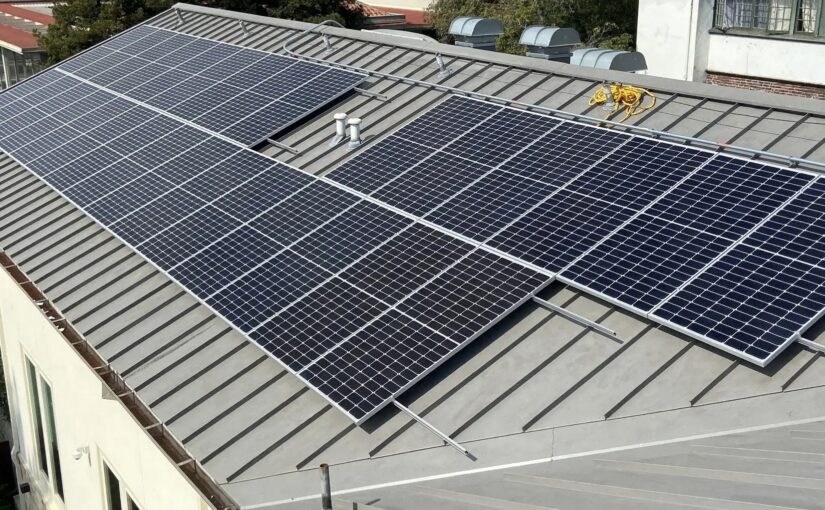
Photo: Solar panels on the roof of Berkeley Hillel
This article was drafted with the aid of Grok, an AI tool by xAI, under the direction and editing of Robert Cox to ensure accuracy and adherence to journalistic standards.
Discover more from Talk of the Sound
Subscribe to get the latest posts sent to your email.