

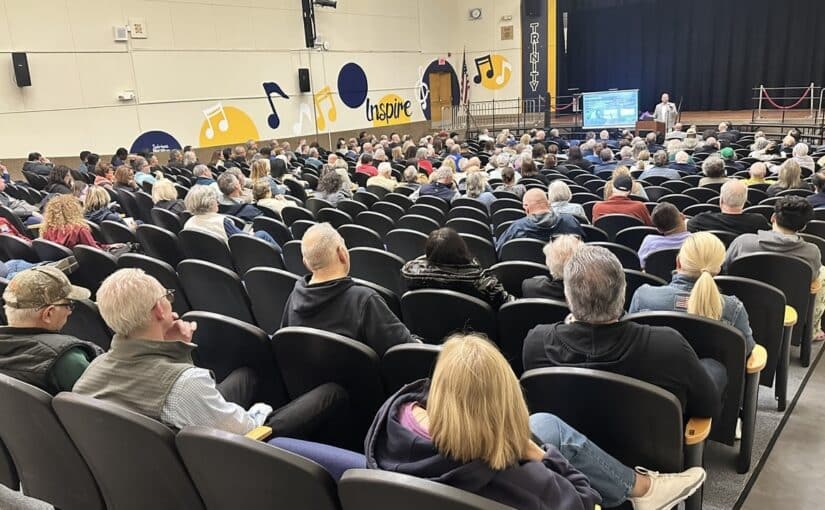
NEW ROCHELLE, N.Y. (May 11, 2026) — More than 200 residents packed a Trinity Elementary School auditorium Monday night to oppose a city proposal that would amend zoning across the entire Davenport Neck waterfront peninsula, potentially allowing beach clubs including the New Rochelle Surf Club to be torn down and replaced with multifamily housing.
Opposition was near-unanimous. When one attendee asked for a show of hands in support of the proposal, only one or two people in the room responded affirmatively. The meeting ended slightly past 8:30 p.m. with at least five residents still waiting to speak.
The proposal was triggered in May 2025 when a developer submitted a petition to the City Council seeking permission to build a 64-unit condominium and rental development on the site of the Surf Club at 280 Davenport Avenue, a project being called “Surf Club Point.” City staff subsequently broadened the review to examine planning issues across the entire Davenport Neck peninsula, which is zoned R1-WF-10. Monday’s meeting was the third in a series of informal community conversations on the subject.
Surf Club owner Tony Martello, 82, opened the meeting with a personal statement. He described surviving a heart attack, kidney failure, and a kidney transplant in recent years, and noted the death of his wife of 60 years. He said the catering business that sustains the club has been declining and that all the clubs on Davenport Neck are struggling. He said he was trying to make a decision that was good for both his family and the community.

Attorney Jessica Damon of Cuddy + Feder introduced the development proposal on behalf of the project team. She said the proposed structure would have a smaller footprint than the existing building, would be set further back from neighboring residences, and would incorporate resiliency improvements.
Architect Brian E. Newman, AIA, of Newman Design presented conceptual renderings describing the style as “contemporary coastal-inspired,” with the proposed building pulled approximately 150 feet from single-family residences — roughly double the current distance.
Kevin Kain, the city’s Director of Planning and Sustainability, presented the zoning rationale. He cited declining marriage rates and shrinking wedding guest counts as evidence that beach clubs face long-term viability challenges under current zoning. The proposed amendment would keep the R1-WF-10 designation but lower allowable building heights and the as-of-right floor area ratio, increase the minimum lot size for multifamily development from one to four acres, require structured parking, mandate sidewalks and on-site open space, and legalize marinas as a special permit use. Kain said the city “wouldn’t be here” if the clubs were doing well.
The city proposed requiring developers to pay an infrastructure fee of approximately $35,000 per unit, with funds directed toward stormwater improvements, pedestrian and traffic circulation upgrades including a drop-off area at Trinity Elementary School on Church Street, and enhancements to public open space.
Resident after resident rejected both the proposal and the city’s rationale during public comment. Traffic on the narrow 0.7-mile stretch of Davenport Avenue was the dominant concern. Nick Paullin-Dyeris (sp.?) of Watermark said adding large residential structures along the corridor would be “a nightmare from a traffic standpoint.” Dr. Kristin Harkin, president of the Davenport Estates Association, which represents 29 homes on Davenport Neck, said she had learned of the meeting only days before and had not been notified by the city. She asked city officials to identify themselves, saying she would “identify you in November.” She said the intersection of Echo Bay Drive and Davenport Avenue is “really unsafe” and that the infrastructure “is not sufficient to support the traffic.”
Ravi Batra, a lawyer and Davenport Neck resident, warned of potential federal constitutional litigation if the development harms existing residents, citing the 14th Amendment and Brown v. Board of Education as analogies. He said the city was “starting to become a developer” and urged it to return to core governance functions. Jim Killorin, who described himself as a disaster expert and community evacuation volunteer, said the community had “had enough development.”
Lee Goldmark of Save the Sound said water quality near the Surf Club has rated C-plus to C-minus over the last two years and warned that additional development would worsen conditions affecting Long Island Sound. An unnamed resident on Lynn’s Way who had lived in the area for six years described ongoing stormwater flooding problems at her property and said additional development would make conditions worse. She said downtown New Rochelle’s storefronts look no different despite 29 new buildings, and that promised benefits from prior development rounds had not materialized.
Vanessa Soman of 25 Gail Drive disputed the city’s claim that Trinity Elementary enrollment is declining, saying the school is getting packed with students from downtown high-rises, and noted that transformer outages occur every two to three months in the area. Physician Saba Abolahrari, a Davenport Estates resident, warned that rezoning one surf club would open the door for others to follow, and asked who was truly benefiting from the change.
Paul Martin, president of the Sutton Manor Association, said he was “so tired of coming to these meetings,” citing prior battles over Flowers Park, 570 Main Street, and DOZ amendments. “There’s the exact same developer fatigue,” he said. Martin asked whether PILOT tax abatements would be available for developments in the zone. City staff confirmed they would be available for rental units but not condominiums, a distinction Martin said would presumably incentivize rentals over condos.
More than one speaker suggested that residents should join together to purchase the Surf Club rather than allow it to be redeveloped. Stephen Simenza of 1 Morrison Drive (sp.?) argued that the city’s emphasis on declining weddings understated the clubs’ versatility, saying they can fill seven days a week with a variety of events beyond weddings.
City Manager Wil Melendez, Commissioner of Development Adam Salgado, and Kain participated primarily in the question and answer session. Salgado engaged directly with residents in several heated exchanges.
District 2 City Council member Albert Tarantino, who represents the Davenport Neck neighbourhood, spoke at the conclusion of the meeting, stressing that there are two distinct issues before the city: the developer’s petition for the Surf Club property and the broader question of whether the zoning created 10 to 12 years ago should be altered. He said the original zoning included carefully crafted setbacks — approximately 75 feet on the sides and 100 feet on the front — designed to scale down buildings as they moved down the peninsula toward residential areas. He noted that homes on Brittany Lane that once sold for $800,000 to $900,000 have recently fetched as much as $2.8 million, and said residents should not have to worry that rezoning will erode those values. He asked the city to produce a full analysis of what each parcel on Davenport Neck would be permitted to develop under the proposed amendment before any further action.
An unnamed resident who said he moved to the area nine years ago after being drawn in by an artist rendering said the city should produce similar visuals before making any zoning decisions. “It’s not just zoning, it’s planning and zoning,” he said. “We need a master plan.
Tarantino echoed the call for more specificity, asking the city to model what each parcel on Davenport Neck — including the VIP Club, Green Tree, and others — would be permitted to build under the proposed amendment before any further action is taken.
No decisions were made at the meeting. If the proposal advances, it would go to City Council for introduction, followed by a formal public hearing in Council Chambers. Any approved zoning change would then require a developer to submit a site plan application to the Planning Board, which would hold its own public hearing. City staff committed to including renderings of proposed community improvements in any submission to Council.
Mayor Yadira Ramos-Herbert and City Council members Shane Osinloye, and Matt Stern were also in attendance. Assistant City Manager Todd Castaldo was present along with Communications Director John Jones who managed the microphones.
This article is based on a report prepared by Robert Cox from a combination of audio and video recordings, computer-generated transcripts, presentation slides photographed at the meeting, and subsequent correspondence with meeting attendees; it was prepared with the assistance of AI tools under the direction and editing of Robert Cox.
Have information or corrections about this story? Email robertcox@talkofthesound (preferred) or contact via WhatsApp: +353 089 972 0669.