
NEW ROCHELLE, NY (May 29, 2026) — When the New Rochelle City Council unanimously voted in January to establish a Participatory Budgeting Steering Committee, it was celebrated as a civic milestone — the first formal participatory budgeting program in Westchester County, a democratic experiment in which residents would propose and vote on how to spend $200,000 of the city’s capital budget.
But as the newly formed committee prepares to hold its inaugural meeting Tuesday, June 2, a review of public records raises questions about the program’s procurement history, its geographic scope, its timeline, and the total cost to taxpayers.
A Campaign Promise Fulfilled — In One District
The program was championed by District 6 Council Member Matthew Stern, who ran on participatory budgeting as a core campaign commitment during his 2022-23 election campaign. Stern, a former participatory budgeting budget delegate in Brooklyn, sponsored the January 2026 ordinance formally establishing the Steering Committee.
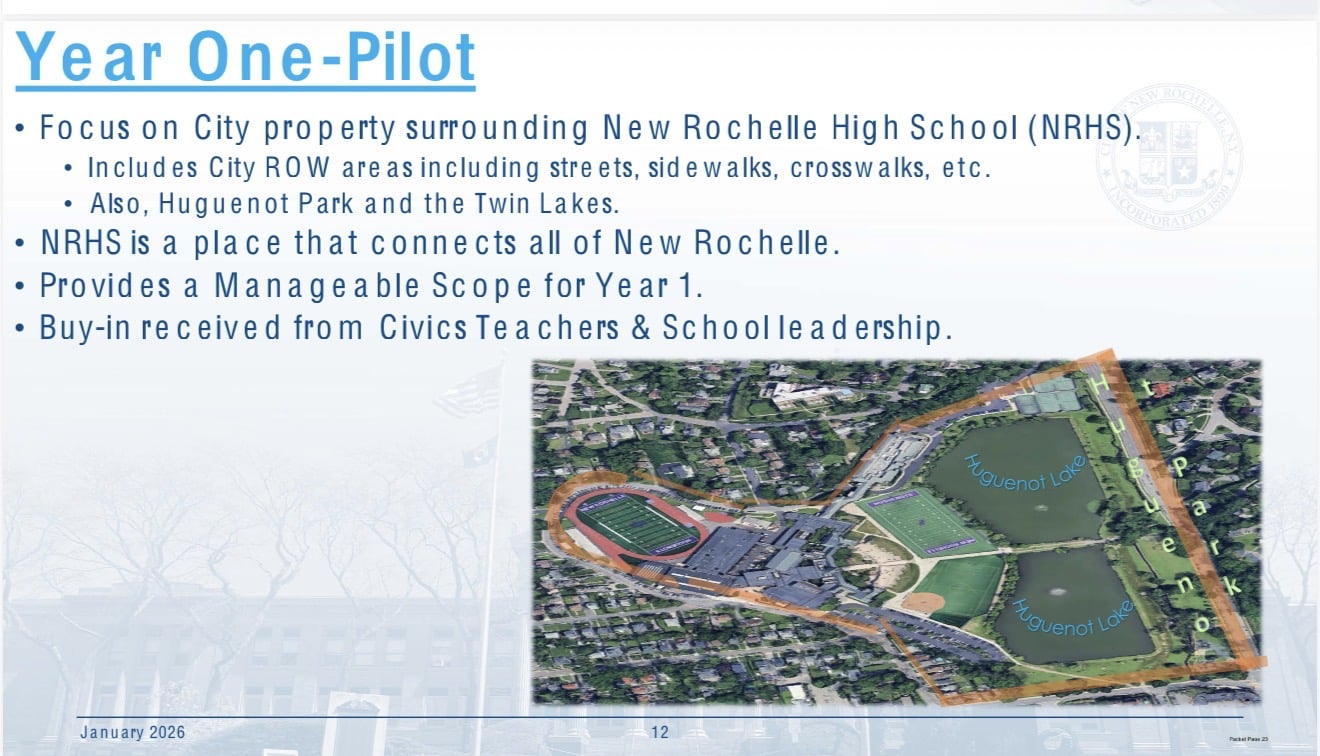
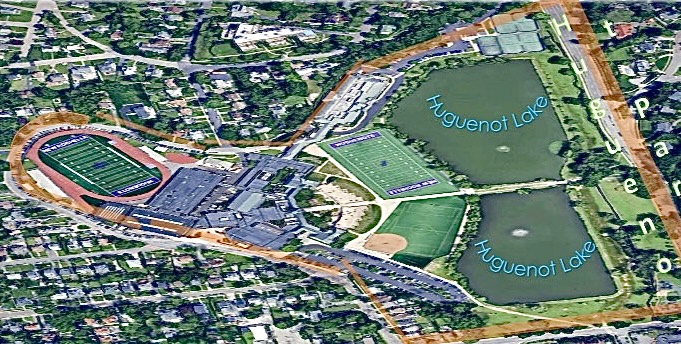
The pilot program, however, is scoped exclusively to public property surrounding New Rochelle High School, Huguenot Park, Twin Lakes, and adjacent streets and sidewalks — all located in District 6, Stern’s own district.
At the January 20 City Council meeting, Stern said: “New Rochelle High School is a landmark that connects our City. By focusing our pilot here, we are investing in a space that serves our youth and families while testing a model we hope to expand citywide in the upcoming years.”
What Stern did not say at the meeting is that the high school and surrounding park areas are in his district.
Talk of the Sound has asked Stern and City officials how the decision was made to scope the pilot to District 6 rather than implement it city-wide, as the City’s own procurement documents described. No response had been received at the time of publication. This story will be updated when responses are received.
A Jurisdictional Problem
The pilot program’s geographic scope may present a significant legal obstacle that City officials have not publicly addressed.
The area designated for the Year One pilot — the property surrounding New Rochelle High School, Huguenot Park, and Twin Lakes — is largely not owned by the City of New Rochelle.
New Rochelle High School and its surrounding campus are owned by the City School District of New Rochelle, a separate municipal entity from the City. The City cannot spend capital funds on property it does not own without a formal agreement with CSDNR. The program’s draft Rulebook requires eligible projects to be located “on publicly owned property or within the public right-of-way” — but CSDNR property is not City-owned property.
Huguenot Park and Twin Lakes present a separate legal issue. Parkland in New York State is subject to the public trust doctrine, which restricts non-park uses and alienation of parkland. Capital improvements that alter a park’s character or use may require specific state legislative authorization.
The remaining eligible area within the pilot zone — streets, sidewalks, and crosswalks within the City’s right-of-way — may represent the only property over which the City has clear legal authority to act.
It is unclear whether the City’s legal counsel reviewed these jurisdictional questions before the program was launched, the ordinance was adopted, or the Rulebook was drafted. Talk of the Sound has asked City officials whether a legal analysis was conducted. No response had been received at the time of publication.
Two RFPs, No Public Award
City records show the administration was planning the program well before the Council formally authorized it.
The City’s 2025 Work Plan, dated February 2025, listed the PB consultant RFP as already “underway” and targeted consultant selection for the second quarter of 2025 — seven months before the $200,000 was appropriated in the December 2025 budget and nearly a year before the January 2026 ordinance.
The City issued its first RFP for participatory budgeting consulting services — Spec 5760 — on February 5, 2025, with proposals due March 5. Less than three weeks later, on March 24, the City issued a second, nearly identical RFP — Spec 5780 — with proposals due April 16.
Both RFPs are listed as closed on the City’s procurement website. No contract award is publicly identified for either specification.
The scope of work in both RFPs is substantial, covering program planning, community engagement, process design, proposal development, voting logistics, implementation monitoring, and evaluation across multiple phases. The second RFP added evaluation criteria specifically referencing experience with programs “focused on specific segments of a municipality — by districts, by conjoined neighborhoods.”
Questions and answers posted April 7, 2025 in connection with Spec 5780 described the program as city-wide. In response to a question about geographic scope, the City answered: “Citywide with breakdown by district.” Yet the subsequent ordinance and program documents scope the pilot entirely to one district.
Talk of the Sound has asked the City why the RFP was reissued, who was awarded the contract, and for how much. No response had been received at the time of publication.
The Cost Question
The 2026 budget includes $200,000 in capital funding for participatory budgeting projects and a separate $20,000 operating appropriation to administer the program — a 10 percent overhead rate on a program controlling less than one-tenth of one percent of the City’s $256 million budget.
The $20,000 figure is significant because the City’s own RFP documents make clear the program is being run primarily by an outside consultant, not City staff. In response to a question about workload split, the City’s Q&A stated simply: “Yes” — confirming that the consultant handles most of the work and City staff play a supporting role.
Given the breadth of the scope of work described in the RFPs, it is unclear whether $20,000 represents the full consultant contract or whether the vendor is being compensated through a different funding source.
Talk of the Sound has asked the City for the total cost of the consultant contract. No response had been received at the time of publication.
A Timeline Already Behind Schedule
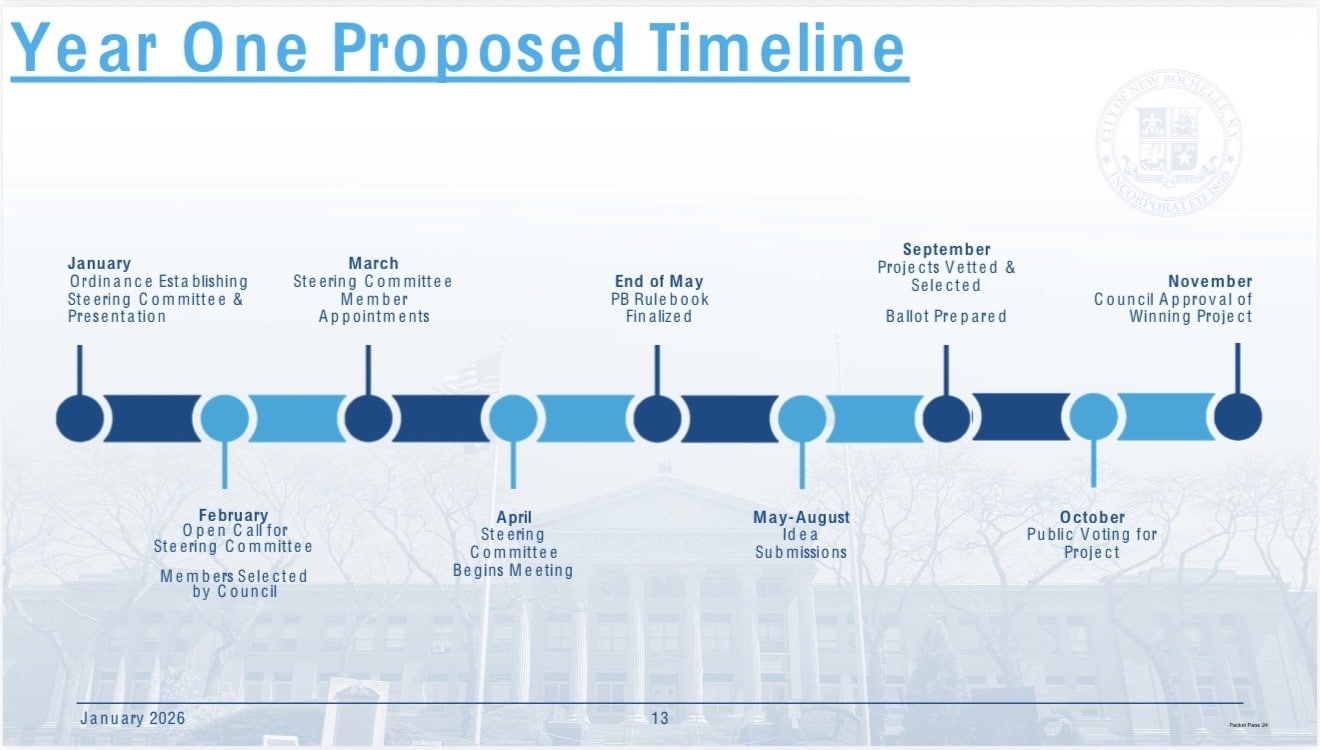
The program has also fallen behind its own stated milestones. After about four months, the program is already two months behind schedule — and the City’s own budget documents show the 2027 budget process traditionally begins in June or July, meaning the committee is convening for the first time just as the next budget cycle gets underway.
The January 2026 presentation to City Council projected the Steering Committee would begin meeting in April 2026 and that the program’s Rulebook would be finalized by the end of May. The committee’s first meeting is June 2, and the Rulebook remains in draft form.
The timeline contradictions run deeper. The April 2025 Q&A distributed to prospective vendors told bidders that winning projects would be implemented in 2027. The January 2026 presentation told City Council that winning projects would receive Council approval in November 2026 — a full year earlier. The City has never publicly reconciled those two timelines.
If the vendor timeline is correct and winning projects are not implemented until 2027, the $200,000 appropriated in the 2026 capital budget may not be spent in 2026 at all. It is unclear whether those funds would roll over or require a new appropriation.
Talk of the Sound has asked the City which timeline governs and what happens to the 2026 capital appropriation if projects are not selected until 2027. No response had been received at the time of publication.
The CCRB Contrast
The program’s launch comes as another City advisory body sits dormant.
The Civilian Complaint Review Board, which has a public safety mandate and was established by local law to provide civilian oversight of the New Rochelle Police Department, was appointed in June 2025. It has not held a single meeting in nearly a year.
The PB Steering Committee, created in January 2026, is scheduled to hold its first meeting Tuesday — potentially before the CCRB convenes for the first time.
Talk of the Sound has asked the City why the CCRB has not met and whether it will convene before or after the PB Steering Committee holds its inaugural session. No response had been received at the time of publication.
The Committee
The City received more than 30 applications for the seven voting seats. Applications were sorted by Council district and provided to each Council member for selection.
On March 18, 2026 — two weeks behind the original target — the City Council unanimously adopted Resolution 2026-32 appointing the following members:
Voting Members:
- Ava Charles, High School Age Youth Resident (selected by Mayor Ramos-Herbert)
- Victor Bowman Jr., District 1 (selected by Council Member Martha Lopez)
- Anthony Bibbo, District 2 (selected by Council Member Albert Tarantino)
- Alicka Ampry-Samuel, District 3 (selected by Council Member David Peters)
- Janna Gullery, District 4 (selected by Council Member Shane Osinloye)
- Giselle Reyes, District 5 (selected by Council Member Sara Kaye)
- Lauren Hurwitz, District 6 (selected by Council Member Matthew Stern)
Non-Voting Ex-Officio Members:
- Matthew Stern, City Council Member
- Gino Frabasile, City Staff Member (selected by City Manager Melendez)
- Makeda Lewis, City School District Representative (selected by Superintendent Reynolds)
Among the more prominent appointees is Alicka Ampry-Samuel, a former New York City Council Member and former Commissioner of the New York City Department of Housing Preservation and Development, who was selected by District 3 Council Member David Peters.
Notable in the committee’s composition is Stern’s dual role: he selected the District 6 voting member, Lauren Hurwitz, and also sits on the committee himself as the non-voting City Council liaison — giving him a presence on the body overseeing a program he sponsored, scoped to his own district.
What Happens Tuesday
The June 2 agenda for the PB Steering Committee’s inaugural meeting includes introductions, a review of the committee’s structure and governing ordinance, an overview of the participatory budgeting process and proposed timeline, and a discussion of the draft Rulebook.
Deputy City Manager Todd Castaldo is listed as the staff contact for the committee. The agenda packet identifies the 2026 funding allocation and eligible project categories as discussion items, suggesting those parameters have not yet been finalized.
The next scheduled committee meeting is June 30, 2026.
Talk of the Sound has submitted questions to City Manager Wilfredo Melendez, Deputy City Manager Todd Castaldo, and Council Member Matthew Stern. No responses had been received at the time of publication. This story will be updated when responses are received.
This article was drafted with the assistance of AI tools under the direction and editing of Robert Cox to ensure accuracy and adherence to journalistic standards. Contact: robertcox@talkofthesound.com | WhatsApp: +353 89 972 0669