

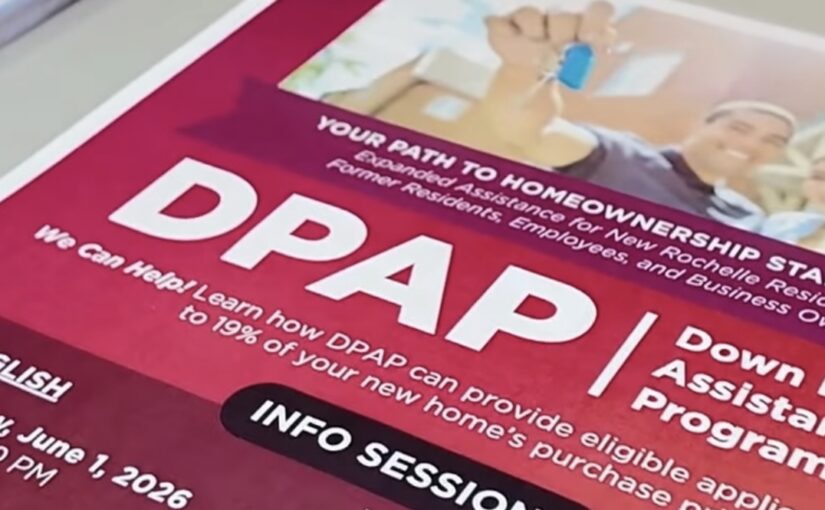
NEW ROCHELLE, NY (May 30, 2026) — The City of New Rochelle is promoting a significantly expanded version of its Down Payment Assistance Program this week, but federal housing records show the program has helped far fewer people than promised since its 2022 launch.
The City is hosting an English-language information session Monday, June 1, at 6 p.m. in City Hall’s Council Chambers, and a Spanish-language session Thursday, June 4, at 6 p.m. in City Hall’s lower level.
What the City Promised in 2022
When the City launched the Down Payment Assistance Program in April 2022, City Manager Charles Strome framed it as a racial equity initiative.
“Expanding affordable housing and opportunities for homeownership is central to New Rochelle’s vision for a growing diverse city where people of all backgrounds are welcomed and provided pathways to grow roots in the community and get ahead,” Strome said at the time.
Talk of the Sound reported in April 2022 that the program was intended to address the racial wealth gap, citing national data showing Black homeownership in New York at 35% and Hispanic homeownership at 28%, compared to 66% for white residents. The program was funded, the City said, through a combination of federal HOME Investment Partnership Program dollars and the City’s Affordable Housing Fund — a pool of money collected from developers as a condition of building in New Rochelle.
The original program set a goal of assisting 125 households over five years, or 25 per year.
What the Records Show
Federal Consolidated Annual Performance and Evaluation Reports filed by the City with the U.S. Department of Housing and Urban Development show the program fell dramatically short of those goals.
In 2022, its first year, the program closed zero transactions. It closed two in 2023, five in 2024, and two more in 2025 — a total of nine closings through Dec. 31, 2025, according to the CAPERs.
That is nine closings against a five-year goal of 125, or 7% of target.
The City’s own 2025 Annual Action Plan, filed with HUD, acknowledged that applicants had been “unprepared for the financial requirements of homeownership,” citing that finding as the reason for launching a new Financial Capability Academy.
Talk of the Sound has submitted records requests to the City seeking official documentation of each closing, including addresses, purchase prices, assistance amounts, property types, and buyer demographic information.
A Program That Stopped — Then Restarted?
Federal records show the City budgeted zero HOME dollars for the Down Payment Assistance Program in 2025, shifting its entire HOME allocation to a separate Tenant Based Rental Assistance program. Despite that, the program continued to operate in 2025.
The Affordable Housing Fund was established by City ordinance in 2006 and is fed by payments developers make when they choose not to build affordable housing units on-site. The fund does not appear as a separately disclosed account in the City’s audited financial statements for 2022, 2023, or 2024, making it impossible for the public to determine how much money the fund holds, what return on investment has been realized, or how it has been spent.
The 2026 Expanded Program Fact Sheet describes DPAP as “funded through a federal grant from the United States Department of Housing and Urban Development’s HOME Program.” The Affordable Housing Fund is not mentioned.
An Expanded — and Significantly Altered — Program
The 2026 expansion makes significant changes to eligibility. Previously, applicants were required to be current New Rochelle residents with at least 12 months of permanent residency. The expanded program now also accepts people who work full-time in New Rochelle, own a business in the city, or formerly lived in New Rochelle for at least two years.
The maximum purchase price has risen substantially — from $494,000 under the original program to $661,000 for existing homes and $840,000 for newly constructed homes. Maximum household income limits have also increased; a family of four may now earn up to $131,350 and remain eligible.
Commissioner of Development Adam Salgado said the expansion “strengthens the workforce and supports local businesses.” Mayor Yadira Ramos-Herbert said the program invests in “stronger families, stronger neighborhoods, and a stronger city.” Neither addressed the program’s performance over the past four years.
In a video posted to the City’s Instagram account this week as part of a “Faces of City Hall” series, Lisa Davis, an operations manager in the Department of Development, described the expanded eligibility as helping people “remain here or move here into New Rochelle.”
She did not mention the racial wealth gap or the program’s poor track record.
The shift in language — from closing the racial wealth gap to helping people “remain here or move here” — marks a significant reframing of the program’s stated purpose. Whether the expansion will reach the Black and Hispanic residents the program was originally designed to serve, or attract a broader and more affluent pool of applicants, remains to be seen.
Talk of the Sound has submitted records requests to the City and a media inquiry to HUD. This story will be updated when responses are received.
This article was prepared with the assistance of AI tools under the direction and editing of Robert Cox.
Have information about this story? Email robertcox@talkofthesound.com (preferred) or contact via WhatsApp: +353 089 972 0669.