
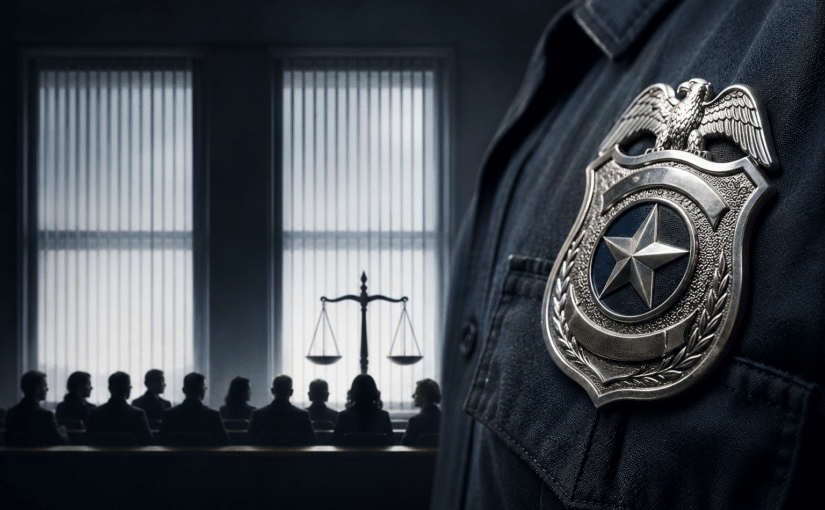
NEW ROCHELLE, NY (June 3, 2026) — Grand juries are supposed to be an independent check on prosecutorial power. In practice, they almost never are — except in one category of case where they consistently refuse to indict: allegations of misconduct against police officers.
The contrast between how grand juries handle ordinary criminal cases and how they handle cases involving law enforcement is stark, well-documented, and has been the subject of sustained academic research and journalism for more than a decade.
The Ham Sandwich Standard
The phrase most associated with grand jury proceedings comes from Sol Wachtler, the former Chief Judge of the New York Court of Appeals, who observed in 1985 that a prosecutor could get a grand jury to indict a ham sandwich. The standard for indictment is probable cause — the lowest threshold in the criminal justice system. It does not require proof beyond a reasonable doubt. It does not even require a preponderance of the evidence. It requires only that there is probable cause to believe a crime was committed.
That low bar, combined with the fact that grand jury proceedings are conducted in secret with only the prosecution presenting evidence and no defense attorneys present, means that indictment is nearly automatic when a prosecutor wants one.
The numbers bear that out. In 2010, the last year for which the federal government published comprehensive grand jury statistics, federal prosecutors pursued more than 162,000 cases. Grand juries declined to indict in 11 of them — a refusal rate of roughly 0.007 percent. The Bureau of Justice Statistics has not published comparable data since, though legal experts say there is no indication the pattern has changed materially.
As University of Illinois law professor Andrew Leipold told FiveThirtyEight in 2014: “If the prosecutor wants an indictment and doesn’t get one, something has gone horribly wrong. It just doesn’t happen.”
A former Justice Department prosecutor writing for Lawfare in 2025, citing the 2010 data, put it in personal terms: in 25 years at the DOJ, he never had a grand jury no bill one of his cases, and could recall only a couple of instances where it happened anywhere in his entire district.
The Police Exception
Against that backdrop, the pattern in police use-of-force cases is striking.
A 2014 FiveThirtyEight analysis — published in the wake of grand jury decisions not to indict officers in the deaths of Michael Brown in Ferguson, Missouri, and Eric Garner in New York — found that while grand jury refusals are vanishingly rare in ordinary criminal cases, police officers represent a documented exception. In Harris County, Texas, grand juries had not indicted a Houston police officer, in a decade, since 2004. In Dallas, grand juries reviewed 81 police shootings between 2008 and 2012 and returned just one indictment.
FiveThirtyEight identified three structural reasons for the pattern: grand jurors tend to trust police officers; prosecutors, who work daily alongside law enforcement, may be reluctant to present police cases aggressively; and in some jurisdictions, prosecutors feel legally or politically obligated to bring police shootings to a grand jury even when they do not intend to obtain an indictment.
Research by Philip Stinson, a criminologist at Bowling Green State University and a former police officer, has documented that officers are rarely charged in on-duty killings. Since 2005, 172 officers have been arrested for murder or manslaughter resulting from on-duty shootings. Of those, only 35 have been convicted of any crime — often a lesser offense such as manslaughter rather than murder.
A 2025 article in the Oregon Law Review by Ilana Friedman drew on that research to reach a broader conclusion: while the grand jury is known as a “prosecutor’s rubber stamp due to its pro forma tendency to almost always return true bills in favor of indictment,” police-suspect charging declinations “stand in stark contrast with the popular idea that a grand jury would indict a ham sandwich if asked to do so.”
Why It Happens
Legal scholars and journalists have identified several reinforcing factors that make grand jury no true bills more likely in police cases.
The grand jury hears only what the prosecutor presents. There is no defense attorney, no cross-examination, no presentation of contrary evidence unless the prosecutor chooses to include it. When a prosecutor does not want an indictment, the grand jury is a reliable instrument for producing that outcome — without the political exposure of a prosecutorial declination.
This dynamic drew particular attention after the 2014 Ferguson grand jury proceedings, in which the St. Louis County prosecutor presented exculpatory evidence — something prosecutors are not required to do and almost never do in ordinary cases. Legal observers argued the unusual approach reflected a presentation designed to produce a no true bill rather than an indictment.
Jurors themselves also bring different assumptions to police cases. ABC News reported in 2020 that experts consistently find jurors willing to give officers the benefit of the doubt in use-of-force situations — an assumption that does not apply to ordinary defendants.
Finally, the legal standard that governs police use of deadly force — established by two Supreme Court rulings in the 1980s — gives officers considerable latitude in making split-second decisions, making it harder for prosecutors to establish that probable cause exists for a crime even when a shooting results in death.
What About Beyond Shootings?
The research on grand juries and police has focused primarily on use-of-force cases — officer-involved shootings where the legal standard and split-second judgment calls create genuine ambiguity.
Less studied, but equally significant, is how grand juries handle police misconduct cases that do not involve split-second decisions — cases involving evidence tampering, false reports, or deliberate acts of dishonesty where there is no ambiguity about what occurred, only about whether a prosecutor chooses to present the case aggressively.
The same structural factors apply: grand juries hear only what prosecutors present, jurors bring pro-police assumptions, and prosecutors who work daily with law enforcement may be reluctant to pursue cases aggressively. Whether those factors produce the same pattern of no true bills in non-use-of-force police misconduct cases — cases where the evidence is documentary rather than circumstantial — is a question the available research does not yet fully answer.
This article was prepared with the assistance of AI tools under the direction and editing of Robert Cox.
Have information about this story? Email robertcox@talkofthesound.com (preferred) or contact via WhatsApp: +353 089 972 0669.