


NEW YORK, NY (July 22, 2026) — Newly released records show Adam Salgado, now commissioner of development for the City of New Rochelle, told his former employer, the New York City Department of Transportation, in 2013 that he was resigning due to sexual harassment, retaliation and what he called sexual assault by a manager. The records surfaced only after Talk of the Sound appealed DOT’s partial denial of a 2024 Freedom of Information Law request.
In a July 21, 2026 letter, DOT Assistant General Counsel Michael Twomey said the agency’s review of the appeal dated July 7, 2026 identified seven additional pages of responsive records not provided in the original response. The appeal was granted in part and denied in part. Redactions were applied under Public Officers Law Sections 87(2)(b) and 89(2)(b) to protect personally identifying information. Other records were withheld entirely under Section 87(2)(a), which the letter states implicate confidential medical records under 29 CFR Section 825.500(g), a federal Family and Medical Leave Act regulation.
The letter states judicial review may be sought through a proceeding under Article 78 of the New York Civil Practice Law and Rules within four months of the determination. It was copied to the New York State Committee on Open Government and DOT Records Access Officer Judith Falk.
What the new records show
Among the newly released records is a May 10, 2013, letter Salgado sent to Jean Frankowski, DOT’s director of human resources, notifying her he would not continue working at the agency. In the letter, Salgado wrote that he had complained to DOT’s EEO Office about “sexual harassment and retaliation” and said he had been subjected to two demotions resulting in a salary decrease of more than $58,000 per year in under two months, with the second demotion occurring while he was on Family and Medical Leave Act leave.

Salgado wrote that his complaints had been brought to the EEO Office and DOT’s legal counsel “several months ago” without remedial action, and that he had recently been told the agency’s investigation of “the manager who sexually assaulted me” had been delayed. He said he was “truly fearful of returning to an office” where he would work alongside the individual and characterized his departure as a “Constructive discharge.”
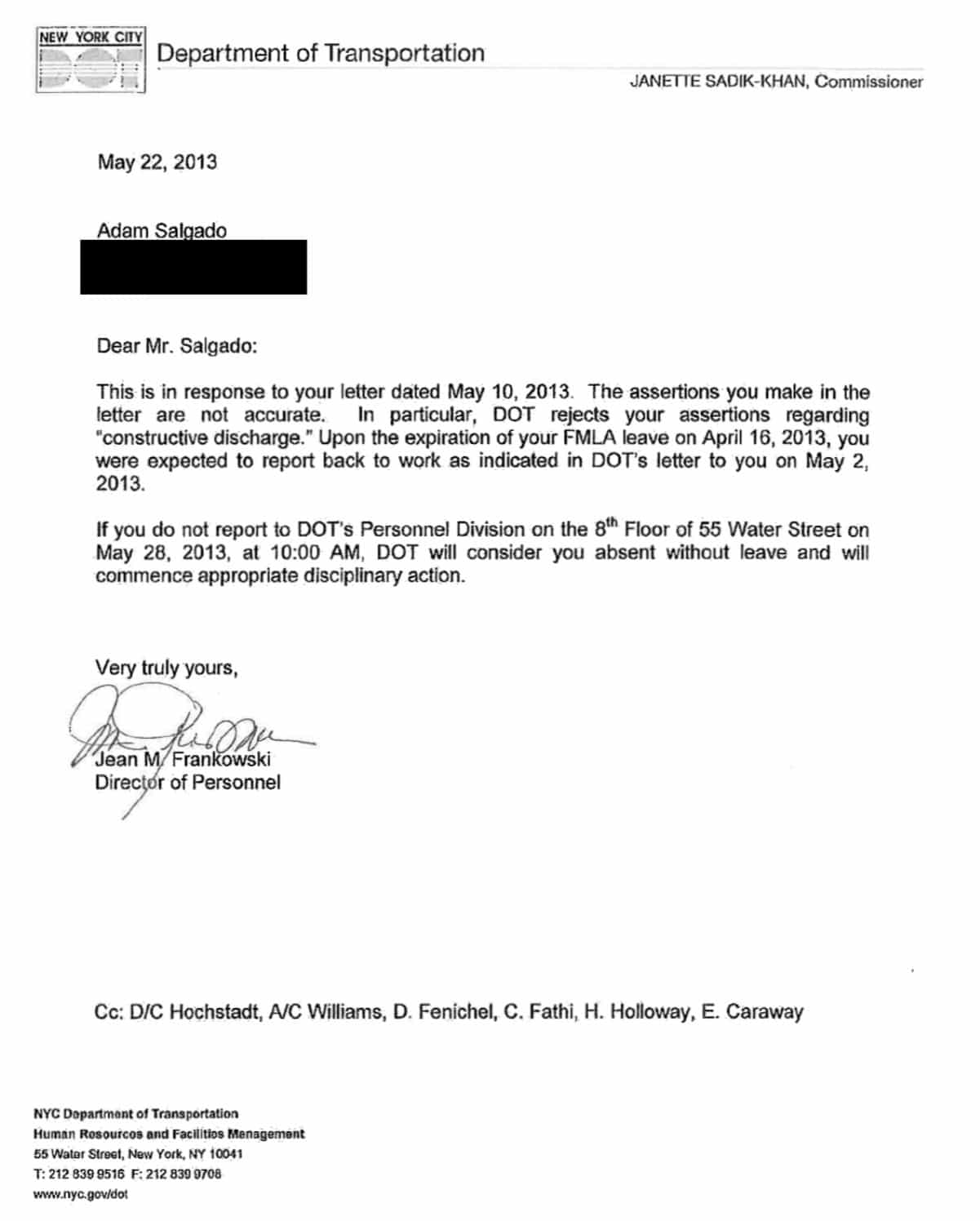
In a May 22, 2013, response, Frankowski disputed Salgado’s characterization, stating DOT rejected his “constructive discharge” assertion and that his FMLA leave had expired April 16, 2013. The letter directed Salgado to report to DOT’s Personnel Division by May 28, 2013, or be considered absent without leave and subject to disciplinary action.
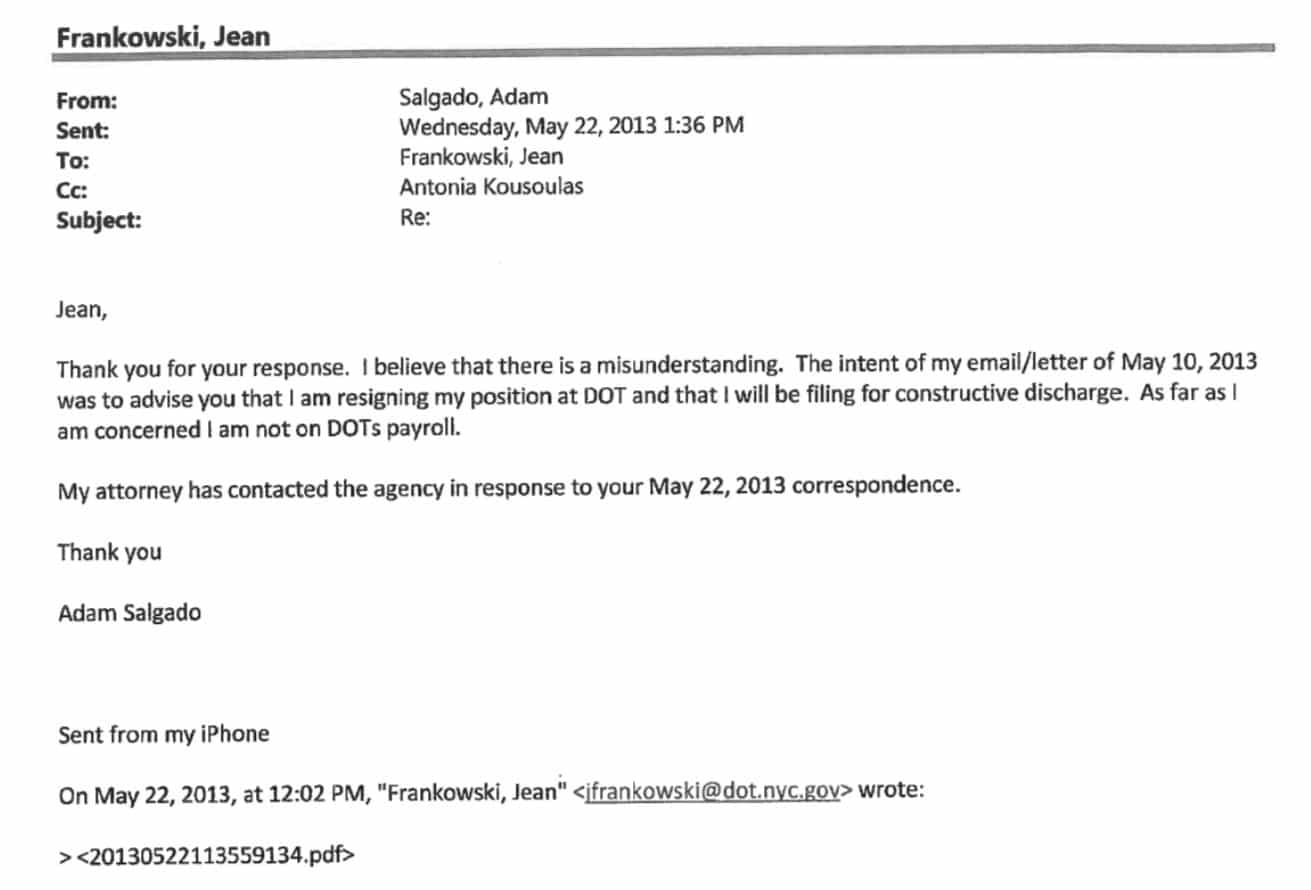
Salgado replied the same day, confirming his intent to resign rather than return to work, and noted his attorney had contacted the agency.
What “constructive discharge” means
Constructive discharge is a recognized legal doctrine in employment law. It refers to a situation in which an employee resigns because working conditions have been made so intolerable that a reasonable person in the same position would feel compelled to quit. Under this doctrine, a resignation can be treated as legally equivalent to a firing for purposes of discrimination and retaliation claims, provided the employee can show the employer deliberately created, or knowingly allowed, conditions difficult enough that quitting was the only reasonable option. Ordinary workplace dissatisfaction does not meet that standard. The doctrine is established under both federal Title VII case law and the New York State and City Human Rights Laws.
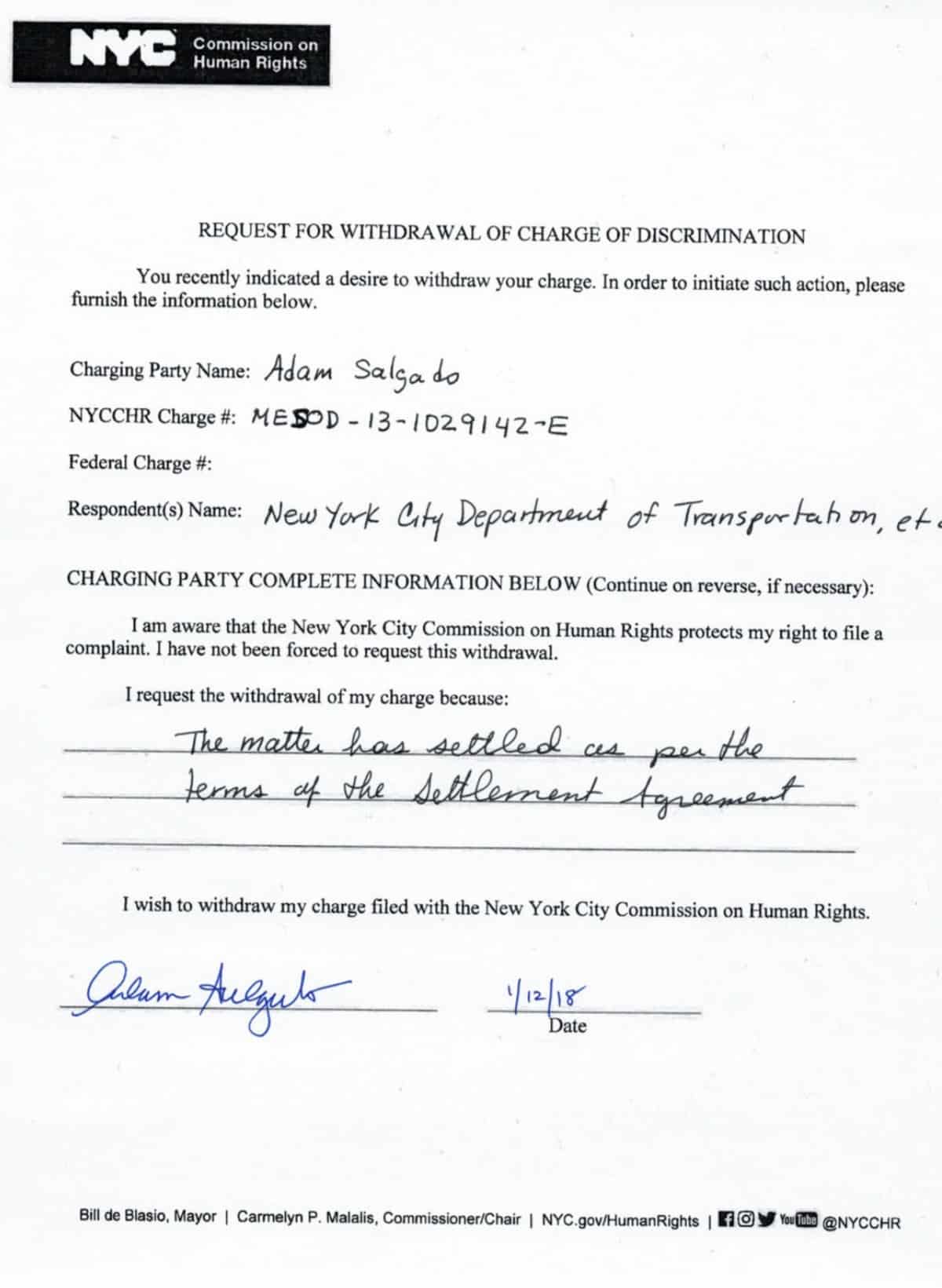
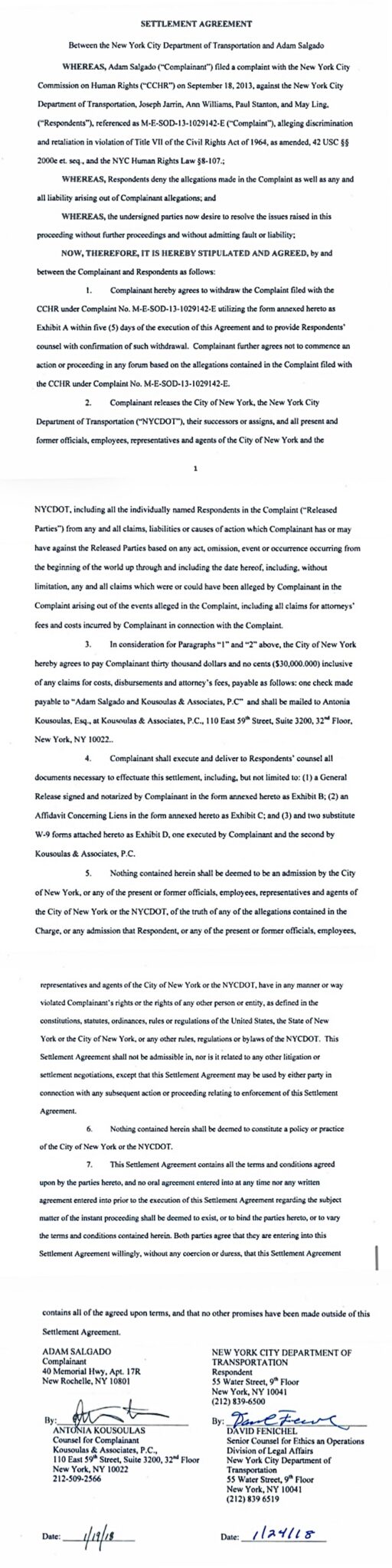
The records also include a Jan. 12, 2018, form filed with the New York City Commission on Human Rights requesting withdrawal of Salgado’s discrimination charge, Complaint No. M-E-SOD-13-1029142-E, naming as respondents DOT along with Joseph Jarrin, Ann Williams, Paul Stanton and May Ling. As previously reported by Talk of the Sound, Jarrin served as Salgado’s supervisor at DOT during the period in question, later becoming the agency’s executive deputy commissioner and eventually principal deputy assistant secretary for finance and budget at the U.S. Department of Transportation before leaving that post in January 2025. The withdrawal form states the request was made because “the matter has settled as per the terms of the Settlement Agreement” — the same settlement previously reported by Talk of the Sound, under which the city paid Salgado $30,000.
A note on prior reporting
Talk of the Sound’s original FOIL request, filed in 2024, described Salgado as having been fired by DOT, consistent with prior sourcing. The newly released records show Salgado himself invoked “constructive discharge” in his May 10, 2013, resignation letter — a legal claim that treats a resignation as equivalent to a firing when an employee is forced out by intolerable conditions. That framing is consistent with earlier reporting that Salgado was fired. The records do not resolve whether Salgado resigned or was terminated by DOT; they show only that Salgado characterized his own departure as a constructive discharge in 2013, and that his discrimination complaint was withdrawn following a settlement five years later, in January 2018.
Pending litigation
In August 2025, Warren and Salgado filed a defamation complaint against Cox, Talk of the Sound, and Words in Edgewise in U.S. District Court for the Southern District of New York, seeking $250,000 each over statements published between October 2024 and January 2025. Separately, Cox has filed a copyright infringement claim, Cox v. Loomba, in the same court, alleging Loomba shared paywalled Words in Edgewise articles with Warren and Salgado and lawyers in his firm — the same articles cited in the Warren-Salgado defamation complaint — without authorization.
What this clarifies and what remains unknown
The records establish that Salgado initially characterized his departure from DOT as a constructive discharge but later characterized his departure from DOT as a resignation prompted by alleged sexual harassment, retaliation and sexual assault. The newly released letters do not name the manager Salgado accused of sexual assault.
The medical-records exemption cited in DOT’s appeal response indicates that at least some of the records still being withheld relate to Salgado’s FMLA leave. It remains unclear whether any withheld records pertain to Jarrin specifically or the reason for the FMLA leave.
Talk of the Sound is reviewing whether to pursue further appeal or an Article 78 proceeding regarding any records that remain withheld.
RELATED
New York DOT Records Confirm Salgado Discrimination Complaint Against Ex-Supervisor Jarrin (7/7/2026)
The New Rochelle Thimblerig — Part I(10/28/2024)
New Rochelle Corporation Counsel Seeking Blank Check from Taxpayer to Fund Her Personal Lawsuit Against Robert Cox (12/10/2024)
New Rochelle Authorizes Unlimited Funding of Private Lawsuit to Suppress Reporting by Local Journalist (12/11/2024)
New Rochelle Officials: Sex, Drugs and Lies (5/10/2025)
Six Month Anniversary: New Rochelle Legal Threats Backfire (6/2/2025)
This article was prepared with the assistance of AI tools under the direction and editing of Robert Cox.
Have information about this story? Email robertcox@talkofthesound.com (preferred) or contact via WhatsApp: +353 089 972 0669.