

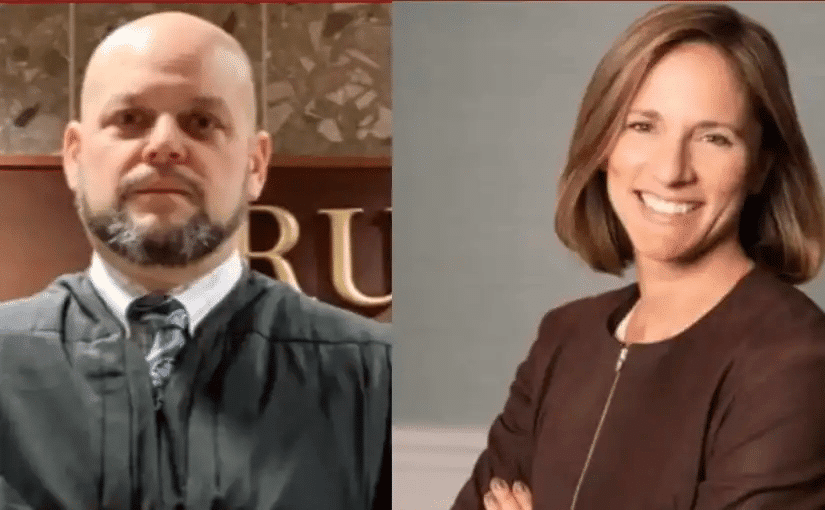
NEW ROCHELLE, NY (May 22, 2026) — This is the second in a series of stories examining the Westchester County District Attorney’s office and its obligations to disclose information about police officer credibility to defendants and the public. The first story documented DA Miriam Rocah’s broken promise to release an adverse credibility list — commonly known as a bad cop list — and raised questions about whether officers Sean Kane, Alec McKenna, and Michael Vaccaro should have been on it. This story documents what was happening inside the DA’s office at the same time.
A Reform Law and a Progressive DA Who Fought It
In 2019, New York State passed the Discovery for Justice Reform Act, replacing the old “blindfold law” — Criminal Procedure Law Article 240 — with CPL 245. The new law was landmark criminal justice reform. It required prosecutors to automatically disclose discovery material to the defense, on an accelerated timeline, without waiting for the defense to ask. It established a presumption of sharing. It placed an affirmative obligation on prosecutors to go obtain discovery material — not merely to hand over what was given to them.
Among the material CPL 245 requires automatic disclosure of: officer disciplinary records. Every case. Every officer. Without a request.
Miriam Rocah was a progressive prosecutor who ran on criminal justice reform. CPL 245 was exactly the kind of reform she publicly supported. She campaigned on releasing a bad cop list identifying officers whose conduct made them unreliable witnesses. She won, took office in January 2021, then spent four years stonewalling on releasing that list.
She went further, suing a a sitting New Rochelle judge in the New York State Supreme Court for enforcing CPL 245.
The Molina and Serrano Cases
The dispute arose from two unrelated DWI cases before New Rochelle City Court Judge Matthew J. Costa — People v. Michael Molina and People v. Gustavo Villamares Serrano.
In the Molina case, Rocah’s office filed a Certificate of Compliance on July 28, 2021, certifying that all discovery had been produced. It then continued producing officer disciplinary records on November 5 and November 10, 2021 — more than three months after filing that certificate. The disciplinary records in question concerned the arresting state trooper — including a Letter of Censure for failing to properly inventory an impounded vehicle, resulting in failure to discover narcotics. That conduct — a documented evidence-related failure by the arresting officer — is precisely the kind of prior dishonesty that Brady and Giglio require prosecutors to disclose.
Judge Costa found the Certificate of Compliance invalid. He sanctioned Rocah’s office by precluding the trooper’s testimony and any evidence he obtained — effectively ending the prosecution.
In the Serrano case, Rocah’s office declined to produce required training manuals without first seeking a ruling from the court on their discoverability. Costa sanctioned the DA again, precluding breathalyzer test data and field sobriety test testimony.
Rocah’s response to being sanctioned for late disclosure of officer disciplinary records and for withholding required discovery: she filed an Article 78 proceeding in New York State Supreme Court seeking a writ of prohibition to prevent Costa from enforcing his sanctions. The DA filing an Article 78 against a sitting judge is so unusual that a New York State courts official described it to Talk of the Sound as “a rarity.”
The NYSCEF Question
Every other case — civil or criminal — Talk of the Sound has covered in Westchester County was filed electronically through NYSCEF — the New York State Courts Electronic Filing system — making the documents publicly accessible to anyone with a computer or phone.
Rocah opted out of NYSCEF for this case. She filed on paper.
The result: a case specifically about a DA’s disclosure obligations was conducted in the format least accessible to the public. Talk of the Sound had to make multiple in-person trips to the Westchester County courthouse in White Plains, photographing more than 1,000 pages of documents on an iPhone, to follow the proceedings. No member of the public could follow the case from a computer. No journalist could access the filings without physically appearing at the courthouse.
Talk of the Sound has asked DA Cacace’s office why Rocah opted out of NYSCEF for a case about disclosure obligations, and whether opting out is standard practice for the DA’s office. No response has been received as of publication.
Rocah’s Legal Argument
Rocah’s position in the Article 78 was straightforward: under CPL 245.80, a court cannot sanction prosecutors for late disclosure unless the defendant demonstrates prejudice. Neither Molina nor Serrano had shown prejudice. Therefore Costa had no authority to impose sanctions.
That argument — that defendants aren’t harmed by late disclosure of officer disciplinary records as long as they can’t prove it — is the direct opposite of what the Brady list was supposed to accomplish. The entire purpose of maintaining and releasing a bad cop list is to ensure that defendants and their attorneys know about officer credibility issues before trial, with enough time to use that information. Rocah was arguing in court that defendants don’t need that information early. She was arguing in her campaign materials that the public has a right to know.
The two positions cannot be reconciled.
The Cacace Ruling
The judge assigned to decide Rocah’s Article 78 was Susan Cacace.
On September 30, 2022, Cacace denied Costa’s motion to dismiss — allowing the case to proceed. On January 30, 2023, she issued her final ruling: Rocah won. Costa was prohibited from enforcing his preclusion orders. His sanctions were overturned.
Cacace found that Costa had acted in excess of his authority by imposing sanctions without a showing of prejudice by the defendants. Late disclosure of officer disciplinary records — even months after a Certificate of Compliance had been filed — could not be sanctioned absent demonstrated prejudice to the defense.
The practical effect in Westchester County criminal cases: prosecutors could continue filing Certificates of Compliance before all required material had been produced, continue producing officer disciplinary records late, and face no consequences as long as defendants could not demonstrate prejudice.
Susan Cacace is now the Westchester County District Attorney.
The Trooper Fortune Parallel
The Molina case involved a state trooper who failed to properly inventory an impounded vehicle, resulting in the failure to discover narcotics — a documented evidence-related act that Rocah’s office disclosed months late and then fought to avoid being sanctioned for.
That conduct is functionally identical to Sean Kane’s 2013 gravity knife incident — stopping a civilian, finding a weapon, discarding it, and failing to log it as evidence. The same type of prior dishonesty. The same type of late or non-disclosure question. The same type of officer. The same prosecutorial office.
Whether Kane’s 2013 incident was ever disclosed to defense attorneys in subsequent cases — as CPL 245 and Brady/Giglio require — is a question Talk of the Sound has asked DA Cacace’s office. No response has been received.
The Boilerplate Court Order
The Harper case file — the case that brought Sean Kane’s conduct to light — contains a standard Brady/Giglio court order. It is boilerplate, used in Westchester County criminal cases. It places an affirmative obligation on prosecutors not merely to disclose Brady material when handed to them, but to go obtain it.
After the repeal of Civil Rights Law Section 50-a in June 2020 made police disciplinary records publicly available for the first time since 1976, every prosecutor in Westchester County handling a case involving an NRPD officer had both a court-ordered obligation to obtain those records and the means to do so through subpoena or FOIL. If Talk of the Sound could obtain Kane’s disciplinary records, McKenna’s disciplinary records, and Vaccaro’s disciplinary records through FOIL, so could every prosecutor who handled a case involving any of those officers. Without a fight. With subpoena power. With direct access to police files.
Talk of the Sound has asked DA Cacace’s office how long that boilerplate has been in use — whether it was in place for the McKenna grand jury in November 2020, the Vaccaro trial in 2022, and the Kane grand jury in December 2024. No response has been received.
The Vaccaro Connection
There is one more thread connecting this story to the cases Talk of the Sound has been investigating.
Judge Costa — the same judge Rocah fought in the Article 78 — was also the judge assigned to the criminal trial of New Rochelle Detective Michael Vaccaro, who was charged with Attempted Assault after a February 2021 road rage attack on Malik Fogg. On July 21, 2022 — Day Four of the trial, while Article 78 motion practice was simultaneously underway — Costa acquitted Vaccaro in minutes, handing Rocah an embarrassing defeat.
The Article 78 against Costa was filed on May 13, 2022 — two months before the Vaccaro trial began. Rocah followed Costa on Twitter from her personal account around the time he ruled on Vaccaro’s pretrial motions. Costa disclosed this on the record, noting his decision had been made the week before and was not affected by the follow. The optics were uncomfortable enough that Costa felt compelled to address it publicly.
Whether the Article 78 against Costa — fighting his enforcement of discovery obligations — was in any way connected to the Vaccaro prosecution proceeding before him is a question Talk of the Sound cannot answer. It is a question worth asking.
What Has Changed — and What Hasn’t
CPL 245 has been amended since it took effect. The late disclosure practices that Judge Costa tried to sanction may or may not persist under current DA Cacace. Talk of the Sound has asked whether DA Cacace’s current position on timely Brady/Giglio disclosure differs from the position her predecessor successfully argued before her when she was a judge. No response has been received.
What has not changed: the adverse credibility list was never released. Kane, McKenna, and Vaccaro have never been publicly confirmed or denied as being on any such list. The boilerplate Brady/Giglio court order placing affirmative disclosure obligations on prosecutors exists in the Harper case file and presumably in every Westchester County criminal case file. Whether those obligations were met in cases involving Kane, McKenna, and Vaccaro remains unanswered.
Talk of the Sound has learned that Costa appealed Cacace’s January 30, 2023 ruling to the Appellate Division Second Department. Following Costa’s departure from the bench, New Rochelle City Court Judge Sanger-McCarthy assumed responsibility for the matter. Talk of the Sound has contacted the Appellate Division Second Department clerk’s office seeking the appellate docket number and the current status or outcome of that appeal. A response has not yet been received. The outcome of that appeal — whether Cacace’s ruling was affirmed, reversed, or modified — is material to the question of whether Westchester County prosecutors remain insulated from sanctions for late disclosure of officer disciplinary records.
Talk of the Sound will report responses from DA Cacace’s office as they are received.
Update — May 26, 2026: Talk of the Sound has learned that Costa appealed Cacace’s January 30, 2023 ruling to the Appellate Division Second Department. Following Costa’s departure from the bench, New Rochelle City Court Judge Sanger-McCarthy assumed the matter at the trial court level. The appellate docket number is 2023-02319. The appeal was filed February 7, 2023. The matter was on the court’s calendar on November 20, 2025. A decision is pending. The Second Department issues decisions on Wednesdays. Talk of the Sound has requested copies of all appellate briefs from the Second Department clerk’s office, and will monitor the hand downs. This article will be updated when the decision is issued.
Update — May 27, 2026: The Westchester County DA’s office has provided two significant responses to Talk of the Sound’s follow-up questions.
First, the office confirmed that disciplinary records for Kane, McKenna, and Vaccaro are “presently” in their respective 1K files and are being disclosed to defense attorneys in pertinent cases — defined as all cases where the officer would be testifying at trial.
Second, and more significantly, the office acknowledged that compiling officer disciplinary records into 1K files after the repeal of Civil Rights Law Section 50-a on June 12, 2020 “was not automatic” and “was a bit of a process getting these materials from the various PDs.” The office stated it may take time to determine exactly when the specific incidents involving Kane, McKenna, and Vaccaro were added to their respective files.
That acknowledgment is significant. It means there was a gap — of unknown duration — between when New York law required prosecutors to obtain and disclose officer disciplinary records and when the Westchester County DA’s office actually had those records in its possession. Whether Kane’s 2013 gravity knife incident, McKenna’s documented pattern of disabling cameras, and Vaccaro’s false statements suspension were in the DA’s files in time for the relevant proceedings — the McKenna grand jury in November 2020, the Vaccaro trial in 2022, and the Kane grand jury in December 2024 — is a question the office is now researching. Talk of the Sound will report the answer when it is received.
A Note on Sourcing
Talk of the Sound covered the Rocah v. Costa Article 78 proceedings extensively in 2022 – 23, making multiple in-person trips to the Westchester County courthouse to access the paper-filed documents. Those articles — published on Talk of the Sound and Words in Edgewise — form the primary source record for the legal proceedings described in this story. All court documents referenced are available on Talk of the Sound.
This story is part of a continuing investigation into the New Rochelle Police Department, the Westchester County District Attorney’s Office, and the New Rochelle Civilian Complaint Review Board. The full research report is available to paid subscribers at Words in Edgewise.
This article was prepared with the assistance of AI tools under the direction and editing of Robert Cox.
Have information about this story? Email robertcox@talkofthesound.com (preferred) or contact via WhatsApp: +353 089 972 0669.
Discover more from Talk of the Sound
Subscribe to get the latest posts sent to your email.