

Training still not complete with no explanation on Cammer status, numerous structural and legal questions go unaddressed, no required monthly meeting scheduled for August, no Annual meeting or Semi-Annual reports mentioned
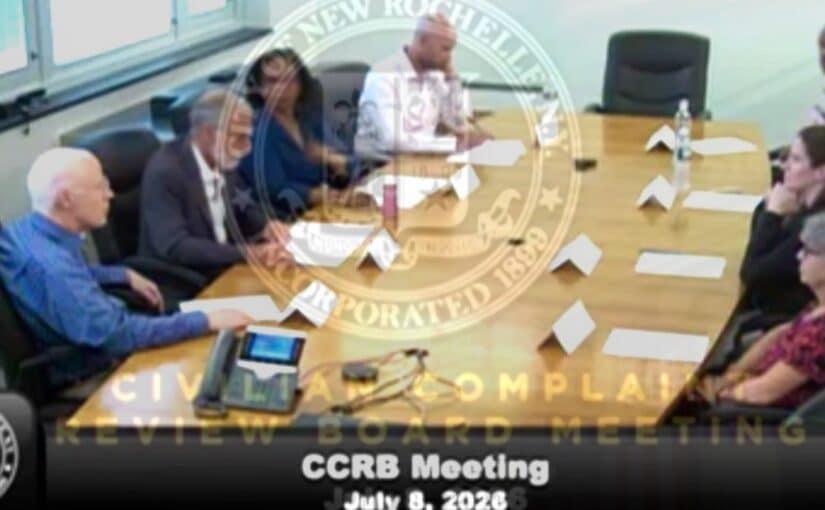
NEW ROCHELLE, NY (July 10, 2026) — The New Rochelle Civilian Complaint Review Board held its inaugural meeting Wednesday evening at City Hall, more than a year after its original seven members were first appointed (two resigned before the Board ever met) and nearly two years after the City Council adopted the ordinance creating it. The meeting lasted approximately thirty minutes and was devoted entirely to introductions, an overview of the board member’s activities to date, and a preliminary discussion of bylaws and committee structure. No cases were reviewed. No bylaws were adopted. No semi-annual reports were discussed. The board’s next meeting was announced as September — two months away.
The meeting was open to the public and recorded for posting on the city’s website.
The Board
All seven members of the Board include two replacement members were present. Co-Chairperson Renée M. Baron, the District 6 representative, presided. Co-Chairperson Damon Maher, the District 3 representative, served alongside her. The five other members present were Julie L. Mercer (Mayor’s at-large appointment), Christian Walker (District 1), Donna O’Keeffe (District 2), Michael Cammer (District 4), and Fabiola C. Brito Briseno (District 5). Todd Castaldo, Deputy City Manager, attended as the city’s staff liaison to the board.
Castaldo, serving as pro-tem Chairperson of the newly-seated Board, inexplicably struggled with member’s names as he called the roll, starting with Renée M. Baron. He pronounced her name “Bah-Ron”. She immediately corrected him.
Baron opened with introductions. Members described their backgrounds and motivations for serving.
Baron said she grew up in New Rochelle and moved back 11 years ago. She did not mention she has been an associate professor at Juilliard since 2004 where she has served as the faculty advisor for Equity, Diversity, Inclusion, and Belonging initiatives since 2019.
Maher, an attorney and former Westchester County legislator, said police reform had been a significant part of his legislative portfolio and that his work on a county-wide police reform task force in the aftermath of George Floyd’s killing made this board’s work feel personally important.
Cammer said he was a long-term New Rochelle resident with concerns about policing and systemic racism. He did not mention he is a Senior Research Scientist at NYU Langone Medical Center.
Mercer identified herself as an employment attorney with a background in discrimination and harassment law. She did not mention she is Senior Employment Counsel at Omada Health.
Walker said he was from Los Angeles and lived the past five years in Europe. He is not the son of Hershel Walker who has the same full name as the CCRB member: Christian Ismell Walker.
Brito Briseno, who said she came to Pelham from the Dominican Republic thirty-five years ago, said her immigrant perspective gave her a useful vantage point on police-community relations. She did not mention she is Parish Manager/Administrative Assistant at Our Lady of Perpetual Help-St. Catharine in Pelham.
O’Keeffe spoke about her child attending the public schools and her board role as Secretary of New Rochelle Little League. She did not mention she was in the past a teaching assistant and worked for the City School District of New Rochelle
Castaldo noted he has lived in New Rochelle his entire life and has worked for the city since 2019.
Training Status
Maher provided an accounting of the board’s training to date. Members, he said, have completed approximately 38 hours of training across several sessions: a three-to-four-hour live presentation by the New York State Committee on Open Government covering open meetings law and the Freedom of Information Law; three three-hour online sessions with a representative of the National Association for Civilian Oversight of Law Enforcement, or NACOLE, covering civilian oversight history, models and organizational best practices — nine hours total; more than four hours with a Monroe University faculty member on the history of race and policing; and seven evenings of the New Rochelle Citizens Police Academy, each running approximately three hours, for a total of roughly 21 hours. Three more CPA sessions remain, adding approximately nine more hours. Members have also individually agreed to a four-hour Saturday night ride-along with a New Rochelle police officer, though Maher noted that participation is voluntary.
Maher estimated the board’s total training hours, when complete, will be approximately 50.
What Maher did not address is that the city ordinance requires NACOLE to deliver 9.75 hours of training on six specific curriculum topics — not nine hours. Nor did he address that NACOLE told the city it would not deliver certain required portions of the curriculum, and that Monroe University was brought in to cover those topics. The Monroe substitution was never authorized by a vote of the City Council, which is the only body with authority to amend the ordinance that specifies NACOLE by name as a required provider. The June 16, 2026 ordinance amendment — which restructured the board’s Co-Chairperson provisions and extended inaugural member terms — did not amend §9-117(C) or address the NACOLE shortfall in any way. NACOLE remains in the code as a required provider today.
The significance of the training gap is direct: the ordinance bars members from reviewing cases or accessing confidential Internal Affairs files until training is complete. Because the training as delivered does not comply with the ordinance as written, it is an open question whether any member is currently authorized to perform the board’s core function.
The training situation is further complicated by Cammer’s status. Appointed on June 16, 2026, Cammer joined after the CPA training cycle — which began in May 2026 — was already underway. The remaining three CPA sessions will complete the program for the original six members. A new CPA cycle typically begins in the spring. If that schedule holds, Cammer would not be able to complete the required training until spring 2027 at the earliest — meaning he would be legally precluded from participating in any case review or accessing any confidential IA files for the better part of a year after his appointment. This was not addressed at Wednesday’s meeting.
Overview of the Board’s Role
Maher provided an overview of the board’s intended function. He described the model as review-focused: the Internal Affairs Lieutenant presents completed internal investigations to the board, which then issues its opinion and a disciplinary recommendation to the Police Commissioner. The Commissioner makes the final decision. If the Commissioner’s discipline deviates from the board’s recommendation, the Commissioner is required to provide a written explanation.
Maher acknowledged the question that has followed the board since its inception: “I guess the question is that folks — everyone knows — why is this taking so long and what have you done so far?”
Bylaws and Committee Structure
Baron introduced the bylaw discussion, proposing three standing committees: a bylaws committee to draft the board’s rules of procedure; a complaint review committee to handle the initial review of cases; and an outreach committee to manage public engagement and community visibility.
No formal vote was taken on any committee. Baron asked members to consider where they would be best placed and said the committee assignments would be finalized at a future meeting.
Maher noted that the board would follow Robert’s Rules of Order and said he had ordered laminated Robert’s Rules reference cards — “place mats,” he called them — for every member from Amazon, though they had not arrived in time for Wednesday’s meeting.
Maher also acknowledged a fundamental tension in the Co-Chairperson structure: “only one person can preside at a meeting.” He proposed an alternating model — month to month. Baron said every six months. No formal decision on the alternating schedule was made at the meeting. The question of who presides at any given meeting remains unresolved.
The practical consequence of not adopting bylaws on Wednesday is significant: the city ordinance requires the board to adopt rules of procedure before it can conduct any business. The bylaws committee has not been formally constituted, no deadline for producing a draft has been set, and the next meeting is two months away. The board remains legally unable to act on any complaint in the interim.
Website and Communications
Castaldo told the board that a city webpage for the CCRB already exists and currently contains member identities, the adopting legislation including the June 16 amendment, agendas, agenda packets, and minutes. Several members appeared unaware the page existed.
Members do not yet have city email addresses. Castaldo said IT accounts would be activated after a brief training webinar — approximately 15 to 20 minutes — but that the accounts would be shut off if the training was not completed. Without city email addresses, there is currently no public-facing way for a civilian to contact any member of the board created to receive civilian complaints.
Public Comment
Despite public comment not being on the agenda and Robert’s Rules not having been adopted, Maher made a motion to allow members of the public to speak. A voice vote was taken. The motion was declared passed by Baron, and two speakers addressed the board.
The first speaker, Gene Tozzi, who identified himself as having been active in police reform advocacy since 2001, said he had been “harassing various public officials to get your training done” and wished the board well. The second speaker, Daphne Torres-Douglas, identified herself as part of New Rochelle Against Racism and said the board had been a long-sought goal for her organization. She expressed enthusiasm for the board’s formation and said she was “hoping that you all would be meeting more regularly” but that “quarterly as we are landing” was acceptable.
No member corrected Torres-Deklas’s characterization of the board’s meeting frequency as quarterly. The ordinance requires the board to meet at least once a month. The board’s announced next meeting in September is two months away — already inconsistent with the monthly requirement, and considerably less frequent than quarterly for much of the period since the board was seated.
NewROAR — New Rochelle Against Racism, stylized with “ROAR” in capitals — is a local police accountability advocacy organization whose members have long pushed for the creation of a civilian oversight board. Two of the Council Members most directly responsible for the current CCRB leadership structure are publicly identified NewROAR members: David Peters, the District 3 representative who moved both the appointment resolution and the code amendment at the June 16 City Council meeting, is the founder and past leader of NewROAR; Shane Osinloye, the District 4 representative who recommended Cammer’s appointment and seconded the resolution, appears on NewROAR’s published membership list. Daphne Torres-Deklas, who offered enthusiastic support at Wednesday’s meeting as one of two public commenters, also appears on NewROAR’s published membership list. Co-Chairperson Damon Maher, while not confirmed as a formal NewROAR member, shares the organization’s perspective on police accountability — he described police reform as a central part of his legislative portfolio during his six years on the Westchester County Board of Legislators and cited his work on the county’s post-George Floyd police reform task force as a motivating factor in seeking appointment to the board. Gene Tozzi, the first public commenter, and Michael Cammer, the board’s District 4 member, have appeared at City Council meetings alongside NewROAR members and share the organization’s perspective on police accountability, though Talk of the Sound could not confirm formal membership in the organization. The result is that the public voices heard at the inaugural meeting of New Rochelle’s police oversight board, and several of the elected officials and board members who shaped its current composition, are all associated — to varying degrees including in some cases confirmed membership — with the same organization that has advocated for the board’s creation for years.
What Was Not Addressed
Wednesday’s meeting did not address a number of issues previously identified by Talk of the Sound as significant structural and legal questions facing the board:
Overdue reports: The ordinance required the board to issue a semi-annual public report by December 31, 2025, and a second report by June 30, 2026. Neither has been produced. Neither was mentioned at Wednesday’s meeting.
Annual public meeting: The ordinance required the board to hold an annual public meeting — open to the public and to City Council members — by June 30, 2026. That deadline has passed. Wednesday’s meeting was not noticed as the annual public meeting and does not appear to satisfy the requirement.
The Kane/Harper window: The board’s only currently viable founding case is Kane/Harper — the matter involving former NRPD Lieutenant Sean Kane’s documented planting of drugs on Ivin Harper in May 2024. A grand jury returned a no true bill in December 2024. Harper has filed a notice of claim and completed the pre-litigation 50-H examination required before suing a municipality. A civil lawsuit is expected imminently. Once filed, §9-122 Exception (d) will close the board’s window on the case for the duration of the litigation. The Kane/Harper matter was not mentioned at Wednesday’s meeting.
The exemption trap: The four cases that created public demand for a CCRB — McKenna/Flowers, Vaccaro/Fogg, Conn/Garris, and Kane/Harper — are all exempt from CCRB review under §9-122. New York Executive Law Section 70-b now requires the state Attorney General to investigate every officer-involved death, meaning every future fatal police shooting in New Rochelle will automatically be exempt from CCRB review from the moment it occurs. This structural issue was not addressed.
Independent legal counsel: The ordinance does not authorize the board to retain its own outside legal counsel. The board’s only legal advisor is the Corporation Counsel’s office, which simultaneously represents the city in litigation involving current and former NRPD officers whose conduct falls within the board’s mandate. This was not addressed.
The collective bargaining question: In November 2020, the city’s own outside labor counsel, Vincent Toomey, warned in writing that giving a civilian board authority over police discipline could trigger mandatory collective bargaining obligations with the police unions. That warning has never been publicly resolved. The police unions have not challenged the CCRB to date — but only because the board has never taken any disciplinary action. The first time it does, that warning may be the first argument the unions make. This was not addressed.
Resolution 2025-102 contradiction: The resolution that created the original board membership states that members “may be” a present or former law enforcement officer — directly contradicting the ordinance’s requirement that “no member may be” one. That contradiction has never been corrected. It was not mentioned Wednesday.
The June 16 sequencing defect: At the June 16 City Council meeting, the resolution appointing Baron and Maher as Co-Chairpersons (Item 17) was voted on before the ordinance creating the Co-Chairperson position (Item 21) had been adopted. The resolution’s own recitals stated the code had “already” been amended at a moment when it had not yet been voted on. The validity of the appointments under that sequence has not been publicly addressed. It was not raised Wednesday.
No complaint intake mechanism: There is currently no public-facing way to file a complaint with the board. No email address, phone number, or complaint form has been made public. This was noted implicitly in the email discussion but not resolved.
Payroll: The city’s Finance Department recently confirmed to Talk of the Sound via a Freedom of Information Law request that no payroll, tax, or payment-setup records exist for any CCRB member, despite a compensation requirement in effect since the board’s creation. The June 16 amendment set stipend amounts of $2,000 annually for Co-Chairpersons and $1,500 for members. Whether payment infrastructure now exists was not addressed Wednesday.
Adjournment
Baron moved to adjourn. A motion was seconded. Baron called for a voice vote and declared the meeting adjourned — then caught herself: “We gotta vote. Oh, we have to vote, I’m sorry. I need those Robert’s Rules orders.” A formal vote was then taken and the meeting was adjourned.
The board’s next meeting has not been formally scheduled. Castaldo and Baron both indicated it is anticipated for September — two months away. Under §9-118(A) of the city code, “The CCRB will meet at least once a month, on a schedule to be determined by the Chairperson.” The board’s announced September timeline would put it immediately out of compliance with that requirement, and no one at Wednesday’s meeting — including the city’s own staff liaison — noted the conflict.
RELATED
This article was prepared with the assistance of AI tools under the direction and editing of Robert Cox.
Have information about this story? Email robertcox@talkofthesound.com or contact via WhatsApp: +353 89 972 0669.