
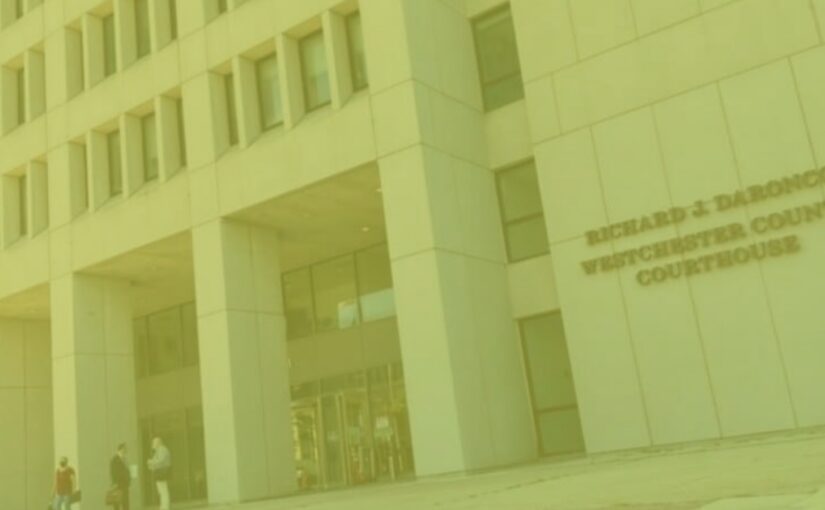
WHITE PLAINS, NY (August 14, 2026) — A Westchester County Supreme Court judge has ordered the City School District of New Rochelle to submit unredacted copies of its Shrub Oak International School legal invoices directly to the court for private review, after the district’s public version of the records left nearly every dollar figure blacked out.
Acting Supreme Court Justice Sheralyn Pulver issued the order in a Court Notice filed August 13, 2026, directing the district to produce an unredacted version of the invoice records at issue in the case for in camera review — a process in which a judge examines withheld or redacted material privately to determine whether it was properly shielded from disclosure — by August 21, 2026. The order applies to records identified as Exhibit A to the district’s Answer, filed with the court as NYSCEF Document No. 34.
The case, Robert A. Cox v. City School District of New Rochelle et al., Index No. 57316/2026, is an Article 78 proceeding brought under New York’s Freedom of Information Law (FOIL) by Robert Cox, publisher of Talk of the Sound and Words in Edgewise.
Background
The case stems from three FOIL requests Cox submitted to the district on October 8, 2024, seeking legal invoices and payment records related to Shrub Oak International School dating to 2019, emails between the district and Shrub Oak employee Lauren Koffler, and timesheets and paychecks for aides who accompanied students traveling to and from the school.
The requests followed years of reporting by Cox, beginning in 2020, on the district’s placement of four autistic students at Shrub Oak, a private therapeutic school in Mohegan Lake that is not on New York State’s list of approved special education schools. According to Cox’s reporting, the placements began in 2019 and continued even after state education officials directed the district to remove the students that same year. Cox has reported that the district spent $3,328,452.60 on the placements — $2,858,151.70 in tuition and $470,300.90 in transportation and aide costs — in violation of state law.
The district acknowledged the October 2024 FOIL requests but issued more than a dozen extensions over the following 14 months, repeatedly citing the “voluminous” nature of the records sought, according to court filings. Cox filed an administrative appeal on December 29, 2025, citing constructive denial due to the delay.
On January 12 and 13, 2026, the district produced approximately 543 pages of emails and 380 pages of legal invoices. According to Cox’s court filings, the invoice production, prepared by the district’s outside counsel, Ingerman Smith, LLP, was redacted almost in its entirety. A review of the full 380-page production identified only five visible dollar figures in the entire document — three individual line items ($66, $396 and $45) and two hourly billing rates ($220 and $225 per hour) — with no invoice totals or subtotals disclosed anywhere. The email production was described in court filings as facially incomplete, with missing attachments and broken threads.
Cox filed a second administrative appeal on January 14, 2026, challenging the adequacy of the production and the scope of the redactions. The district did not respond within the 10-business-day period required under Public Officers Law § 89(4)(a), which under the statute constitutes a denial by operation of law. Cox commenced the Article 78 proceeding on February 11, 2026.
The district moved to dismiss the petition on March 27, 2026, arguing the matter was moot because records had been produced, that there had been no final agency determination, and that the petition failed to state a cause of action. Cox filed opposition papers on April 3, 2026.
In a Decision and Order dated April 28, 2026, Justice Pulver denied the district’s motion to dismiss as to the legal invoices claim, finding that Cox had exhausted his administrative remedies and that live controversies remained regarding the breadth of the redactions and the completeness of the production. Two related claims in the case, concerning the emails and the aide payment records, were dismissed on procedural grounds because Cox had not completed the administrative appeal process on those specific issues before filing suit; those dismissals did not affect the legal invoices claim.
The district filed a Verified Answer on May 20, 2026, asserting that the redactions were necessary to protect attorney-client privileged communications and to remove material characterized as non-responsive to the request. According to Cox’s court filings, the Answer did not include a sworn statement from any attorney who reviewed the invoices and determined that specific entries were privileged, an affidavit from any records custodian describing the search and review process, a privilege log or comparable index identifying the basis for specific redactions, or any identification of which entries were redacted as privileged versus non-responsive.
Cox filed a Reply Affirmation on June 3, 2026, laying out what the invoice production showed and asking the court to require the district to submit a sworn evidentiary showing — including a privilege log or comparable document — providing particularized justification for each category of redaction, or, in the alternative, to conduct an in camera review of the unredacted records.
The August 13, 2026 Court Notice adopts the latter course, directing the district to submit the unredacted invoice records to Justice Pulver for private review by August 21, 2026.
The matter remains pending before Justice Pulver.
RELATED
This article was prepared with the assistance of AI tools under the direction and editing of Robert Cox.
Have information about this story? Email robertcox@talkofthesound (preferred) or contact via WhatsApp: +353 089 972 0669.
Discover more from Talk of the Sound
Subscribe to get the latest posts sent to your email.