

NEW ROCHELLE, NY (August 14, 2026) — As the New York State Comptroller’s office begins an audit of New Rochelle’s finances, journalist Robert Cox has filed three new Freedom of Information Law requests seeking city financial records, adding to a nearly yearlong struggle over what the city has and has not disclosed about its finances.
The Comptroller’s office confirmed the audit Wednesday. “I can confirm we are going to do an audit,” Mark Johnson, press secretary for Comptroller Thomas DiNapoli, said in an email, adding that he could not comment further.
The audit follows a formal complaint Cox filed with the Comptroller’s Division of Investigations on June 10, alleging financial mismanagement by the city, including an unauthorized interfund transfer, budget overspending, repeated internal-control weaknesses identified by the city’s outside auditor, and a sharp decline in the city’s fund balance.
What’s Changed Since the Complaint?
Twenty days after Cox’s complaint, on June 30, the city’s outside auditor, EFPR Group, issued the 2025 Annual Comprehensive Financial Report (ACFR), giving the city’s finances an unmodified, or “clean,” audit opinion. The report was signed by Finance Commissioner Alistair Featherstone and Deputy Finance Commissioner Adam Ross. City officials confirmed to Cox that Ross has given notice and is expected to leave city government in the coming weeks.
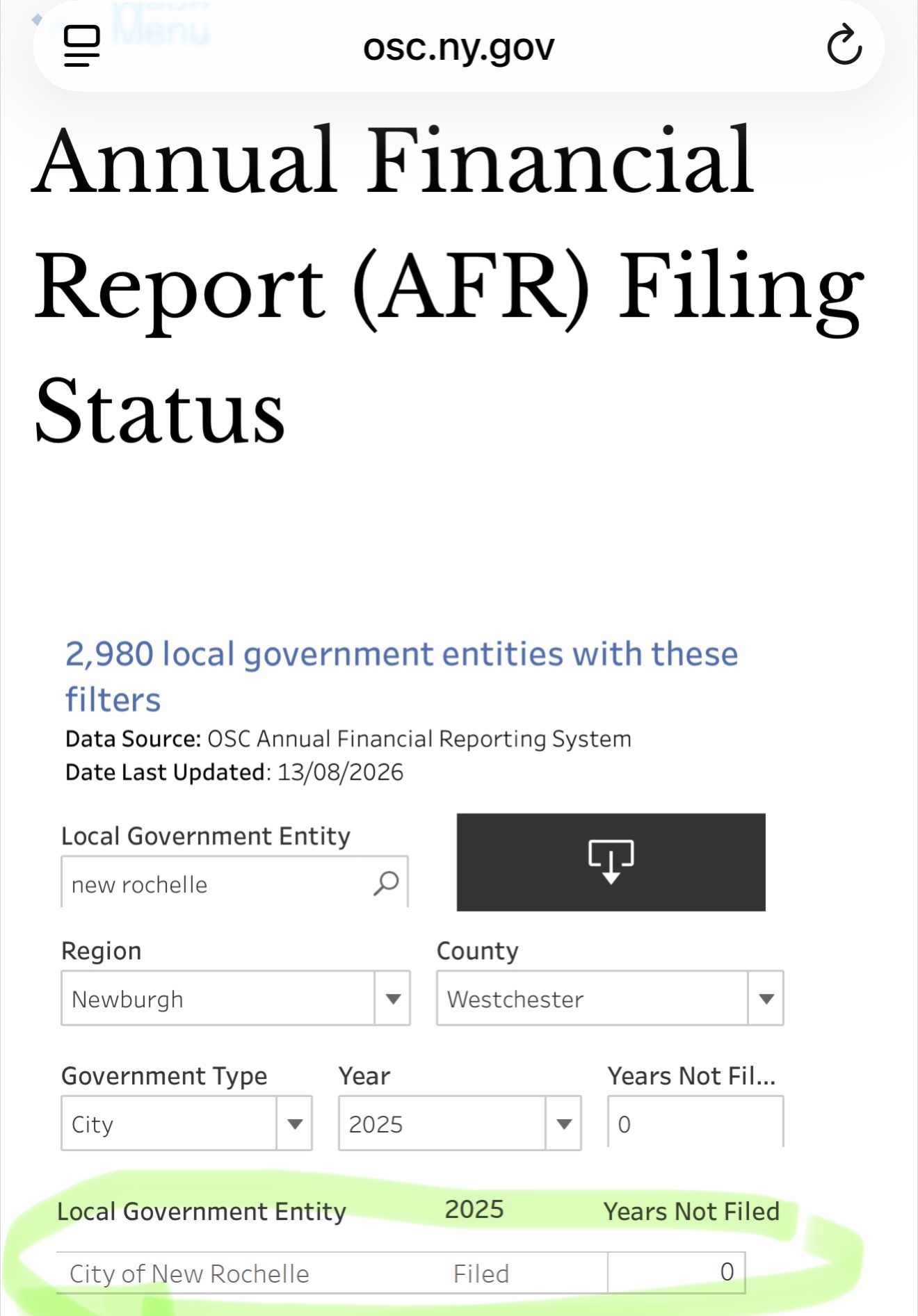
Separately, New York State Comptroller data (search “New Rochelle”) shows the city’s 2025 Annual Update Document — a statutory fund-level filing distinct from the ACFR — was filed on time, with zero years outstanding, according to OSC’s filing-status system as of August 13.
The ACFR’s unassigned fund balance figures also require context the complaint’s original framing didn’t have available. The complaint cited a roughly 63% decline in the city’s unassigned fund balance between 2023 and 2024 — from about $24.5 million to $10.5 million — over the course of the Ramos-Herbert administration’s first year. That decline reflects real spending and transfer activity during that period.
The FY2025 ACFR shows unassigned fund balance at $23.1 million by year-end, and attributes the increase to “revenue recognition related to the ARPA funding.” The city’s unearned revenue liability fell by roughly $22.8 million over the same period, from $25.4 million to $2.6 million — consistent with previously received ARPA funds, held on the books as a deferred liability, being recognized as earned revenue in 2025 rather than new money arriving or reserves being rebuilt through improved fiscal management. The 2024 decline and the 2025 increase are not directly comparable: one reflects a real reduction in available reserves, the other a one-time accounting recognition of funds the city already had. The underlying issues raised in the complaint — the interfund borrowing, the budget overspending, the repeated material weakness — are not addressed by this figure.
But the ACFR itself references a second report that has not been made public: EFPR’s “Report on Internal Control Over Financial Reporting and on Compliance and Other Matters,” also dated June 30, 2026, prepared in accordance with Government Auditing Standards. The ACFR states the report exists but does not include it, and the city has not posted it separately, unlike similar reports it has made public for other city-affiliated entities, including the New Rochelle Corporation for Local Development and the New Rochelle Industrial Development Agency.
New York’s Freedom of Information Law sets a floor, not a ceiling, on what a municipality can disclose. FOIL compels a government body to produce specific records that are not exempt when a request is made; it does not prevent a municipality from proactively publishing any non-confidential record it chooses, with or without a request. The internal-control reports the city has posted for the CLD and the IDA are examples of exactly that — voluntary disclosure, not something FOIL required in those instances. The city has not yet been asked, and has not yet declined, to release its own internal-control report; as of this writing, it simply has not chosen to post it, the way it has for those component units.
That omission points to a gap between what the public was shown on June 9 and what the city ultimately filed. At the June 9 meeting, EFPR’s presentation to the Council itemized three specific findings by number: finding 2025-002, an interfund transfer from the Capital Projects Fund to the General Fund found to violate New York Local Finance Law § 165.10; finding 2025-003, budget overspending in the General Fund and Section 8 fund in violation of the City Charter; and finding 2025-001, a material weakness in internal controls reflected in 78 adjusting journal entries in 2025, following 97 the year before. A review of the full 163-page ACFR filed June 30 shows none of that findings detail — the specific findings numbers, the statutory citations, or the adjusting-entry counts — appears anywhere in the document. The dollar figures and fund balances presented in the ACFR match what EFPR told the Council on June 9. The compliance findings that gave those figures their significance do not appear in the ACFR at all; they exist only in the separate internal-control report that remains outside public view.
What was the Council Was Told About Fund Balance?
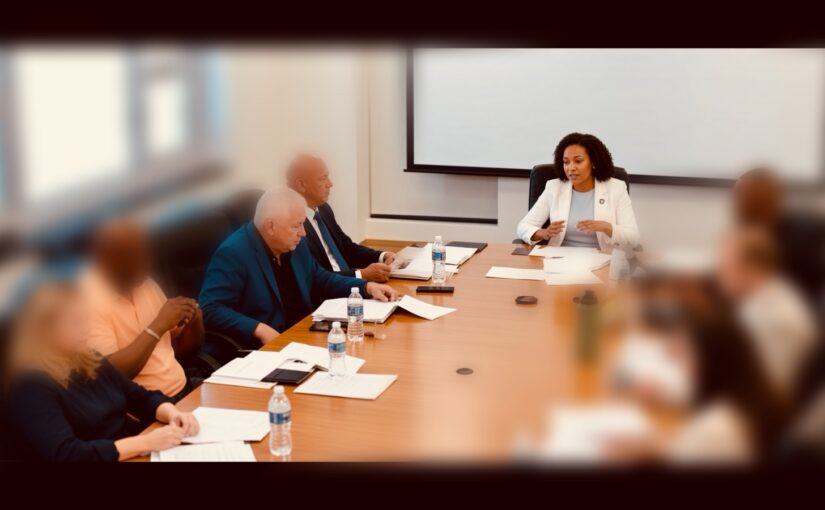
Video of the June 9 meeting shows several exchanges about the city’s fund balance that, in this reporter’s view, left the numbers less clear rather than more so — for the Council and for anyone watching. Readers can judge for themselves; the video is above.
Council Member Martha Lopez-Hanratty asked EFPR partner Thomas Smith to explain the difference between the “nonspendable” and “unassigned” categories of fund balance. Smith explained that nonspendable fund balance represents money that has effectively already been spent in an accounting sense — his example was a January health insurance bill paid in December, creating a prepaid asset that shows up in the fund balance total but isn’t available to spend again. Lopez-Hanratty then restated it back: “So it’s we have the money we are not going to be on the negative — that means the money’s there, it’s just that we have not spent it.” Smith replied, “Exactly.” That restatement inverts what Smith had just described. Nonspendable fund balance isn’t money sitting available, waiting to be spent — it’s money already committed or consumed in a form that makes it unavailable as cash.
Council Member Matt Stern asked, twice, approximately how much fund balance the city had “today.” He was told fund balance is a fiscal year-end snapshot that moves throughout the year based on when tax collections and expenses hit, and that “if we were to close shop today, we have more revenues than expenses, so fund balance would be higher.” Stern’s question was never given even an approximate figure.
Council Member Albert Tarantino asked how much the General Fund and Section 8 Fund overspent their budgetary authorizations — the dollar figure behind finding 2025-003. A member of the audit team responded by explaining that the finance commissioner and treasurer transition had happened at year-end, creating a gap in year-end responsibilities, and that the city planned to do more frequent mid-year reviews going forward. No dollar figure was given, then or later in the meeting.
The meeting’s final several minutes, after Stern’s questions, involved an exchange involving Mayor Yadira Ramos-Herbert, Tarantino, the finance commissioner, and members of the audit team about how ARPA funding factors into the reported fund balance. At one point, a figure of “closer to 22 million” was given as the amount ARPA revenue added to the fund balance in 2025. The meeting later reconvened after City Manager Todd Castaldo caught an apparent error in what the finance commissioner had told the Council and pulled him aside; the finance commissioner then returned and stated, on the record, that 2025 ARPA expenditure was $6 million, moved into the Capital Projects Fund for one-time capital spending, with $1.8 million of that grant remaining for 2026. He reaffirmed the city’s total fund balance at $33.9 million — “not 20.” It is not clear from the video whether that correction addressed the earlier $22 million figure, corrected a different number entirely, or answered a different question than the one originally asked.
What is clear, despite the back-and-forth, is what didn’t happen: Tarantino asked how much cash the city actually has available to spend in a genuine emergency — the undesignated portion of the fund balance, not the topline number. Between the original answers, the reconvened meeting, and the finance commissioner’s corrections, that question was never answered. It joins Tarantino’s other unanswered question from the same meeting — how much the General Fund and Section 8 Fund actually overspent their budgets. Two direct questions, two non-answers, on the record, at the same meeting.
A Pattern of Denials
The fight over financial records predates the audit. Request No. 26-1060 was received by the City on June 11, 2026; the City denied it on July 13, appealed on July 15, and City Manager Melendez signed a final denial on July 29, which Cox received on July 31.
Cox’s June 11 request sought a draft financial statement that Thomas Smith, a partner at EFPR Group, consulted and read from while answering a City Council member’s question about the audit at a June 9 Committee of the Whole meeting. On July 13, the City denied the request, calling the document a “non-final intra-agency document” exempt under Public Officers Law § 87(2)(g). Cox appealed on July 15, arguing that Smith’s public use of the document waived any claim to withhold it — a well-established principle under the Open Meetings Law: once a document is produced, discussed, or worked from during a public meeting, any claim that it remains non-public is waived.
City Manager Melendez signed a final administrative determination denying the appeal on July 29, which Cox received on July 31. In his denial, Melendez argued the record did not qualify for FOIL’s exception to the intra-agency exemption — an exception that specifically carves external audits out of § 87(2)(g)’s protection, meaning such records must be disclosed. Melendez’s stated basis: that the City, not an outside party, had retained EFPR to perform the work. That reasoning does not distinguish this audit from any external audit — an outside auditor is, by definition, retained by the client it audits. Applying Melendez’s logic, no external audit performed for the City could ever qualify for the exception, which would read the exception out of the statute altogether.
That denial came as Cox and the city are already in litigation over FOIL. A separate, consolidated Article 78 proceeding covering 24 other FOIL requests — mass-denied then denied again on appeal by Melendez — has been filed, accepted by the court, assigned a judge, and is being served on the city this week.
The dispute over FOIL requests also figures into a separate federal lawsuit. In August 2025, Warren and Commissioner of Development Adam Salgado sued Cox, Talk of the Sound, and Words in Edgewise for defamation in the U.S. District Court for the Southern District of New York, a case that traces back in part to disputes over FOIL requests Cox filed with the city. Twenty-four of those requests are now the subject of the consolidated Article 78 proceeding described above.
That lawsuit itself has become a records fight. In December 2024, the City Council voted 5-2 to authorize unlimited taxpayer funding for the litigation against Cox. On August 12, 2026, Cox filed FOIL Request No. 26-1496 seeking records from March 25, 2024 to the present concerning how that funding was authorized, including internal communications, memoranda, drafts, and correspondence with outside counsel related to the Council’s decision.
The pattern extends beyond finance. Cox also has a pending Article 78 proceeding, filed in Westchester County Supreme Court, seeking developer Bob Young’s response to the city’s request for proposals to redevelop Flowers Park — a case that has followed a similar arc of FOIL denials and city inaction.
Three New Requests
On Friday, Cox filed three additional FOIL requests targeting specific financial transactions disclosed in the ACFR:
- Request No. 26-1514, seeking the EFPR internal-control report referenced in, but not included with, the ACFR.
- Request No. 26-1515, seeking records and correspondence concerning the roughly $20 million interfund borrowing described in a note to the ACFR, in which the General Fund borrowed from the Capital Projects Fund to cover a final tax warrant payment to the school district.
- Request No. 26-1516, seeking records concerning an outstanding receivable owed to the city by Twining Properties, connected to the Pratt Landing development, including payment status and any collection efforts.
RELATED
State Comptroller Confirms Audit of New Rochelle Following Complaint by Cox (8/14/2026)
FORMAL COMPLAINT TO THE NEW YORK STATE OFFICE OF THE STATE COMPTROLLER (6/10/2026)
New Rochelle Audit Flags Illegal Fund Transfer, Budget Violations as Financial Troubles Continue (6/9/2026) Finance & Auditor presentation in June again show significant audit adjustments and material weakness.
New Rochelle Touted Strong Finances as Fund Balance Collapsed Before Audit Was Finalized (3/18/2026) Finance & Auditor presentation last fall highlighted a “clean audit,” but the 2024 financial report shows a $179 million deficit, sharply reduced reserves and significant audit adjustments.
Butcher’s Bill Comes Due for New Rochelle Democrats (Sept. 7, 2025) Analysis of financial decisions and policies contributing to mounting fiscal pressures
New Rochelle Fund Balance Q&A Devolves Into Unintelligible Mush (Sept. 10, 2025) City officials struggle to explain declining fund balance during a contentious public discussion
Hidden Audit Presentation Records Released by New Rochelle(Sept. 11, 2015) Previously undisclosed audit presentation materials reveal internal concerns and financial reporting issue.
New Rochelle Annual Comprehensive Financial Report December 31, 2024 (Nov. 5, 2025) Official financial report showing a $179 million negative net position, sharply reduced reserves and audit-related adjustments.
This article was prepared with the assistance of AI tools under the direction and editing of Robert Cox.
Have information about this story? Email robertcox@talkofthesound (preferred) or contact via WhatsApp: +353 089 972 0669.