

Sustainable Westchester customers saved millions when energy markets spiked, then gave it all back as fixed CCA prices exceeded utility rates
WESTCHESTER COUNTY, NY (August 26, 2026) — New York regulators concluded this week that customers enrolled in Community Choice Aggregation electricity programs statewide paid roughly $116 million more than they would have paid for default utility service.
Now, the state’s underlying data show what happened closer to home.
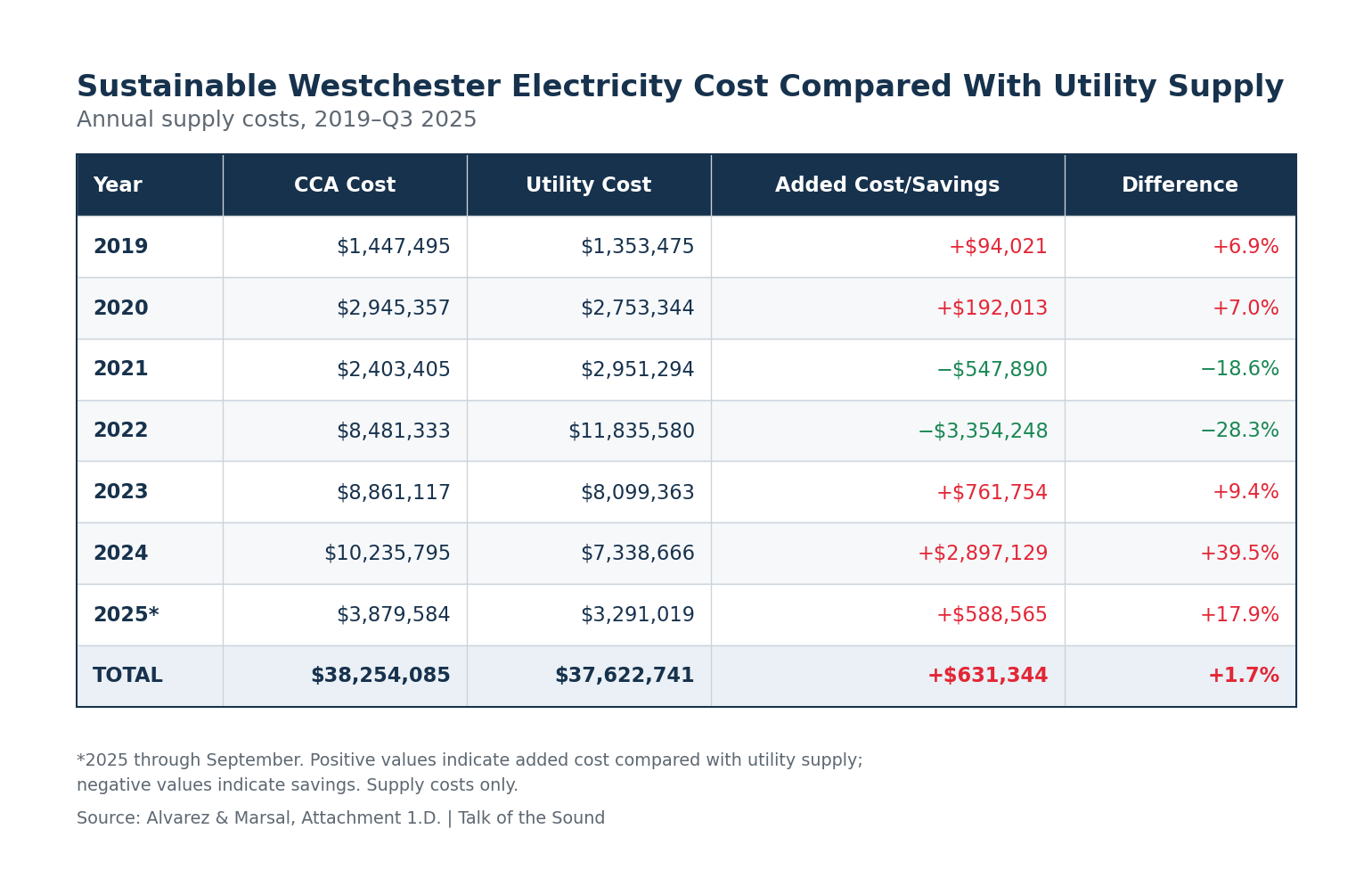
Customers enrolled in electric CCA programs administered by Sustainable Westchester paid approximately $38.25 million for electricity included in the state analysis, compared with approximately $37.62 million for the same electricity at the applicable utility rates.
The difference was $631,344 in additional costs to Westchester Power customers, or approximately 1.7%.
But that relatively modest bottom-line difference obscures something much more interesting.
Westchester Power customers experienced enormous swings between savings and additional costs depending on what happened in energy markets after Sustainable Westchester entered into fixed-price electricity contracts.
Customers saved $3.35 million in 2022 alone. Two years later, they paid nearly $2.9 million more than they would have paid for utility supply.
By the end of the period examined by the state, the additional costs had erased the savings.
The findings offer a rare opportunity to measure the financial performance of Westchester Power, the flagship electricity program operated by nonprofit Sustainable Westchester and the first Community Choice Aggregation program established in New York.
Westchester Power by the Numbers
The figures come from an analysis conducted for the New York State Department of Public Service by Alvarez & Marsal as part of the state’s comprehensive review of Community Choice Aggregation.
The consultant separately analyzed Sustainable Westchester’s electric CCA programs in Attachment 1.D of its report.
The analysis covers approximately 512.6 million kilowatt-hours of electricity purchased through Sustainable Westchester programs during the period examined.
This Is the Supply Part of Your Electric Bill
There is an important distinction in understanding these numbers.
The state’s comparison concerns only the electricity supply portion of customers’ bills, not their total electric bills.
A typical electric bill contains separate charges for the electricity itself and for delivering that electricity over the poles, wires and other infrastructure operated by the regulated utility. Westchester Power changed the electricity supplier and supply price; the regulated utility continued providing delivery service and charging customers for it.
Therefore, a finding that Westchester Power’s supply cost 39.5% more than utility supply in 2024 does not mean customers’ total electric bills were 39.5% higher.
Sometimes Westchester Power Came Out Far Ahead
The program clearly saved customers money during portions of the period examined.
In 2021, Sustainable Westchester customers saved approximately $548,000 compared with utility supply.
Then came 2022.
Customers paid approximately $8.48 million through Sustainable Westchester for electricity that the consultant calculated would have cost approximately $11.84 million at utility rates.
That was a savings of approximately $3.35 million, or 28.3%.
The timing is significant.
Sustainable Westchester itself described 2022 as an extraordinarily volatile period for energy markets. During presentations to municipalities as the organization worked to restart CCA contracts that year, its officials pointed to turmoil following Russia’s invasion of Ukraine as a major factor disrupting energy markets and the procurement process.
Westchester Power’s existing fixed prices looked extremely attractive as utility supply prices surged.
Then Westchester Power Fell Far Behind
The advantage didn’t last.
In 2023, Sustainable Westchester customers paid approximately $762,000 more than utility supply.
Then came 2024.
Customers paid approximately $10.24 million through Sustainable Westchester for electricity the consultant calculated would have cost approximately $7.34 million at utility rates.
The difference was nearly $2.9 million — 39.5% more for the supply portion of customers’ bills.
Some individual months were substantially worse.
In November 2024, Sustainable Westchester’s supply cost approximately 82.5% more than the comparable utility supply cost. In December, the difference was approximately 68.5%.
Through September 2025, customers were running approximately $589,000 above utility supply costs for the year.
Fixed Prices Did Not Eliminate Risk
Those dramatic swings help explain something fundamental about Westchester Power.
Sustainable Westchester promoted fixed electricity prices as providing customers with stability and protection from volatile energy markets.
And the CCA price really was fixed.
Once Sustainable Westchester entered into a supply contract, the price was locked for the duration of that contract, typically about two years. Meanwhile, the market — and the utility supply price against which the CCA contract was ultimately measured — continued moving.
In financial terms, Westchester Power was essentially replacing a floating electricity supply price with a fixed one.
That provided certainty about the price customers would pay, but certainty did not eliminate risk. It changed the nature of the risk.
If market prices subsequently rose above the fixed CCA price, customers benefited from having locked in the lower price. If market prices fell below it, customers remained locked into the higher price and lost the opportunity to benefit from lower utility rates.
A fixed-rate bond offers a useful analogy.
An investor who buys a 10-year bond knows the interest rate the bond will pay. If market interest rates subsequently fall, that locked-in rate becomes increasingly attractive. But if market rates rise substantially, the investor remains locked into the lower rate and gives up the opportunity to earn the higher return available elsewhere.
The fixed rate itself hasn’t changed. The market around it has.
Westchester Power worked on much the same principle.
The state’s data show both sides of that trade dramatically. Sustainable Westchester customers benefited enormously when utility supply prices surged in 2021 and 2022. When utility prices subsequently fell below the CCA contract price, the advantage reversed.
Was It Skill — Or the Market?
That raises a more fundamental question about how Westchester Power’s performance should be evaluated.
Sustainable Westchester frequently attributed unfavorable pricing outcomes to external events affecting energy markets, including extreme weather, fuel-market disruptions and geopolitical events. In 2022, officials pointed specifically to the war in Ukraine in explaining the turmoil that disrupted its procurement.
When its fixed contracts subsequently beat utility prices, however, Sustainable Westchester presented the savings as evidence of the value delivered by its purchasing strategy.
The state data allow consumers to look at the results over a longer period.
At its peak, Westchester Power had roughly 140,000 to 150,000 customer accounts across participating municipalities. Electricity purchasing decisions therefore affected a substantial portion of Westchester County’s households and small businesses.
Those decisions were being made in markets influenced by forces far beyond Westchester County — wars, hurricanes, fuel prices, weather, generating capacity and global commodity markets.
The year-by-year results therefore raise a basic question: Was consistently beating the energy market a realistic expectation in the first place?
A favorable fixed price can look brilliant after market prices rise and terrible after they fall.
The CCA price isn’t moving.
The benchmark is.
By 2025, the Gains Were Gone
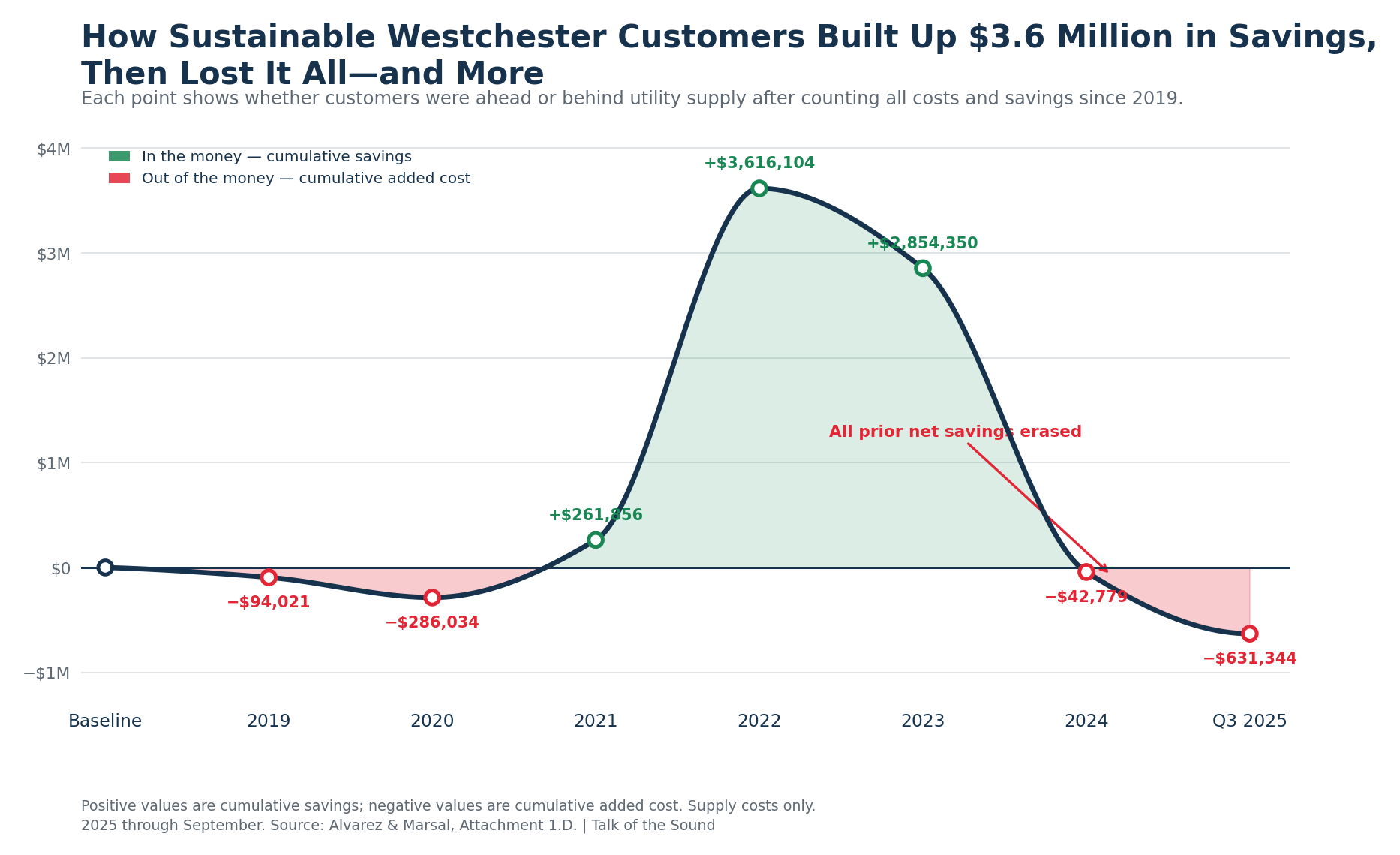
The consultant’s cumulative figures provide perhaps the clearest picture of what happened financially over the period it examined.
By the end of 2022, Sustainable Westchester customers represented in the analysis were cumulatively about $3.6 million ahead of utility supply.
Then the direction reversed.
Higher CCA costs during 2023 ate into those savings. The much larger premium during 2024 erased them.
By December 2024, the cumulative calculation had crossed from savings into additional costs.
By September 2025, Sustainable Westchester customers had paid a cumulative $631,344 more than they would have paid for comparable utility supply.
In other words, the substantial savings generated when market conditions favored the fixed CCA contracts were ultimately consumed when market conditions moved the other way.
Sustainable Westchester Had Another Answer: Renewable Energy
Sustainable Westchester consistently maintained that price was not the only measure of Westchester Power.
The program was also designed to increase the use of renewable energy.
Westchester Power’s renewable products relied on Renewable Energy Certificates, or RECs.
A REC is not a separate stream of renewable electricity physically delivered from an upstate generating facility to a particular Westchester home. Electricity generated from different sources is commingled on the electric grid.
Instead, RECs are market instruments representing the renewable attributes associated with electricity generated from eligible renewable sources. Purchasing and retiring those certificates allows the corresponding electricity consumption to be characterized as renewable under the applicable accounting system.
For Westchester Power, those RECs were an important part of the value proposition. Even during periods when CCA electricity was more expensive than utility supply, Sustainable Westchester could point to renewable energy as a reason consumers were receiving something additional for their money.
That makes another conclusion of the state’s review particularly significant.
DPS Staff concluded not only that CCA failed to produce overall statewide cost savings but that the program made no meaningful contribution toward achieving New York’s clean-energy goals.
The state review therefore challenges both sides of the CCA value proposition: what consumers paid and what New York received environmentally in return.
The State Analysis Doesn’t Cover Westchester Power’s Entire History
There is an important qualification to these numbers.
The state evaluation does not examine Westchester Power from its inception.
Sustainable Westchester began its CCA program in 2015, while the published Sustainable Westchester price analysis begins in 2019. Sustainable Westchester’s initial electricity contract was favorable to participating ratepayers and produced savings compared with utility supply.
The $631,344 figure therefore should not be described as Westchester Power’s lifetime financial result.
The broader Staff Proposal says Alvarez & Marsal analyzed CCA contracts “from 2018 to present,” while its published statewide electricity results cover 2019 through the third quarter of 2025. The report does not explain why the published analysis begins when it does.
Talk of the Sound has asked the Department of Public Service to clarify the period selected for the analysis and the Staff Proposal’s reference to 2018.
What Happened in 2022?
The extraordinary 2022 results require another qualification.
That year was not simply another 12 months under an uninterrupted Westchester Power contract.
Amid turmoil in the energy markets, Sustainable Westchester was unable to complete a new electricity procurement before an existing contract expired. Customers in affected municipalities were returned to utility supply.
Restarting the program required another municipal and regulatory process, including public outreach, customer notification and governmental action by participating communities.
That history helps explain why participation and electricity volumes in the consultant’s monthly data vary considerably during the period.
It also reinforces what the state data show about fixed-price electricity purchasing: contract timing and subsequent movements in energy markets could have enormous effects on whether customers ultimately came out ahead or behind.
What About New Rochelle—or Other Westchester Communities?
For Westchester consumers, the aggregate Sustainable Westchester result raises an obvious question:
What happened in my community?
The consultant’s published data don’t provide the answer.
Westchester Power operated through different contracting arrangements, including Con Edison municipalities outside Yonkers, a separate Yonkers aggregation and municipalities in NYSEG territory. The contract price within a particular aggregation applied across the participating municipalities in that group.
But the consultant’s published Sustainable Westchester table combines the programs rather than providing comparable cost calculations for New Rochelle, White Plains, Rye or other individual municipalities.
Talk of the Sound has asked DPS whether Alvarez & Marsal possesses more granular underlying data, including monthly customer counts, electricity consumption and the utility rates used in its calculations.
We have specifically asked whether the underlying spreadsheets contain enough information to reproduce the state’s analysis municipality by municipality.
If they do, that’s what we intend to do next.
A Note on the Data
Until that underlying information is available, the state analysis gives us an aggregate picture of Sustainable Westchester for the period studied, but not a municipality-level accounting.
For those years, the bottom line is straightforward:
Sustainable Westchester customers purchased approximately 512.6 million kilowatt-hours of electricity included in the analysis.
They paid approximately $38.25 million through CCA.
The consultant calculated that the same electricity would have cost approximately $37.62 million at the applicable utility supply rates.
Customers therefore finished the period approximately $631,344 behind.
Along the way, however, they were at one point millions of dollars ahead.
That may be the most revealing lesson in the data. Westchester Power’s fixed-price contracts could look extraordinarily successful when volatile markets moved in one direction and extraordinarily expensive when they moved in the other.
By the time the state’s analysis ended, the market had taken back everything customers had saved — and then some.
RELATED
Sustainable Westchester Articles
This article was prepared with the assistance of AI tools under the direction and editing of Robert Cox.
Have information about this story? Email robertcox@talkofthesound (preferred) or contact via WhatsApp: +353 089 972 0669.