
NEW ROCHELLE, N.Y. (Sept. 3, 2026) — Jazz Under the Stars, a city-backed summer concert series that began with an unusually expensive no-bid arrangement in 2024 before returning at a sharply lower price under competitive bidding in 2025, has quietly disappeared from New Rochelle’s summer calendar.
The absence became apparent when no Jazz Under the Stars concerts appeared in the city’s social media promotion of summer events.
A City Hall source told Talk of the Sound that organizer Clarence “Rocky” Middleton had “decided not to do it” this year.
The explanation raises an obvious question about who actually controlled a program that was presented as a city initiative and, by its second year, was subjected to competitive procurement.
Jazz Under the Stars began after Middleton, through Rocjoyful Sound Productions Ltd. doing business as Global Jazz Community (“GJC”) submitted an April 8, 2024 proposal directly to Development Commissioner Adam Salgado for weekly jazz performances at Anderson Plaza. A family member of Middleton worked for Salgado in the Development Department.
The city awarded a no-bid contract and agreed to pay Middleton’s company $101,000 for five Thursday-night concerts between July 11 and Aug. 8, 2024 — $20,200 per event. The production budget included money for entertainment, sound production, a hugely expensive Steinway grand piano, tables and chairs, event management, stage and lighting and other costs.
The agreement was later amended to add a sixth performance for another $20,200, bringing the total authorized value of the series to $121,200.
Even using a generous estimate of 40 attendees at each of the six concerts in 2024, Jazz Under the Stars would have generated only about 240 audience visits. Against the $121,200 the City authorized for the six-event series, that works out to roughly $505 for each audience member at each performance. Because some attendees likely went to more than one concert, the cost per unique person reached would have been even higher.
The financial structure offered little public visibility into how much money ultimately reached individual performers. Middleton assembled the musical acts under his GJC dba with city records identifying groups including the GJC Women Allstar Band, GJC Brazilian Jazz Project, GJC Latin Jazz Project, GJC David Lee Jones as well as the Rocky Middleton Quintet.
Records showed lump-sum amounts for bands, production and event management but did not identify what individual musicians or workers were ultimately paid.
People familiar with professional concert production who spoke with Talk of the Sound at the time expressed surprise at the amount the city was spending on the small outdoor jazz series.
The payment structure also raised a separate Charter issue. The five concerts were scheduled for July 11, July 18, July 25, Aug. 1 and Aug. 8, but the City’s payments were not tied to individual performances. A July 17 voucher sought $44,440 — a $30,300 “mobilization” payment plus a $14,140 installment — when only one of the five concerts had occurred. The City’s voucher nevertheless certified in the past tense that the services or materials “were rendered/furnished.” The resulting $44,440 check was issued July 19, while three of the five contracted performances were still in the future.
The arrangement also became entangled in questions over workers’ compensation coverage.
Middleton submitted a New York State CE-200 Certificate of Attestation of Exemption in which Rocjoyful represented that it did not need workers’ compensation coverage because, other than the owner, it had no employees, day labor, leased or borrowed workers, part-time employees, unpaid volunteers or subcontractors.
City records for the concerts, however, described bands, an event manager, stage manager, assistants, event floaters, hosts and outside production vendors.
On Oct. 31, 2024, after Talk of the Sound began investigating these sorts of no-bid contracts, Corporation Counsel Dawn Warren circulated a workers’ compensation notice to city commissioners and staff acknowledging “push back” from vendors and nonprofits over obtaining coverage and stating: “It’s not an option but a requirement.”
At the time, the original five Jazz Under the Stars concerts had already been paid. The additional Aug. 22 concert had been billed to the city for $20,200, but records obtained by Talk of the Sound showed no corresponding payment.
City Hall sources said at the time that the unpaid invoice had become the subject of an internal dispute between the Finance and Development departments. That $20,200 payment, to the knowledge of Talk of the Sound, was never made. The invoice and underlying documentation identified the Aug. 22 performance as the sixth Jazz Under the Stars event.
The contracting changed dramatically the following year.
After scrutiny of the original arrangement, the city competitively bid the 2025 Jazz Under the Stars series. The five-concert cost dropped from $101,000 in 2024 to $45,300 in 2025 — less than half the previous price.
That did not necessarily solve another problem: whether enough people were attending to justify even the reduced cost.
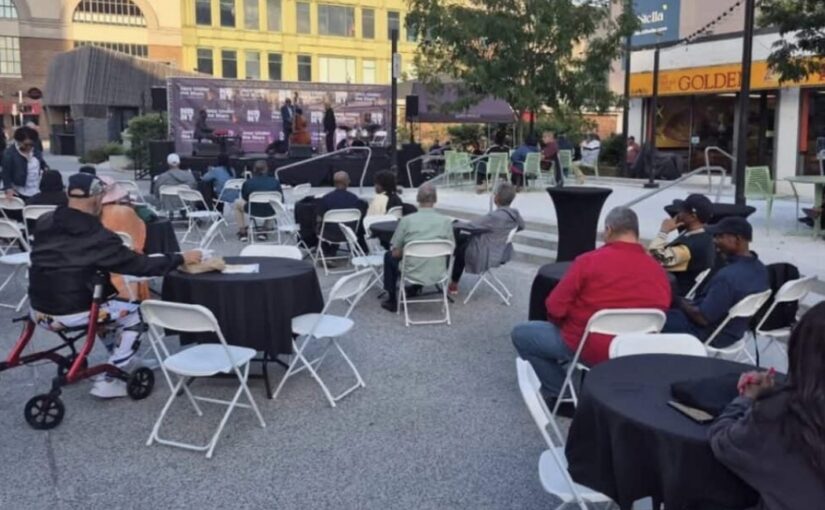
At an Aug. 28, 2025 performance at Anderson Plaza, photographs taken during the event showed four musicians performing before an audience of roughly 20 people.
Now the series is gone altogether.
The disappearance completes an unusual two-year progression: a $101,000 no-bid contract in 2024, an additional $20,200 concert whose payment became entangled in workers’ compensation questions, competitive bidding that dramatically reduced the cost in 2025, sparse attendance at least one publicly documented performance, and no Jazz Under the Stars in 2026.
The explanation that Middleton simply “decided not to do it” is particularly notable because the city’s use of competitive bidding in 2025 suggested Jazz Under the Stars had become a municipal program for which qualified vendors could compete — not a privately controlled event whose existence depended on Middleton’s willingness to continue it.
Questions also remain about the CE-200 filings, how the city handled the unpaid sixth-concert invoice, and what ultimately became of concerns raised over workers’ compensation compliance in connection with Jazz Under the Stars and other publicly funded programs.
Those unanswered questions are now also part of an Article 78 proceeding pending in New York State Supreme Court in Westchester County. Talk of the Sound publisher Robert Cox has challenged the city’s handling of 24 FOIL requests, including Request No. 26-726 for Jazz Under the Stars records. The petition alleges that the city produced records for five of the six concerts but failed to complete production of records concerning the sixth event, then later refused to consider the renewed request on the merits.
The amended proceeding, filed under Index No. 70555/2026, asks the court to annul 24 final administrative determinations issued by City Manager Wilfredo Melendez and to direct disclosure of records that are subject to FOIL.
For now, one thing is clear: after two summers and more than $160,000 in contracted spending, Jazz Under the Stars has gone silent.
This article was prepared with the assistance of AI tools under the direction and editing of Robert Cox.
Have information about this story? Email robertcox@talkofthesound (preferred) or contact via WhatsApp: +353 089 972 0669.
RELATED
The Public’s Right to Know: New Rochelle’s FOIL Stonewall — Part I (8/16/2026)
Pictures Tell the Story of Abysmal Jazz Under the Stars Event in New Rochelle (8/29/2025)
New Rochelle FOIL Request Delays: 4,451 Cumulative Days (and counting) (5/25/2025)
The New Rochelle Thimblerig — Part VI (11/25/2024)
This article was prepared with the assistance of AI tools under the direction and editing of Robert Cox.
Have information about this story? Email robertcox@talkofthesound (preferred) or contact via WhatsApp: +353 089 972 0669.