
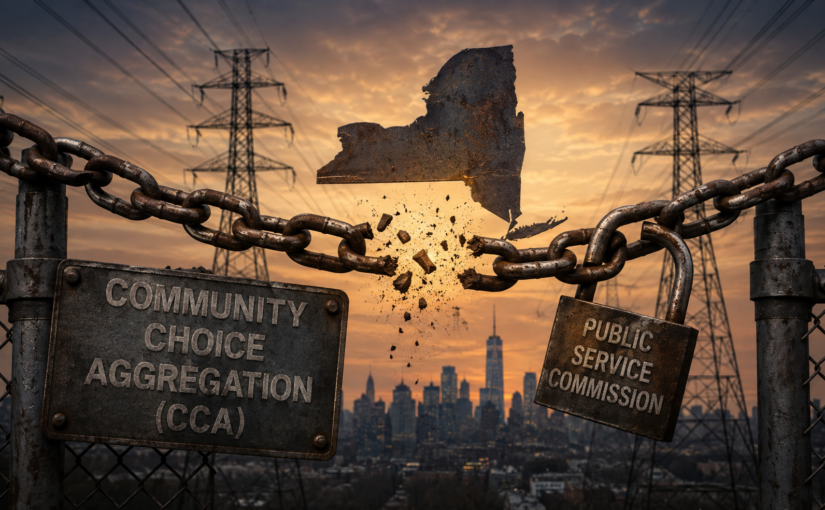
State regulators recommend killing Community Choice Aggregation after finding it failed to deliver promised savings or meaningfully advance New York’s clean-energy goals
ALBANY, NY (August 25, 2026) — One of America’s most aggressive clean-energy states spent a decade experimenting with a new way to buy electricity: automatically enroll entire communities, use their collective purchasing power to negotiate energy contracts and accelerate the transition to renewable power.
New York’s own regulators have now concluded the experiment failed.
Customers paid more. The promised savings largely failed to materialize. Regulators found recurring consumer-protection and compliance problems. And the program made no meaningful contribution toward New York’s clean-energy goals.
On Tuesday, staff of the New York State Department of Public Service recommended that the Public Service Commission formally discontinue Community Choice Aggregation, or CCA, statewide.
“Staff recommends that the Commission discontinue the CCA program in New York State,” the proposal states.
An independent evaluation found customers enrolled in CCA electric programs paid approximately $116 million more from 2019 through the third quarter of 2025 than they would have paid for default utility service.
The evaluation did not examine the entire history of New York’s CCA program. Its statewide electricity price analysis covers 2019 through the third quarter of 2025, so the roughly $116 million in additional costs identified by the review is not a lifetime calculation.
The report does not explain why the statewide analysis begins in 2019, although the Staff Proposal says the consultant analyzed CCA contracts “from 2018 to present.” Talk of the Sound has asked the Department of Public Service to clarify the period selected for the analysis and the reference to 2018.
In 2024 alone, CCA electricity cost customers 39.2% more than utility service.
The findings have implications beyond New York.
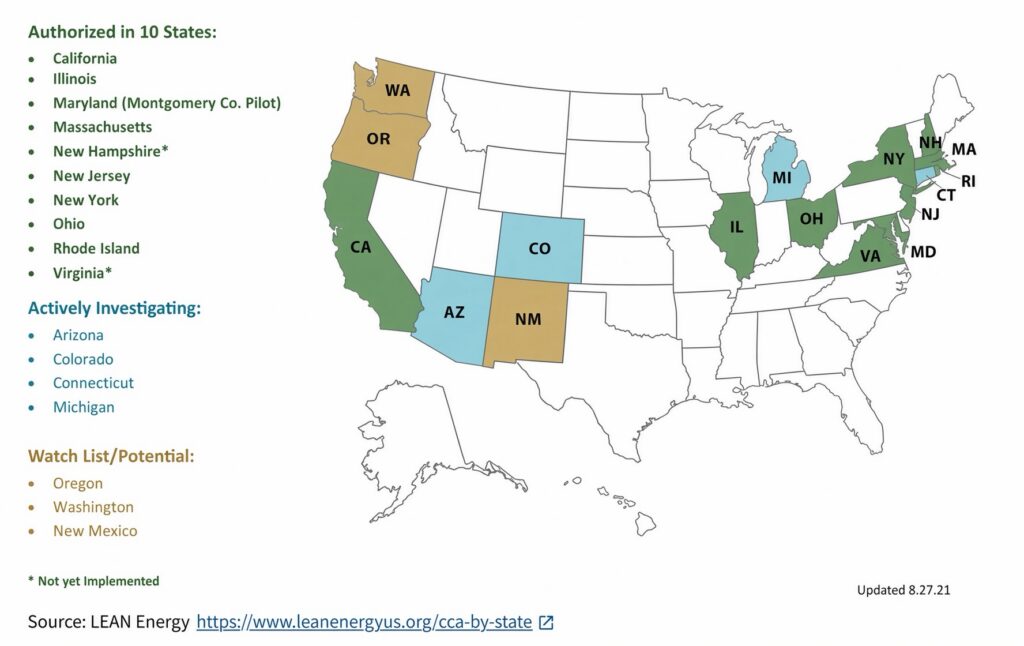
Community Choice Aggregation is authorized in 10 states — California, Illinois, Maryland, Massachusetts, New Hampshire, New Jersey, New York, Ohio, Rhode Island and Virginia — according to the U.S. Environmental Protection Agency.
EPA has described CCA as an option for communities seeking greater local control over electricity sources, more renewable energy and potentially lower electricity prices.
New York has now spent a decade putting those promises to the test.
Its regulators recommend ending the experiment.
CCA Turned Consumer Choice on Its Head
At the heart of CCA was what regulators called “opt-out enrollment,” an unusual inversion of consumer choice.
Unlike traditional consumer choice, CCA turned consent on its head: municipalities could automatically enroll residents in the program without their affirmative consent, leaving individual customers responsible for opting out if they wanted to remain with default utility service.
Rather than asking customers to sign up, municipalities automatically switched their electricity supply from the local utility’s default service to a CCA-selected supplier. Unless customers affirmatively opted out, they were in.
The regulated utility — Con Edison for much of Westchester County — continued delivering the electricity, maintaining the infrastructure and sending customers their electric bills.
That arrangement could make the change difficult for customers to recognize. Their relationship with their utility appeared largely unchanged even though the source and price of the electricity generation portion of their service had changed.
EPA itself acknowledges that opt-in versus opt-out CCA programs can be confusing to consumers.
The opt-out structure was not incidental to the New York experiment. Automatic enrollment gave CCA administrators the enormous customer base needed to aggregate demand and attempt to negotiate favorable electricity contracts.
The new state evaluation concludes that the anticipated economic benefits of that scale largely failed to materialize.
Public Can Comment Before PSC Makes Final Decision
The Staff Proposal is not the final word.
The Public Service Commission will consider the recommendation, and members of the public can submit comments in PSC Case 14-M-0224, the proceeding governing Community Choice Aggregation in New York.
For New Yorkers who participated in CCA programs — including hundreds of thousands of former Westchester Power customers — this is their opportunity to tell state regulators what their experience was and whether they believe CCA should be permanently discontinued.
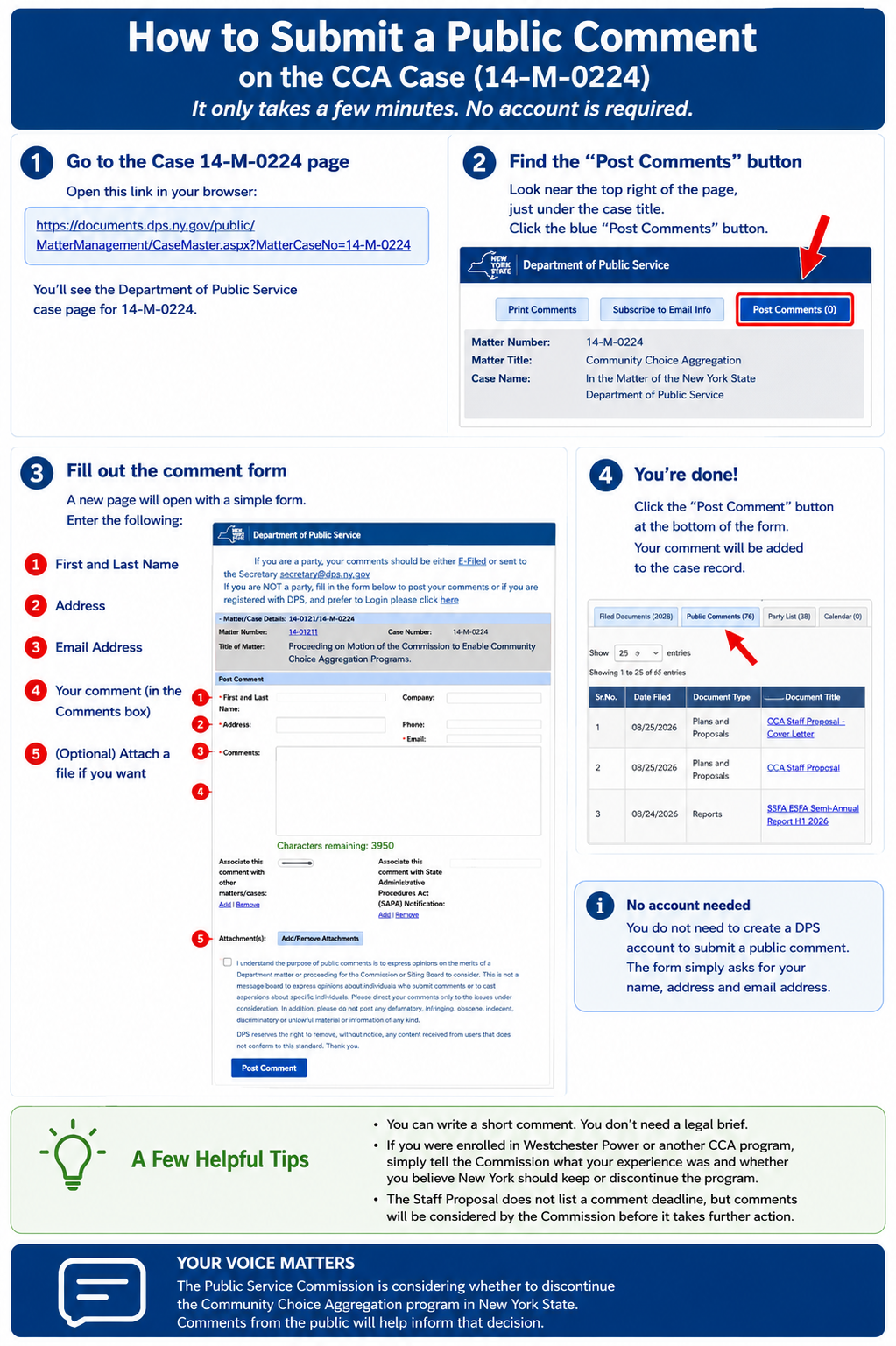
To comment, go to the Public Service Commission page for Case 14-M-0224 and select “Post Comments.”
You do not need to write a legal brief. Ratepayers can simply describe their experience with the program and tell the Commission whether they believe New York should retain or discontinue Community Choice Aggregation.
The Staff Proposal does not state a deadline for comments. Talk of the Sound has asked DPS to confirm the deadline and will update this article when that information is provided.
EPA Asked About National Implications
Talk of the Sound has also asked the U.S. Environmental Protection Agency whether New York’s findings have implications for Community Choice Aggregation programs elsewhere in the country.
EPA was asked whether it continues to view CCA as an effective clean-energy and cost-saving mechanism; whether automatic opt-out enrollment raises consumer-consent concerns; whether the agency has examined CCA costs and renewable-energy benefits nationally; and whether New York’s findings will prompt EPA to reconsider its current guidance on the program.
EPA was also asked whether other states have conducted comprehensive evaluations comparable to New York’s review.
EPA had not responded as of publication.
This article will be updated with any response.
Customers Paid $116 Million More
The numbers underlying the recommendation are stark.
An independent evaluation by Alvarez & Marsal found that from 2019 through the third quarter of 2025, customers enrolled in CCA electric default products paid 16.4% more than they would have paid for default utility service.
In 2024 alone, the premium reached 39.2%.
Over the period studied, customers paid approximately $826.9 million through CCA electric default products compared with approximately $710.5 million at utility rates — a difference of roughly $116.4 million.
Natural gas customers fared even worse on a percentage basis.
From 2021 through the third quarter of 2025, CCA gas customers paid an average premium of 37.5% over utility service.
DPS Staff concluded that CCA customers “rarely realized savings” compared with default utility service.
The state’s price comparison applies only to the electricity supply portion of customers’ bills, not their total electric bills. A typical bill includes separate supply charges for the electricity itself and delivery charges paid to the regulated utility for transporting that electricity over its poles, wires and other infrastructure. CCA changed the supplier and the supply price; the regulated utility, such as Con Edison or NYSEG, continued providing delivery service. As a result, a finding that CCA supply cost, for example, 25% more than utility supply does not mean a customer’s total electric bill was 25% higher.
Green-Energy Benefits Failed to Materialize
CCA was not promoted solely as a way to save consumers money.
A central rationale was that aggregating large numbers of customers could give communities greater control over their electricity supply and accelerate the transition toward renewable energy.
That makes another conclusion of the New York review particularly significant.
DPS Staff found limited evidence that CCA generated meaningful additional municipal engagement and concluded the program was neither a significant nor necessary mechanism for achieving New York’s clean-energy goals.
Staff summarized the results bluntly:
“[T]he CCA program has not produced any cost savings, nor any meaningful contributions toward the State’s clean energy goals under the CLCPA.”
The Climate Leadership and Community Protection Act, or CLCPA, is the centerpiece of New York’s statutory effort to dramatically reduce greenhouse-gas emissions and transition the state toward clean energy.
After approximately a decade of CCA, state regulators concluded the program did not meaningfully advance those objectives.
Renewable-Energy Premiums Were Not Fully Disclosed
DPS also identified consumer-protection problems.
CCA programs frequently offered default products containing higher levels of renewable energy than required under state law, but Staff found that the premiums customers paid for those products were not disclosed in opt-out materials until the Commission intervened in November 2024.
The independent review identified an even more troubling episode involving three municipalities.
Customers there were charged the premium price for a 100% renewable electricity product during 2022, but the supplier failed to purchase the Renewable Energy Certificates necessary to provide the promised renewable product.
In other words, customers paid the renewable-energy premium without receiving the renewable-energy product they were supposed to be buying.
More Than 30 Regulatory Filings Rejected in 2025
The Staff Proposal also sheds new light on how New York’s electric CCA market effectively collapsed during 2025.
DPS documented recurring compliance problems involving inaccurate or missing disclosures, deficient outreach materials, reporting failures and inconsistencies between approved implementation plans and the way CCA programs were actually being operated.
During 2025 alone, Staff issued more than 30 filing rejections involving problems with outreach, websites, opt-out letters and what regulators characterized as “general program misinformation.”
Those regulatory actions had consequences.
Following Staff rejections during the fourth quarter of 2025, municipalities ended their participation and customers were returned to default utility service.
That sequence helps explain the demise of Westchester Power as an electricity CCA, the Sustainable Westchester program that for years automatically enrolled customers throughout much of Westchester County.
Westchester Power’s electricity CCA operation ended when its existing supply arrangement expired in December 2025 after it was unable to obtain the regulatory approvals necessary to continue.
Sustainable Westchester itself continues to operate, but Westchester Power no longer operates an electricity CCA program.
Regulators Considered Fixing CCA — And Rejected That Option
DPS Staff did not arrive at its recommendation without considering whether the program could be repaired.
Staff considered alternatives including changes to the opt-out structure, price guarantees, stronger consumer protections, opt-in renewable products and additional regulatory oversight.
It nevertheless recommended discontinuation.
Under the proposal, remaining CCA customers would be returned to default utility service and the Commission would decline to authorize new CCA programs under the existing framework.
That leaves the Public Service Commission with the ultimate decision.
But the significance of Tuesday’s recommendation extends beyond the fate of one New York energy program.
Community Choice Aggregation represented an experiment in whether governments could use automatic enrollment and the collective purchasing power of entire communities to obtain better electricity deals while accelerating the transition toward renewable energy.
Similar programs have been authorized across the country.
New York now has a decade of experience with the model.
Its independent evaluators found customers paid more. Its regulators found promised savings largely failed to materialize, compliance and consumer-protection problems persisted and CCA made no meaningful contribution toward the state’s clean-energy goals.
And after considering whether the program could be fixed, New York’s own regulatory staff reached a much simpler conclusion:
End it.
RELATED
Sustainable Westchester Articles
This article was prepared with the assistance of AI tools under the direction and editing of Robert Cox.
Have information about this story? Email robertcox@talkofthesound (preferred) or contact via WhatsApp: +353 089 972 0669.