

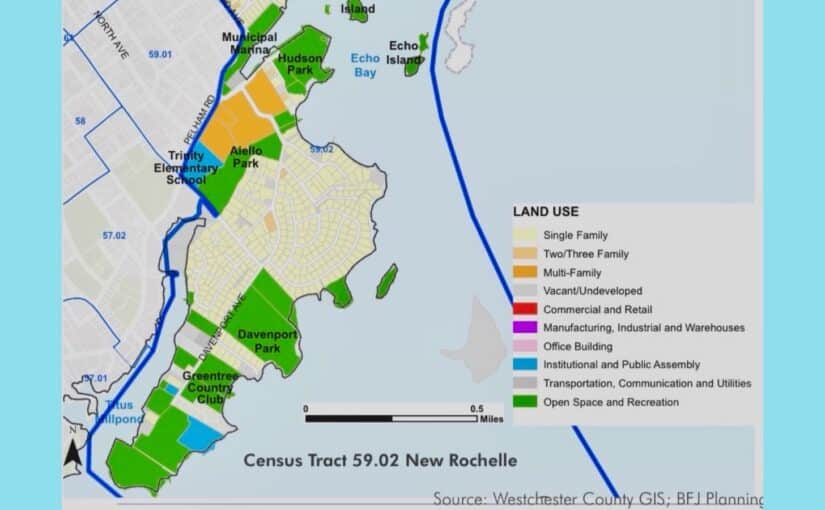
NEW ROCHELLE, NY (September 16, 2026) — New Rochelle officials signaled Tuesday that they will not immediately advance controversial zoning changes for Davenport Neck, saying the Development Department will review objections raised during last week’s public hearing and determine whether the proposal should be revised before returning to the City Council.
Development Commissioner Adam Salgado requested a discussion item at the Sept. 15 regular legislative meeting, one week after a formal public hearing on proposed changes to the R1-WF-10 waterfront zoning district.
Salgado told the Council that no action was being requested Tuesday and that the timing of any next step would depend on the results of the Development Department’s review.
“We received a number of comments from residents,” Salgado said, citing concerns about density, infrastructure, traffic, access, resiliency and the treatment of individual properties.
Staff will review the public testimony and specific requests made during the hearing and consider them in the context of the proposed zoning, he said.
“As part of that review, we’re going to determine whether there are any refinements that are necessary,” Salgado said.
He said the administration would return to the City Council with a recommendation “responsive to the comments that we heard,” but offered no timetable.
“The timing of that will really depend on our initial review and the work necessary to prepare them for Council’s consideration,” Salgado said.
Opposition Extends Beyond Public Hearing Speakers
Fewer than a dozen people spoke at the Sept. 8 public hearing, but the opposition presented to the Council extended well beyond those who came to the microphone.
More than 50 people attended the hearing, with opposition dominating the public comments. Neighborhood and homeowners associations representing hundreds of Davenport Neck residents — many with expensive homes that pay high taxes — had also submitted written objections to the proposed zoning.
Among the groups that formally opposed or raised objections to the proposal were the Association of Davenport Estates, Sutton Manor Association, Watermark Pointe Homeowners Association, Anchorage Association and Sans Souci Homeowners Association.
Sans Souci alone represents 126 homeowners. The associations raised concerns including increased density, traffic, emergency access, flooding, sewer and electrical capacity, stormwater runoff, neighborhood character and the treatment of individual properties under the proposed zoning.
The Sept. 8 hearing followed months of opposition. More than 200 people attended a May community meeting at Trinity Elementary School, where opposition was nearly unanimous when attendees were asked for a show of hands.
2016 Davenport Neck Zoning
The 2016 New Rochelle Comprehensive Plan described the City’s response to a proposal to develop Beckwith Pointe which was codified on March 15, 2016 in Davenport Neck Waterfront Zoning, Ordinance 77-2016
In late 2015, the City received a site plan application for a site on the southern tip of Davenport Neck. In response, the City took the opportunity to review zoning regulations that currently impact beach clubs on Davenport Neck in the existing R1-WF-10 zoning district. In the event that beach clubs turnover to residential development in the future, the City would like to promote clustered, multi-family development that limits flood risk and provides opportunities for expanded waterfront access with an option for a payment in lieu of providing waterfront access that can be used to improve other waterfront public space.
Tarantino Calls for Another Look at 2016 Zoning
Councilmember Albert Tarantino, who represented the area when the existing zoning was developed in 2016, urged the administration to compare the current proposal closely with the zoning adopted a decade ago.
Tarantino said the 2016 process involved extensive discussions with residents, including what he described as nearly door-to-door outreach, and resulted in repeated changes as the city sought community input.
One recurring concern at the time, he said, was avoiding higher-density development closer to concentrations of single-family homes.
Tarantino said the existing zoning was based on acreage, setbacks and estimates of what could be built on individual properties. He said one club that has since become a focal point of the current controversy had a potential buildout of approximately 35 units under that framework.
Under the proposed zoning, he said, that figure is roughly doubled while development capacity is shifted among other properties.
“Nobody’s opposing building on these properties,” Tarantino said of the residents who have spoken out. “I think that the concern is about the density level in certain areas.”
Tarantino urged city staff to conduct “a robust consultation with the neighborhoods” while reconsidering the proposal.
“Otherwise you’re going to have another meeting and there’s going to be 200 people there opposing it,” he said.
Peters Praises Opportunity for Reconsideration
Councilmember David Peters said the process had created an opportunity to reconsider the proposal as additional issues emerged.
Peters said he appreciated the administration’s willingness to spend more time examining the proposal and to re-engage existing neighborhoods.
He also distinguished between residents opposed to development altogether and those who have said they are willing to accept development but object to the proposed density.
Peters said the process had moved from an initial proposal to community engagement and now to another period of review in which refinements could be considered.
He said he hoped the process would ultimately produce a consensus.
Melendez Defends Process
City Manager Wil Melendez defended the administration’s handling of the zoning review, noting that it began with a petition involving a particular property but expanded into a broader examination of Davenport Neck.
Melendez said the city deliberately stepped back from looking at a single site to consider the entire area, including residents’ concerns and the future of the marina industry.
He pointed to three community meetings, the formal public hearing and the additional review now planned by city staff.
“I’m looking at the whole process and I think it’s really playing out kind of the way it really should,” Melendez said.
He said the goal was to develop zoning that addresses what neighborhood residents deserve while providing something a developer could use and from which the city could benefit.
Mayor Yadira Ramos-Herbert then emphasized that the item was for discussion only and that no Council vote would take place.
Proposal Followed Surf Club Development Petition
The citywide review of Davenport Neck zoning began after a developer petition involving the Surf Club property at 280 Davenport Ave.
City staff subsequently expanded the examination to the broader R1-WF-10 waterfront district.
The zoning amendments introduced in July proposed redistributing multifamily development capacity across Davenport Neck, generally reducing density in flood-prone areas while allowing greater density on certain property outside the FEMA 100-year floodplain.
City staff recommended in July that the Council schedule the Sept. 8 public hearing, refer the amendments to the Planning Board and Westchester County Planning Board and approve the zoning changes pending the outcome of the hearing and board reviews.
Tuesday’s discussion left the proposal alive but without an announced timetable for further Council action. City staff will first determine whether changes are warranted before bringing a recommendation back to the Council.
This article was prepared with the assistance of AI tools under the direction and editing of Robert Cox.
Have information about this story? Email robertcox@talkofthesound (preferred) or contact via WhatsApp: +353 089 972 0669
RELATED
New Rochelle to Consider Tear Down of Few Remaining Davenport Beach Clubs to Develop Luxury Housing (5/6/2026)
New Rochelle Proposes Zoning Changes for Davenport Neck to Curb Flood-Zone Density(7/14/2026)
Westchester Family Courthouse in New Rochelle Deliberate Chemical Spill