

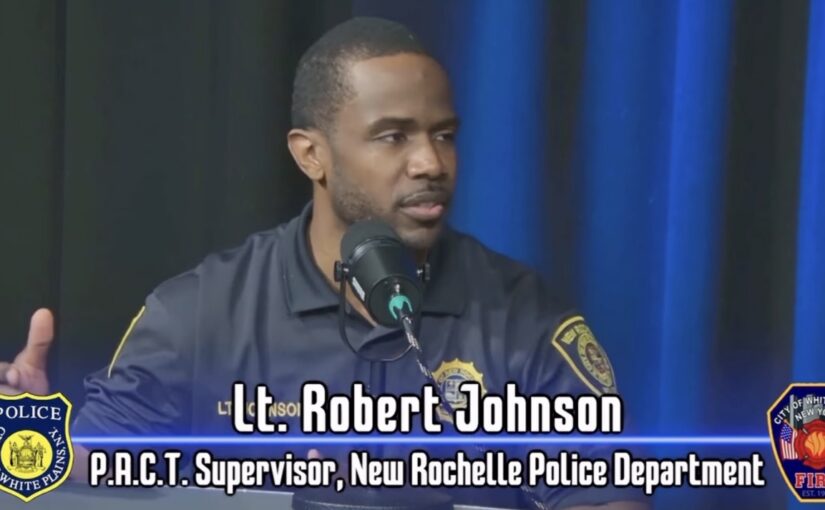
NEW ROCHELLE, NY (October 6, 2026) — New Rochelle Police Lt. Robert Johnson said effective community policing means building partnerships with social workers, mental health professionals and others who can address problems that police officers alone cannot solve.
Johnson, supervisor of the New Rochelle Police Department’s Police and Community Together, or P.A.C.T., Unit, discussed his approach to community policing during an appearance on the White Plains Department of Public Safety’s “The Gems of Public Safety” podcast.
Watch clip here.
The White Plains Department of Public Safety launched the podcast this year as part of an expansion of its digital presence. The series is hosted by White Plains Police Detective Jay Lacayo and is available on Spotify and YouTube. The department has described the series as highlighting public safety personnel and issues.
New Rochelle police said Johnson joined the White Plains Police Department for a conversation about “community policing, connection, and the importance of building trust beyond the badge.”
Asked to define community policing, Johnson said the central idea is partnership.
“To me, it’s partnerships,” Johnson said. “It’s realizing that we as police, we don’t have to have the final solution to every single thing that we get called to.”
Johnson said police routinely encounter problems that require expertise beyond law enforcement.
“Because there are social workers out there, there are mental health professionals, there are a lot of other people that need to be sitting at the table so we can go and address these issues,” Johnson said.
Police are effective at responding to emergencies and making arrests, Johnson said, but those actions may address only the immediate problem rather than its underlying cause.
“We make arrests and we are very good at going out and putting Band-Aids on issues,” Johnson said.
He cited domestic calls as an example, saying officers may separate people temporarily without resolving the underlying dispute.
“But that does not get to the root of the problem,” Johnson said. “And every single law enforcement agency, we end up going to the same houses over and over and over.”
Johnson said community policing means recognizing when another professional or organization is better positioned to continue addressing a problem after police have handled the immediate emergency.
“Community policing is just saying, why don’t we tag somebody else in?” Johnson said. “Yes, we’ve done what we can, but there’s somebody else that can take this ball and run a lot further than we can.”
Johnson said police are an emergency service and should not be expected to assume roles for which other professionals are trained.
“It lets us do what we’re supposed to be here to do, which has not become social workers and counselors and mental health evaluators,” Johnson said. “We’re not supposed to be doing those things.”
Involving other parts of the community, he said, can produce broader solutions while allowing police to concentrate on their responsibilities.
“If we can tag other people in and get the entire community involved in the solution, that helps build a better, stronger community,” Johnson said.
New Rochelle’s P.A.C.T. Unit is the Police Department’s primary community engagement team. According to the city, it includes supervisors, youth detectives, beat officers, a social media coordinator and a Bike Unit and works with schools, civic groups, businesses, churches and youth organizations.
This article was prepared with the assistance of AI tools under the direction and editing of Robert Cox.
Have information about this story? Email robertcox@talkofthesound (preferred) or contact via WhatsApp: +353 089 972 0669.