
Two years to the day after Talk of the Sound sought the legal bills behind New Rochelle’s Shrub Oak placements, the District is still spending taxpayer money fighting disclosure — as Vision 2030 unfolds and parents are told a hiring freeze and a $20 million budget hole limit teachers and programs.
NEW ROCHELLE, NY (October 8, 2026) — Two years to the day after Talk of the Sound filed a Freedom of Information Law request seeking the legal bills behind New Rochelle’s use of Shrub Oak International School, the records remain undisclosed and the District is still paying lawyers today to fight a court order requiring their release.
As the City School District of New Rochelle asks parents and taxpayers to confront a hiring freeze, program constraints and a budget deficit that has exceeded $20 million, records obtained by Talk of the Sound show the district spent at least $3.3 million in tuition and transportation on four students placed at Shrub Oak International School, a lavish private school that was not state-approved for such placements.
The documented total includes $2,858,151.70 in tuition and $470,300.90 in transportation. The true cost remains unknown. The figure does not fully account for aides or monitors who traveled with students, and it does not include still-undisclosed legal bills generated by the Shrub Oak matter or the additional money the district has spent fighting disclosure of those bills in court.
The history matters now because New Rochelle is again asking parents and taxpayers to make choices about scarce resources. As Vision 2030 unfolds, families are being told that budget constraints and a hiring freeze limit what the District can provide in classrooms and programs. The Shrub Oak records offer a documented example of how the District previously allocated millions of dollars — much of it without the State funding available for approved private-school placements — while the full cost remains unknown and the District is still paying lawyers today to resist disclosure of its legal bills.
One of the four students left Shrub Oak after only a few months. The bulk of the years-long spending involved the remaining three students, who stayed for years. Records obtained by Talk of the Sound under a series of Freedom of Information requests establish tuition payments through the 2023-24 school year. They do not establish whether any of those students remained at Shrub Oak after that period or whether tuition and related costs continued into later years.
The students needed specialized educational services. The question raised by the records is why New Rochelle concentrated millions of dollars on a handful of students at one of the country’s most expensive private therapeutic schools when acceptable state-approved alternatives existed at a fraction of the cost — and why the district continued paying after its own lawyers, the New York State Education Department and the state’s administrative hearing process had made clear that Shrub Oak was not an approved Committee on Special Education placement.
Not an Approved 853 School
Shrub Oak was not merely a more expensive version of an ordinary special-education placement. New York’s approved private-school framework dates back 50 years, to Chapter 853 of the Laws of 1976. Educators, CSE chairpersons, special-education administrators and lawyers practicing education law have worked within that system for decades. Shrub Oak was not and never has been on the state’s approved list.
That makes the district’s later characterization of what happened as a “mistake” difficult to reconcile with the scale and duration of the spending. The placements were not routine, inexpensive assignments that could disappear inside a large school bureaucracy. They involved multiple students, unusually high tuition, transportation, CSE action, administrators and public money.
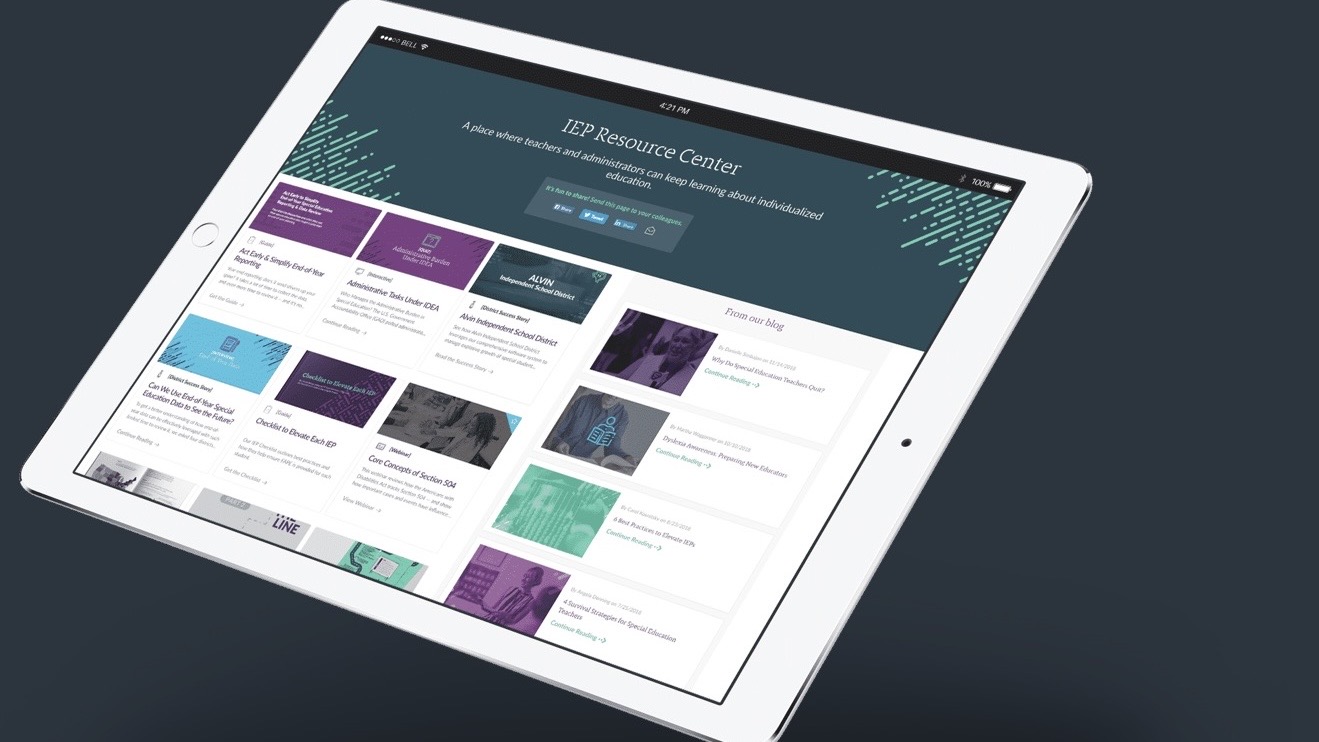
New Rochelle uses IEP Direct, now part of Frontline Education, to manage special-education records and placements. The system is structured around approved programs and can be customized locally. Shrub Oak would not ordinarily appear as an approved 853 placement because it was not one, raising the question of how the school was incorporated into New Rochelle’s placement process at all.
Four Students, One Pivotal Placement
The first New Rochelle student entered Shrub Oak on July 1, 2019, in a five-day residential placement. A second student entered as a day student on Oct. 23, 2019 (“Student No. 2”). A third entered a five-day residential program on Nov. 13, 2019. A fourth entered as a day student on Feb. 24, 2020.
Student No. 2 became pivotal to the matter because that student’s parent wanted the child moved from Shrub Oak’s day program into its substantially more expensive residential program and had been seeking residential placement since late 2019. On April 1, 2020, the CSE recommended a Shrub Oak residential placement, but within two weeks the district reversed course.
According to New York State Education Department State Review Officer Decision No. 21-158, the parent testified that an April 14 district email said the district’s attorney had advised that New Rochelle first had to consider state-approved residential programs before it could place the student in Shrub Oak’s residential program. The CSE reconvened on April 21.
At that meeting, district personnel told the parent that regulations required the district to explore state-approved programs. The parent asked whether that requirement was new. It was not. The parent wanted Shrub Oak specifically.
The SRO decision says she was not conducting her own search of approved schools because Shrub Oak was her school of choice. According to the meeting summary cited by the SRO, Shrub Oak’s director of clinical services had told the parent that other programs did not have what the student needed and “that it [wa]s all a matter of money.”
Shrub Oak knew it was not an approved 853 program and knew public-school CSEs operated within a state-regulated placement system. Its clinical director was nevertheless urging the parent toward Shrub Oak while characterizing the dispute as “a matter of money”. This conduct raises serious ethical and legal issues for Shrub Oak.
A family representative (Rev. Mark McLean), then said they were determined to get what the student needed “by any means necessary.”
The broader record shows the dispute was not over whether the student could receive a free appropriate public education somewhere. Two state-approved schools later accepted the student. The district chose the Woods School. An impartial hearing officer found that placement appropriate, and the State Review Officer upheld the result. The fight was over the parent’s insistence on Shrub Oak.
Full NYSED State Review Officer Decision No. 21-158
The Parent Takes the Fight to Albany (or Careful What You Wish For)
After the April 21 CSE meeting, the parent escalated the matter to state officials. The SRO decision says she wrote to the state seeking help and asked for a reprieve from the requirement that New Rochelle explore state-approved programs.
NYSED records obtained under FOIL by Talk of the Sound provide the direct connection.
On May 5, 2020, NYSED Regional Associate KimLori Devine contacted New Rochelle after the parent sent a letter to then-Interim Education Commissioner Shannon Tahoe concerning the student.
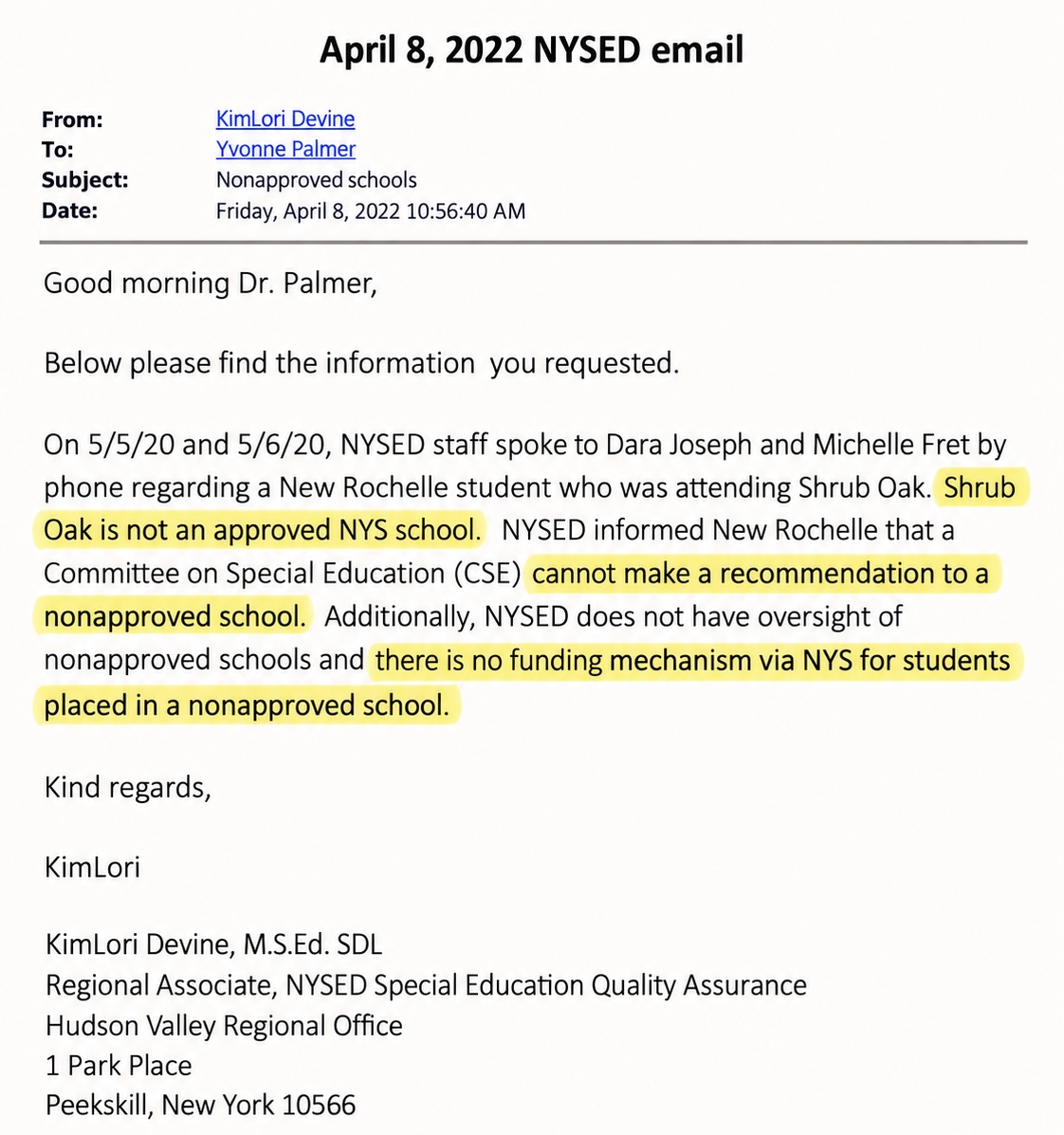
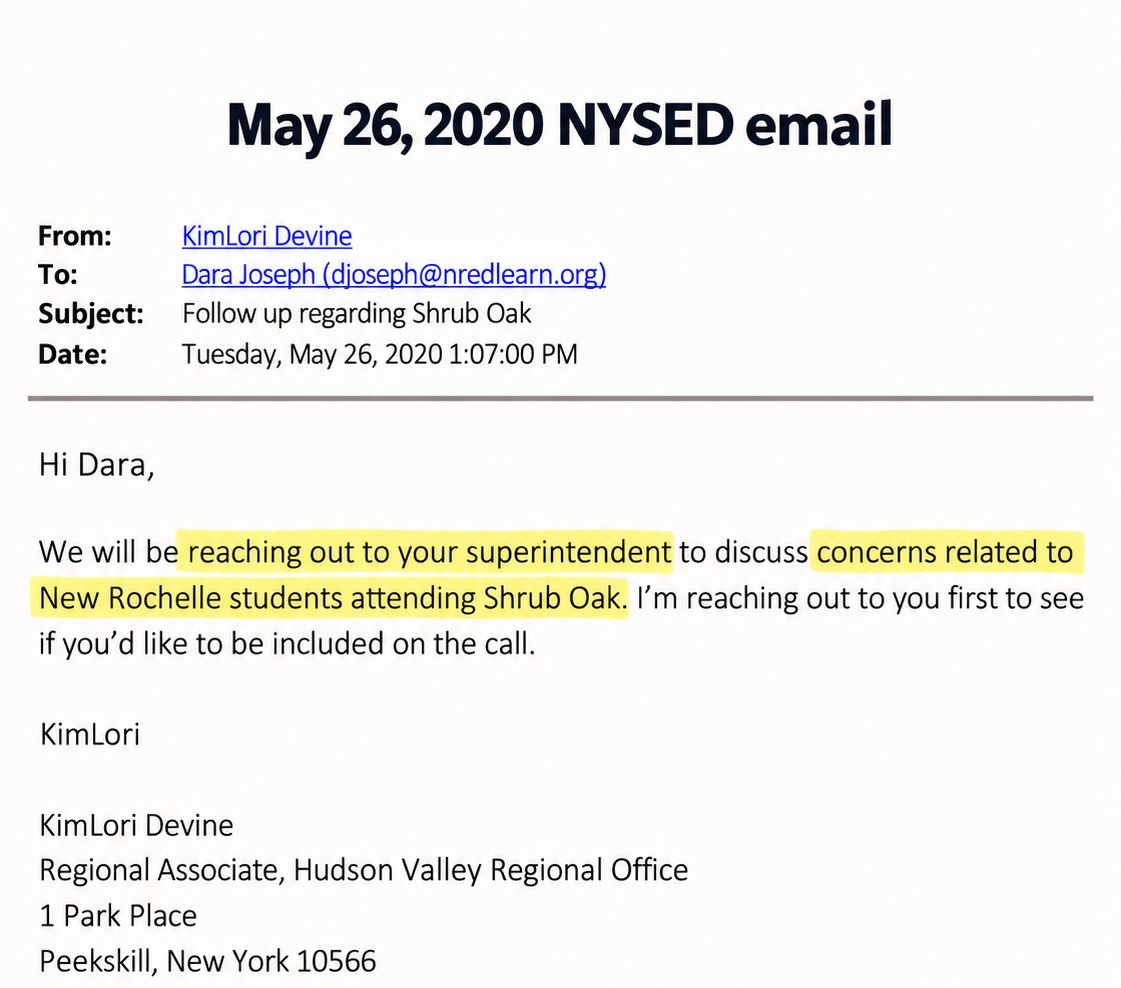
The effort to preserve the Shrub Oak placement brought the school itself under state scrutiny. NYSED officials spoke with New Rochelle personnel on May 5 and May 6, 2020. The state later memorialized what it told the district: “Shrub Oak is not an approved NYS school,” and a CSE “cannot make a recommendation to a nonapproved school.” NYSED also told New Rochelle that it did not oversee nonapproved schools and that there was “no funding mechanism via NYS for students placed in a nonapproved school.”
By May 26, the concern had widened beyond a single student. Devine wrote that NYSED would contact the superintendent “to discuss concerns related to New Rochelle students attending Shrub Oak.” What began as a fight over one student’s move from a day placement to a residential placement had exposed that New Rochelle had multiple students at Shrub Oak.
The 2021 SRO decision later made the problem part of the official administrative record. It stated that New Rochelle had placed Student No. 2 at Shrub Oak during the 2019-20 school year “notwithstanding that the school was not State-approved.”
The SRO also concluded that New Rochelle acted consistently with federal and state requirements when it ultimately insisted on a state-approved residential placement. The Woods School had accepted the student, the impartial hearing officer found it appropriate, and the appeal was dismissed. The spending continued.
A Rule the District Knew Well and Was Told
An April 2022 NYSED email to New Rochelle special-education administrator Yvonne Palmer eliminates any serious argument that the district did not understand the state’s position. NYSED Regional Associate KimLori Devine memorialized what the state had already told New Rochelle two years earlier: Shrub Oak was not approved; a CSE could not recommend it; and there was no NYS funding mechanism for students placed there.
By then, the approval issue had been put before New Rochelle repeatedly. The governing framework dated to 1976. District counsel had raised the state-approved-school requirement in April 2020. NYSED expressly told New Rochelle in May 2020 that a CSE could not recommend Shrub Oak. The impartial-hearing process produced an approved alternative. The SRO dismissed the parent’s appeal in 2021. NYSED then memorialized its earlier warning again in 2022.
Despite that accumulation of legal advice, state intervention and administrative rulings, district tuition records show Shrub Oak payments continuing into the 2023-24 school year. The central unanswered question is how this continued for years.
Budget Books Show the Share of Spending
A review of every New Rochelle school budget book publicly available on the district website, beginning with the 2021-22 school year, shows the district was budgeting millions of dollars annually for private and out-of-district special-education tuition while spending a striking share of that money on a handful of Shrub Oak students.
The district’s own budget documents describe this category of spending as tuition for students placed by the Committee on Special Education in approved private day and residential schools.
In 2021-22, New Rochelle budgeted $3.83 million for private-school special-education tuition. District vendor records show roughly $696,577 in Shrub Oak spending tied to that school year, equal to about 18% of the entire budgeted tuition account.
In 2022-23, Shrub Oak spending was roughly $884,033 against the same $3.83 million budgeted tuition line, or about 23%. Roughly 23 cents of every dollar New Rochelle budgeted for private and out-of-district special-education tuition that year was associated with Shrub Oak.
For 2023-24, the district budgeted about $4.91 million for special-education tuition outside the district. Shrub Oak vendor records reflect roughly $594,467 tied to that school year, or about 12% of the budgeted account. Those percentages are significant because by then the long-running Shrub Oak expenditure largely involved only three students.
NYSED did not merely tell New Rochelle that Shrub Oak was not approved. The state expressly said there was “no funding mechanism via NYS for students placed in a nonapproved school.” New Rochelle was therefore devoting an unusually large share of its private-placement tuition budget to Shrub Oak without access to the placement-specific state funding mechanism available for approved private special-education placements. The Shrub Oak tuition had to be absorbed by the district’s own budget rather than offset through that state reimbursement structure.
New Rochelle’s annual budget books describe private special-education tuition as funding CSE placements in approved private schools. During the same period, the district was paying hundreds of thousands of dollars each year to Shrub Oak, which state officials had expressly told New Rochelle was not approved. Every Shrub Oak dollar was therefore more expensive to New Rochelle than a comparable reimbursable placement would have been.
Money committed to Shrub Oak reduced the resources available elsewhere in the district budget at a time when well over 1,000 other students with disabilities also required teachers, aides, therapies, transportation, counseling and placements.
How the Spending Came to Light
The Shrub Oak investigation traces back to July 2023, before the Board of Education approved another year of spending at the school.
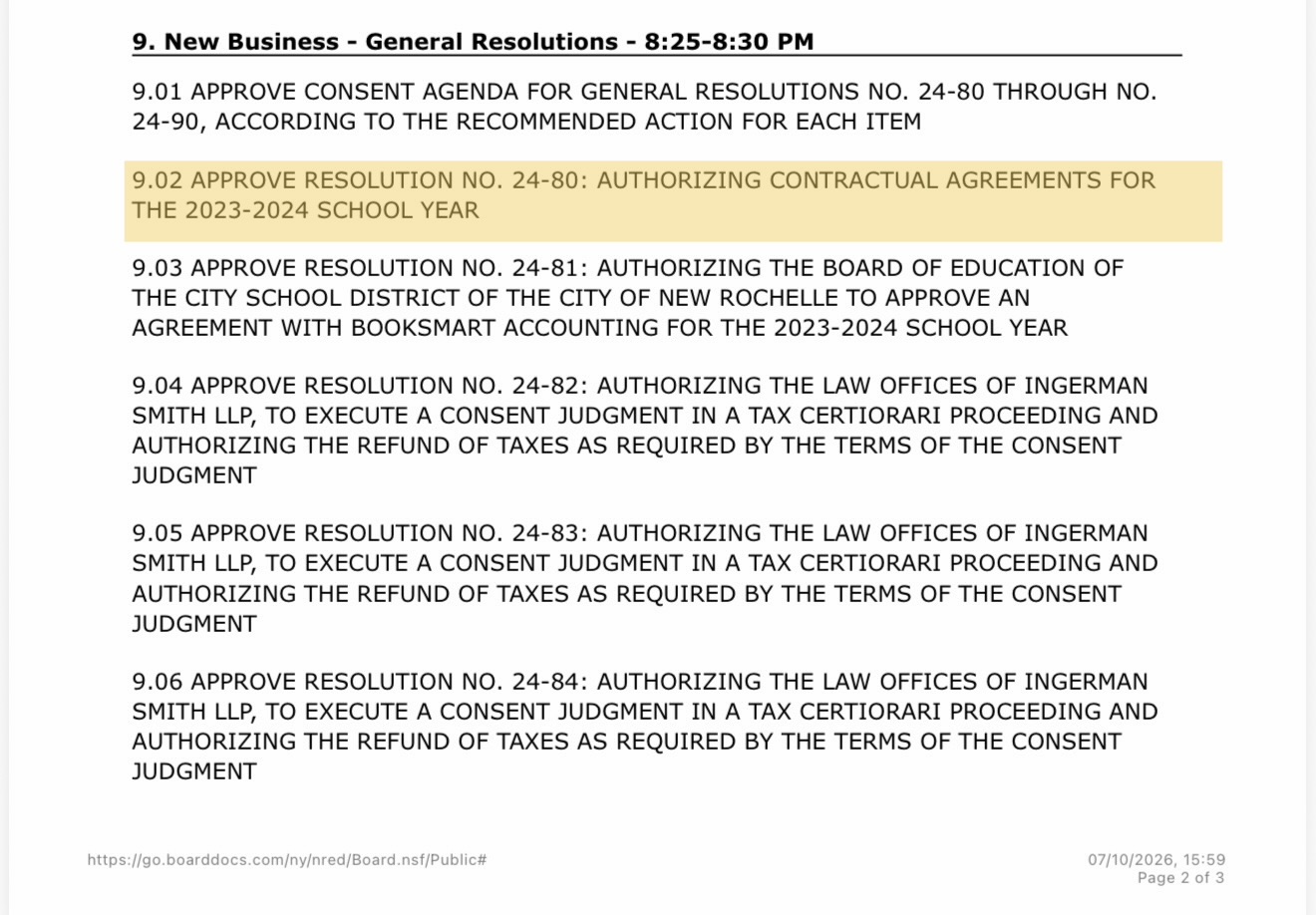
On July 24, Talk of the Sound contributor Andrew Newman was reviewing the agenda for the following night’s Board meeting when Resolution 24-80 caught his attention. The accompanying contract sheet sought authorization to spend $447,200 for a single student at Shrub Oak International School from July 1, 2023 through June 30, 2024.
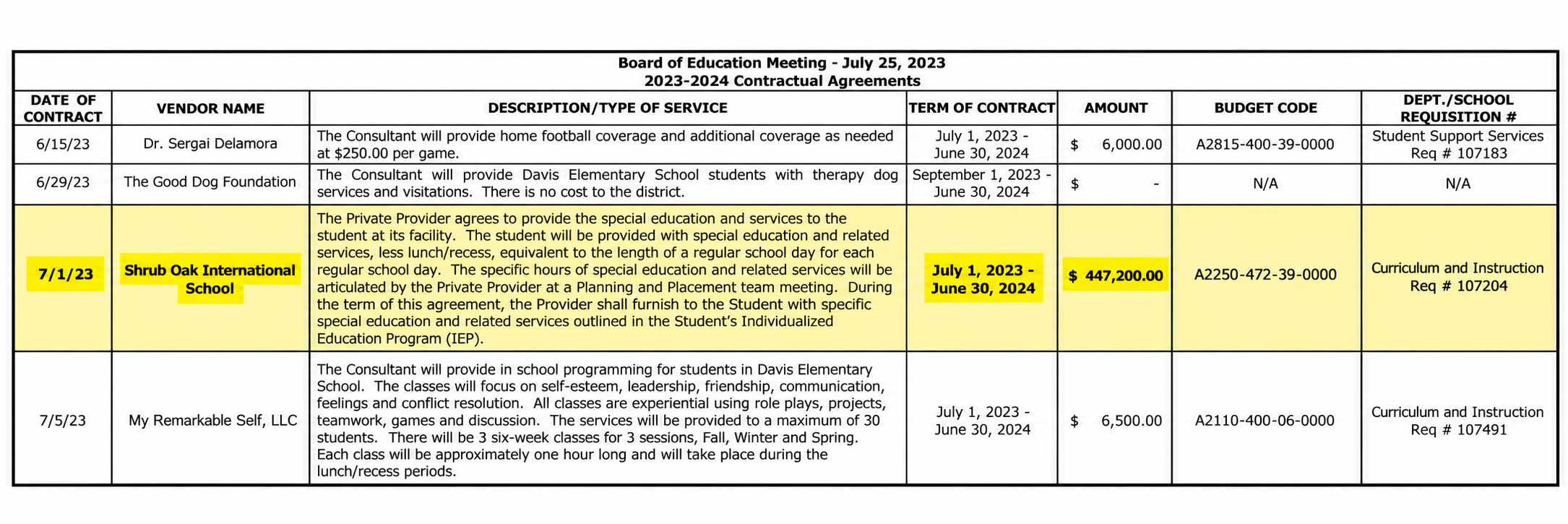
Newman checked New York State’s list of approved private schools and found that Shrub Oak was not on it. He emailed Board President William Iannuzzi that day, attaching the State list and questioning both the cost and the school’s approval status.
“This certainly seems to be an excessive amount of taxpayer money being allocated,” Newman wrote. “Please note, Shrub Oak International is not on the list of NYS-approved private schools.”
“Can you please explain the justification for this expenditure?” he asked.
Newman also raised the issue privately with Talk of the Sound Publisher Robert Cox.
The issue surfaced publicly the following night. During public comment at the July 25 Board meeting, New Rochelle resident Vince Malfetano specifically identified Resolution 24-80 and told the Board he had been informed that Shrub Oak did not appear to be listed by New York State as an approved school.
“I made a call today and maybe I’m wrong,” Malfetano told the Board. “This person told me that they looked up and apparently according to them this school is not listed in the state of New York as being approved to offer the services. So somebody might wanna look at that.”
Later in the meeting, Board President William Iannuzzi called for approval of General Resolutions 24-80 through 24-90 as a single consent agenda. A motion was made and seconded. Board members voted unanimously in favor, with no opposition or abstentions, and Iannuzzi announced that the motion carried.
There was no Board discussion of the dual warnings about Shrub Oak before the $447,200 contract was approved.
The District Calls It a Mistake
Six days after the Board approved the $447,200 Shrub Oak contract, on July 31, 2023, Superintendent Corey Reynolds responded to Andrew Newman on behalf of Board President William Iannuzzi.
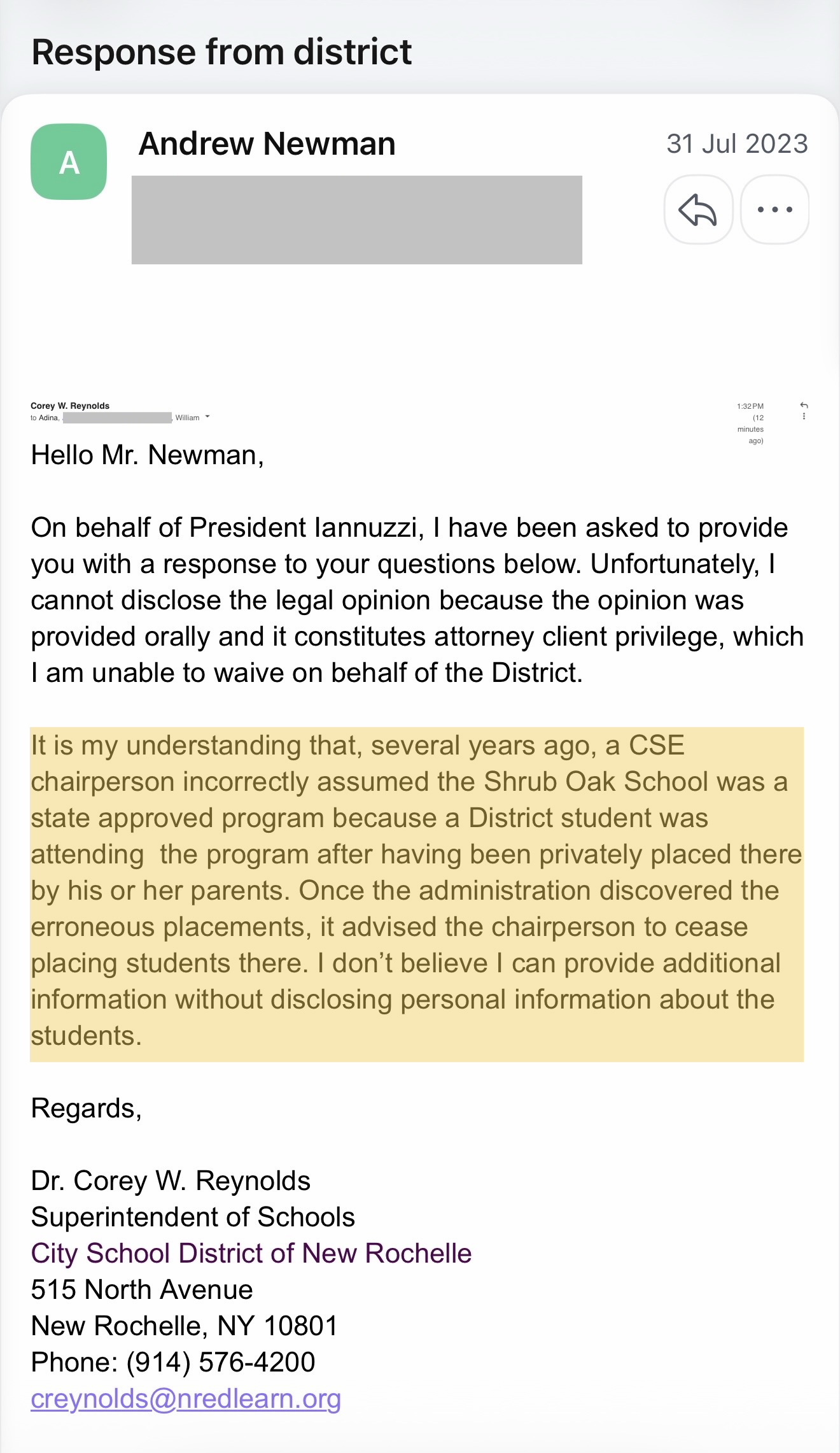
“Several years ago, a CSE chairperson incorrectly assumed the Shrub Oak School was a state approved program because a District student was attending the program after having been privately placed there by his or her parents,” Reynolds wrote. “Once the administration discovered the erroneous placements, it advised the chairperson to cease placing students there.”
Reynolds also said the District had received legal advice concerning the matter but declined to disclose it, saying the opinion had been provided orally and was protected by attorney-client privilege.
The employee Reynolds did not name was Tashica Crawford. The SRO decision describes Crawford by her professional designation as a school psychologist. District materials identify her functionally as an out-of-district facilitator under the heading for CPSE/CSE chairpersons.
It is possible that Crawford initially made the assumption Reynolds describes — one student was already at Shrub Oak before she took over the out-of-district role in September 2019 — that explanation does not account for the larger chronology.
Four students were initially placed at Shrub Oak over roughly eight months. By April 2020, the district’s own attorney was advising on the requirement to consider state-approved programs. By May, NYSED was directly involved. The matter went through an impartial hearing and a state administrative appeal. According to sources familiar with the matter, including the parent, the controversy was also repeatedly escalated internally to senior administrators and the Board of Education.
Even if the first initial placement was a mistake, that does not explain years of subsequent spending after the approval problem was known. Nor does it explain why, after the administration had supposedly discovered the “erroneous placements” and told staff to stop making them, the Board approved another $447,200 Shrub Oak contract for a single student in July 2023.
Cox began filing Freedom of Information Law requests in 2024, aimed at determining how many students New Rochelle had placed at Shrub Oak, how much the District had spent, what transportation and aide costs were involved, what lawyers had advised the District, and why the spending continued despite Shrub Oak’s nonapproved status.
Those records eventually showed that the $447,200 contract that caught the attention of Newman and Malfetano was only one piece of a much larger expenditure dating back to 2019.
The Transportation Figure Is Incomplete
The $470,300.90 currently attributed to transportation is substantial, but the records underlying that figure have presented their own problems. Cox first sought the actual transportation payment records, invoices and reimbursements in April 2024. The district later supplied material that did not provide the complete underlying documentation requested, including what appeared to be a summary rather than the NVISION records, invoices and payment records needed to independently reconstruct the total.
There was also the question of aides and monitors assigned to travel with students. On Oct. 8, 2024, Cox requested all timesheets and paychecks for aides assigned to travel with students to and from Shrub Oak from 2019 forward. The district did not issue its final response until Nov. 6, 2025, more than a year later.
The district said it had searched its records and contacted First Student, the bus company that operated the route. According to the district, First Student also had no responsive records. The district ultimately certified that it had no timesheets or paychecks for aides assigned to travel to and from Shrub Oak during the requested period.
That leaves a basic financial question unresolved: if aides or monitors were riding those buses and somebody was paying for those services, where are the records establishing the actual cost? Whatever that amount proves to be, it is not fully captured in the current $3.328 million total.
The tuition records obtained by Talk of the Sound run into the 2023-24 school year, but they do not establish whether any of the remaining students continued at Shrub Oak after that period. Additional FOIL requests will be required to determine whether tuition, transportation or related expenses continued into 2024-25 or later.
The Legal Bills Remain the Largest Unknown
The potentially largest unresolved component of the total is the legal cost. Attorneys were involved in the Shrub Oak matter by at least April 2020. Lawyers participated in the impartial hearing and represented the district through the state administrative appeal. Legal advice about the state-approved-school requirement itself became part of the official SRO record.
The invoices could also show how deeply District lawyers were involved while the Shrub Oak placements themselves were being made, including whether counsel participated directly in CSE meetings or other placement decisions.
Cox’s Oct. 8, 2024 FOIL request sought all invoices and payments for legal services provided to the district concerning Shrub Oak from 2019 forward. The district did not promptly produce them. It unilaterally issued itself more than a dozen extensions over approximately 15 months, repeatedly citing the volume of records and potential redactions. After more than 14 months, Cox appealed what he considered a constructive denial. On Jan. 13, 2026, the district finally produced approximately 380 pages of Ingerman Smith billing statements. The production did not answer the question the FOIL had been designed to answer.
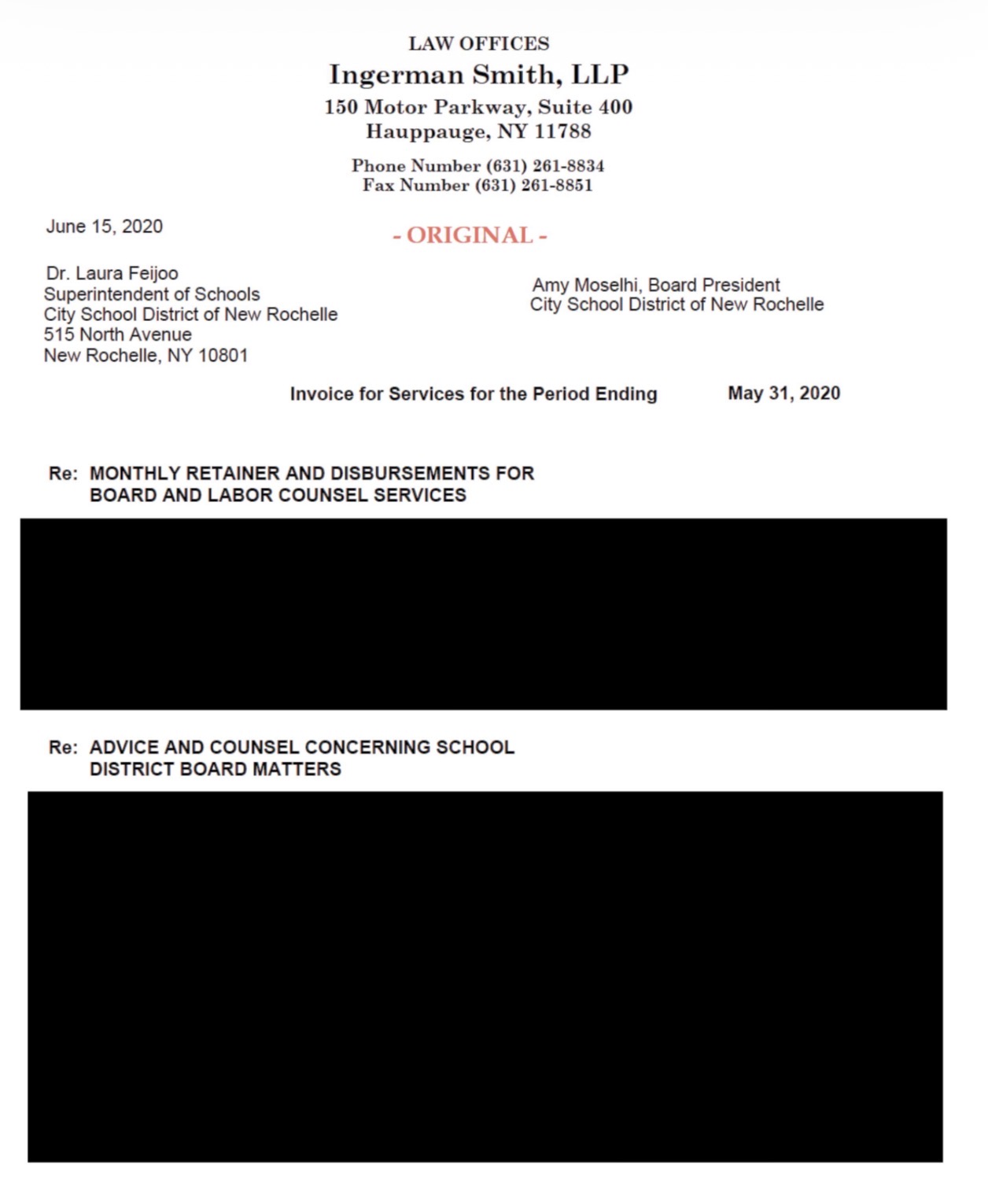
The invoices were so heavily redacted that Cox’s review identified only five visible dollar figures across roughly 380 pages: three individual charges of $66, $396 and $45, along with two hourly rates of $220 and $225. There were no visible invoice totals, subtotals or aggregate legal-cost figures. The district had produced hundreds of pages while withholding the information necessary to determine how much taxpayers had paid for its lawyers.
Cox appealed the redactions administratively on Jan. 14, 2026. The district did not decide the appeal within the statutory period, and Cox commenced an Article 78 proceeding in state Supreme Court in Westchester County.
District Tries to Dismiss the Case
Before the court reached the question of the redacted legal bills, the District tried to have Cox’s Article 78 proceeding dismissed.
In a March 27, 2026 motion, District attorney Michael Liptrot argued that the case was moot, that Cox had failed to exhaust administrative remedies and that the court lacked subject-matter jurisdiction. The District also accused Cox of pursuing a “baseless” proceeding that was “diverting limited and finite resources away from schoolchildren and into this proceeding.”
The filing then pointed to the District’s financial condition, noting that nearly 60% of its students were classified as economically disadvantaged and that the District faced “a budget deficit of over twenty million dollars.”
The argument was notable because the litigation existed only after the District had spent more than a year delaying production of the Shrub Oak legal bills and then released approximately 380 pages so heavily redacted that only five dollar figures remained visible.
On April 28, Justice Sheralyn Pulver rejected the District’s effort to dismiss the legal-invoices portion of the case. She found that Cox had exhausted his administrative remedies by appealing the redactions and that the District had failed to decide that appeal within the time required by FOIL. She also rejected the District’s argument that the dispute was moot, finding that Cox had raised specific unresolved challenges to the breadth of the redactions and completeness of the production.
The legal-invoices claim therefore remained before the court.
District Asserts Privilege in Court
The district also argued that portions of the billing records were protected by attorney-client privilege. That became a major issue because the administrative record contained no evidence that the district had invoked attorney-client privilege or another statutory FOIL exemption when it originally redacted the records.
The Supreme Court eventually ordered an in-camera review. On Aug. 18, Justice Sheralyn Pulver allowed the district to continue redacting material entirely unrelated to Shrub Oak but directed the district to provide the remaining responsive material, including information it claimed was privileged, for the court’s private inspection.
The district submitted 381 pages.
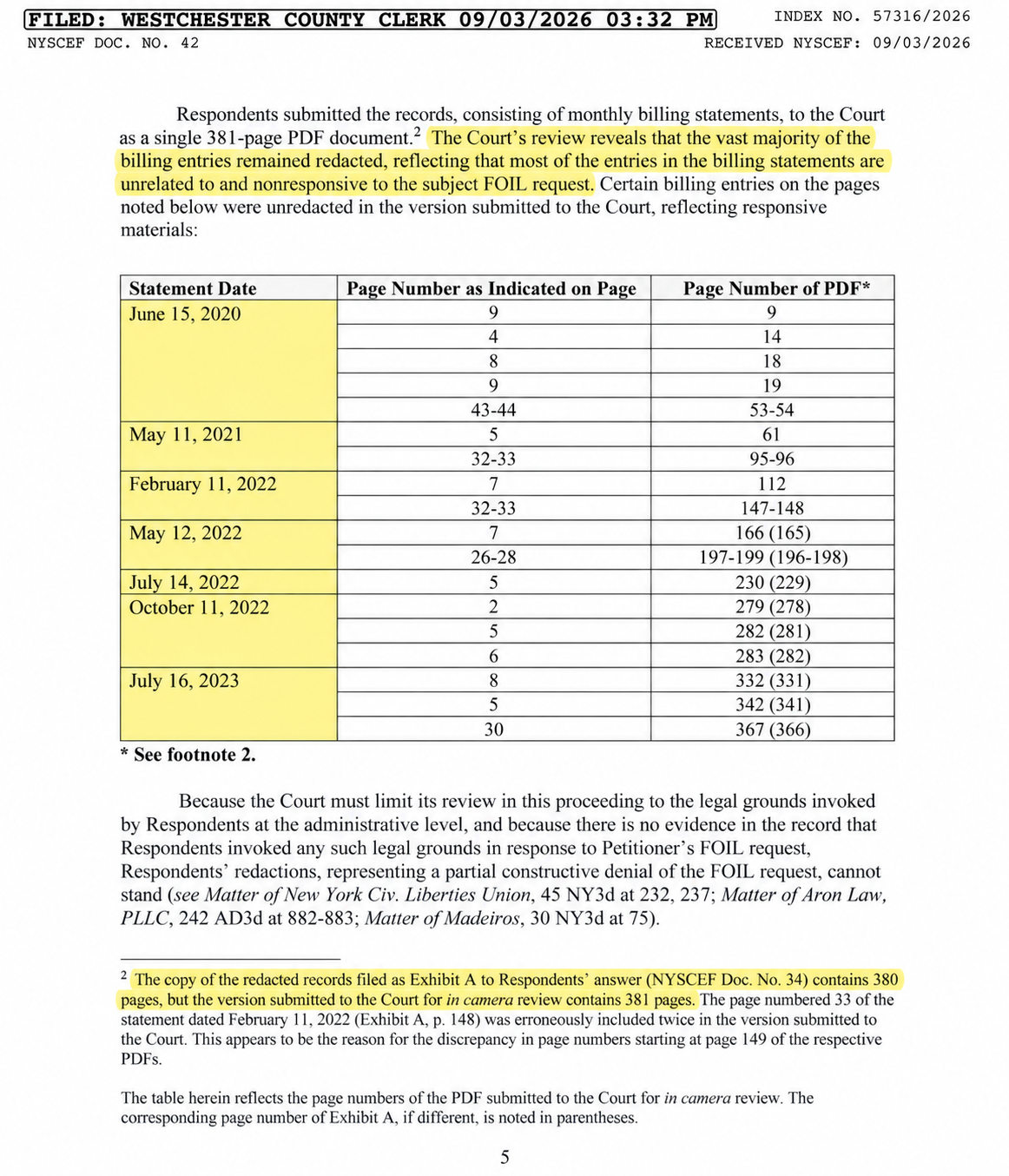
Pulver’s review also established that responsive Shrub Oak legal billing entries were spread across years, not confined to the original 2019-20 placement controversy. Her decision identified responsive material in billing statements dated from June 2020 through July 2023, including entries from 2021 and multiple statements in 2022. The entries themselves remain undisclosed, but the dates show that legal work responsive to the Shrub Oak FOIL request continued for more than three years.
Cox Wins in Supreme Court
On Sept. 3, Pulver ruled for Cox. After reviewing the 381-page submission herself, Pulver found that the district had not established that it invoked attorney-client privilege or another statutory exemption at the administrative stage. The district could not supply a new justification for withholding the records for the first time after the case reached court.
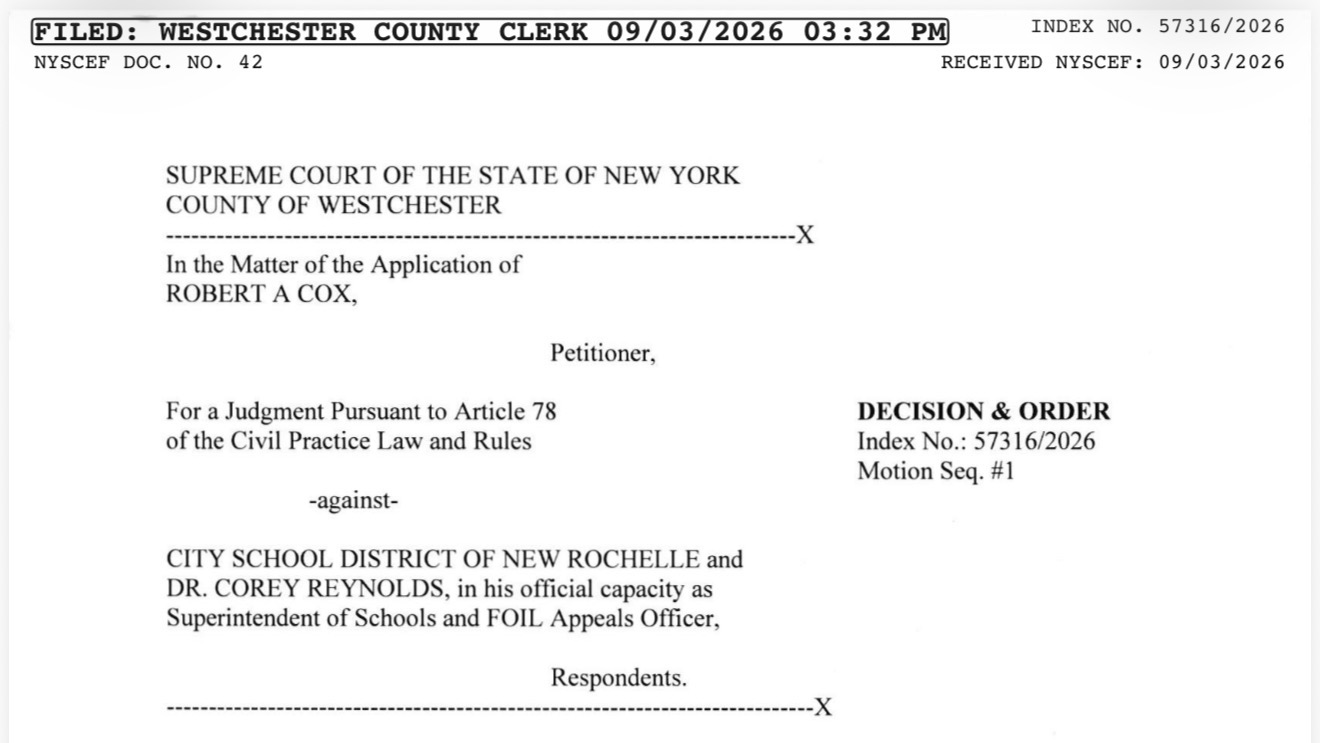
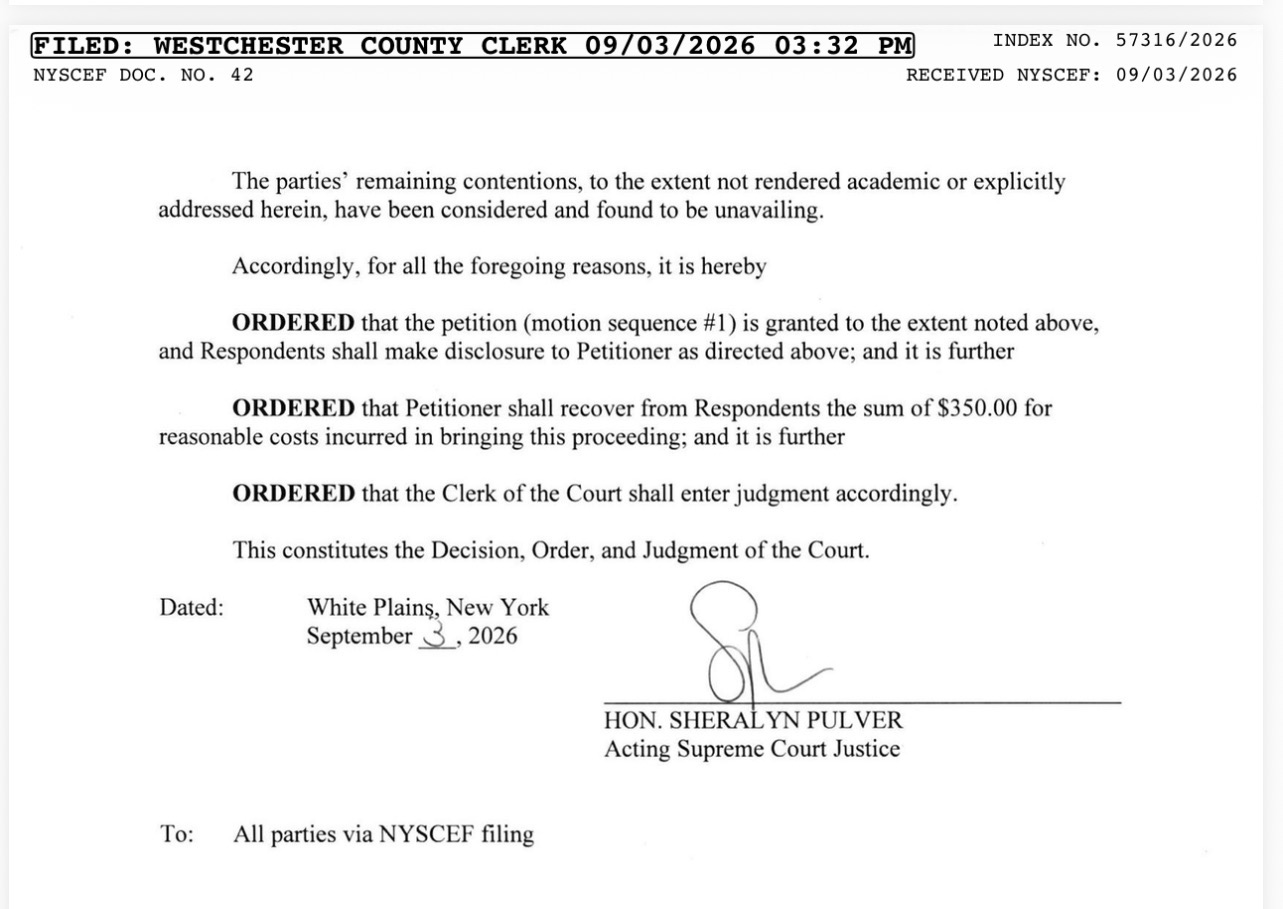
Pulver ordered the district to disclose the responsive portions of the billing statements while permitting material wholly unrelated to the Shrub Oak request to remain redacted. She also found Cox had substantially prevailed and awarded him $350 in litigation costs because the district failed to timely determine his administrative appeal.
The ruling did not order indiscriminate release of unrelated legal matters. The judge had already reviewed the records and directed disclosure consistent with the version the district itself submitted for in-camera inspection.
The decision came after a FOIL process marked by repeated delays. The original legal-bills request was filed Oct. 8, 2024 — exactly two years ago. The district issued itself more than a dozen extensions over approximately 15 months before producing the heavily redacted invoices in January 2026.
What Happened After the Court Ordered Disclosure
When Justice Sheralyn Pulver issued her Sept. 3 Decision, Order and Judgment, Cox expected the District to produce the records and pay the $350 in costs awarded by the court. At most, he anticipated the District might wait until after the next Board of Education meeting if some internal approval was required. That meeting was held Sept. 10. It came and went without the records or payment.
On Sept. 15, Cox emailed District attorney Michael Liptrot of Ingerman Smith LLP asking when the District would comply with Pulver’s order. Liptrot did not respond. Six days later, on Sept. 21, Cox filed and served a Notice of Entry of the Sept. 3 judgment. A Notice of Entry is the formal step that starts the time to appeal. Once it was served, the District generally had 30 days — until Oct. 21 — to file a Notice of Appeal.
Liptrot responded Sept. 22, confirming receipt of the Notice of Entry and saying the District was “currently considering its legal options, including but not limited to taking an appeal.”
Two days later, on Sept. 24, the Board met with Ingerman Smith, the District’s longtime outside counsel, in executive session before the public portion of its work session. Later that evening, immediately after the Board’s Vision 2030 discussion, Board President Makeda Lewis announced a “walk-on,” saying a “time sensitive legal matter” had “come up tonight” and was being added to the agenda.
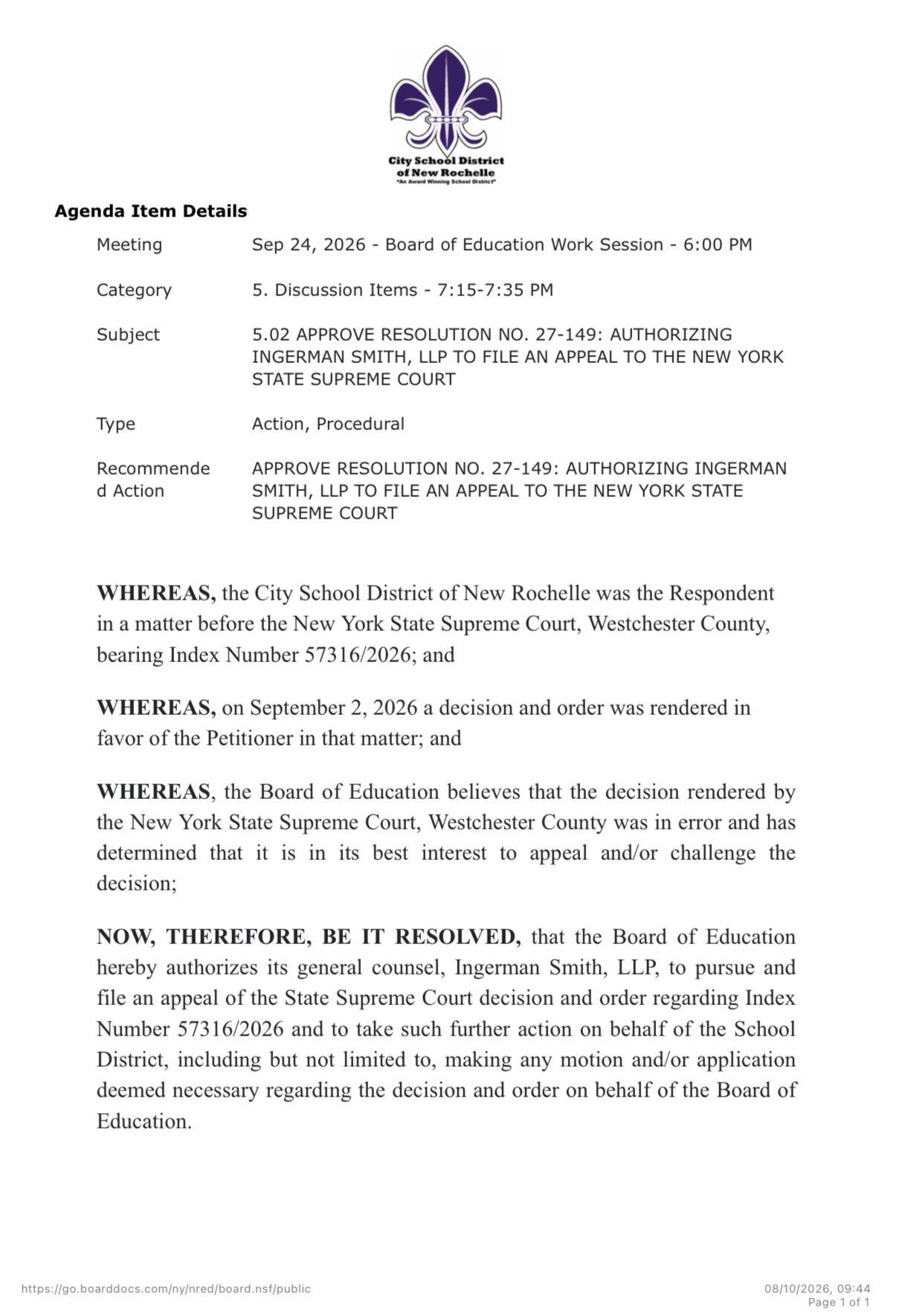
The walk-on was Resolution 27-149, authorizing Ingerman Smith to pursue and file an appeal and to take any further action, including motions or applications, it deemed necessary concerning the decision. The resolution itself incorrectly dates the Supreme Court decision as Sept. 2; Pulver’s Decision, Order and Judgment was dated and entered Sept. 3. Don Vega moved the resolution, William Iannuzzi seconded it, and the Board approved it without opposition or public discussion.
The Sept. 24 vote came three weeks after Pulver’s ruling and two weeks after the Board’s Sept. 10 meeting, when no appeal authorization had been brought forward. It also came three days after Cox filed Notice of Entry and two days after Liptrot said an appeal was under consideration.
Cox did not know at the time that the Board had authorized an appeal. Living in Ireland, he did not watch the Sept. 24 meeting live and reviewed the meeting recording only several days later. Liptrot did not notify him that the Board had authorized the appeal.
Still preparing to enforce Pulver’s judgment, Cox arranged to obtain a certified copy of the Decision, Order and Judgment and had both the District and Superintendent Corey Reynolds personally served on Sept. 29. The Affirmation of Service was filed with the court. Cox then notified Liptrot that service had been completed and said that unless the District produced the records and paid the $350 by Oct. 7, he intended to seek enforcement of the judgment.
Instead, on Oct. 2, Liptrot filed the District’s Notice of Appeal, 11 days after Cox served Notice of Entry and 19 days before the Oct. 21 appeal deadline. Because the District is a governmental entity, the appeal triggered an automatic stay under CPLR 5519(a)(1), temporarily blocking enforcement of Pulver’s disclosure order.
The Second Department opened the appeal Oct. 5 under Docket No. 2026-10900. The following day, Cox went into appellate NYSCEF intending to file a motion under CPLR 5519(c) asking the court to vacate or modify the automatic stay. The system would not accept the filing because the District’s counsel had not yet initialized the appeal in appellate NYSCEF (as of this moment counsel has still not done so).
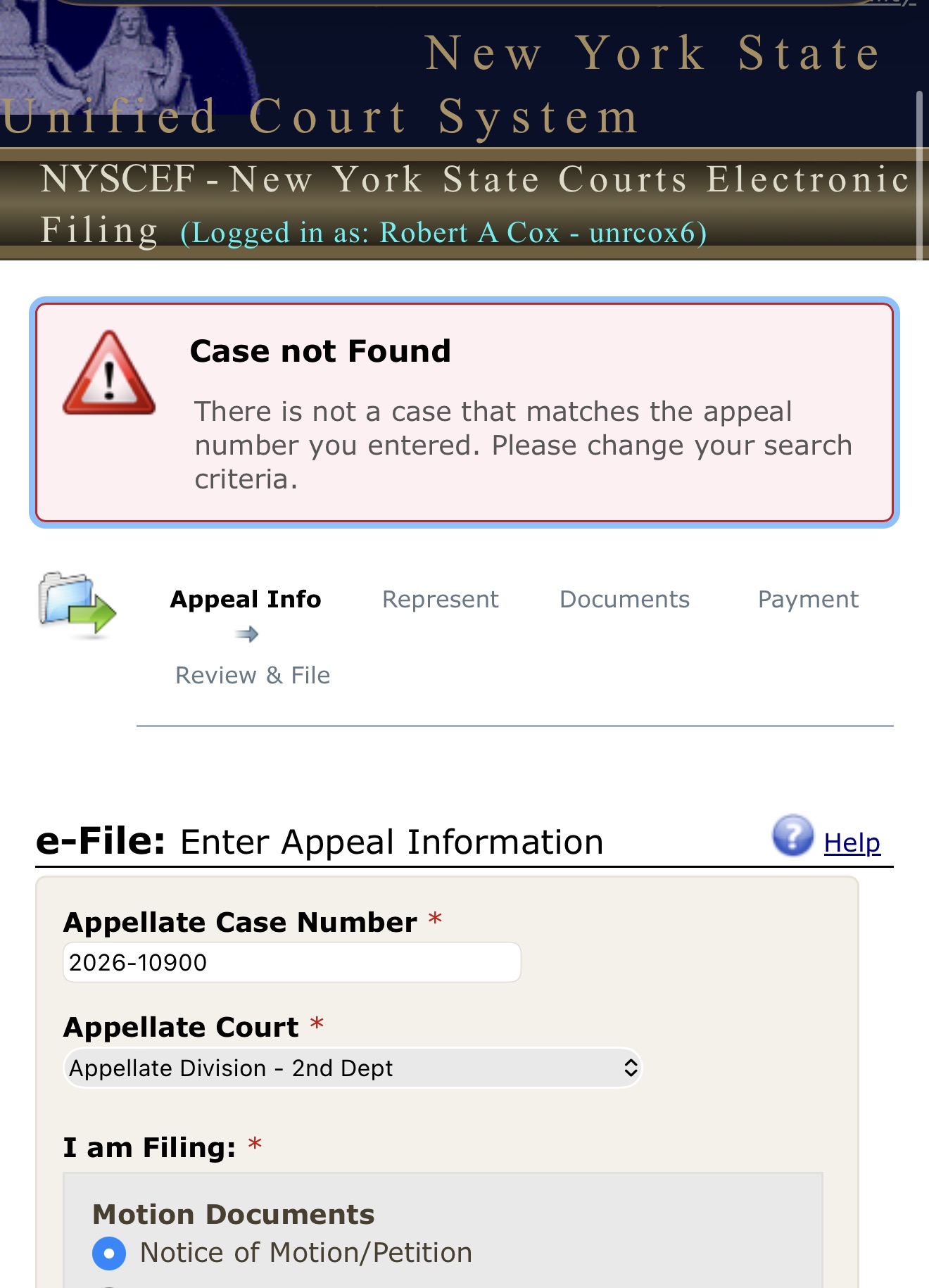
Cox called the Second Department Clerk’s Office in Brooklyn and was told that the District, as appellant, had up to 14 days after filing its Notice of Appeal to initialize the appellate case electronically. Cox asked whether there was another way to file rather than wait for the District to do so. Court staff told him he could submit the motion through the Second Department’s Digital Case Submission portal and arranged access for him.
Cox served District counsel and submitted the motion through that portal on Oct. 6. The motion asks the Second Department to vacate, limit or modify the automatic stay so that Pulver’s disclosure order can be enforced. Alternatively, if the stay remains in place, Cox asks the court to require the District to perfect its appeal by a date certain and to expedite consideration of the appeal.
The required $45 motion fee was paid in person on Cox’s behalf at the Second Department on Oct. 7. With the papers submitted, service completed and the fee paid, the motion was before the court.
The District’s opposition is due Oct. 19. Cox’s reply is due Oct. 25. The motion is returnable Oct. 26 at 10 a.m. on submission, without oral argument.
Cox Motion to Vacate Automatic Stay (Second Department) October 6, 2026
The Appeal Could Add Another Long Delay
If the stay remains in place, the district ordinarily has up to six months to perfect its appeal. Perfection does not mean the appeal is decided; it means the district files the appellate record and briefs needed to put the case before the court. After that, the appeal still must be placed on the Second Department’s calendar, argued or submitted, considered by the judges and decided.
The six-month perfection period is only the first stage of the appellate timetable, and the complete process can extend much longer, particularly where an appeal is not expedited. For a FOIL case, that delay can itself defeat much of the value of disclosure. The request at issue was filed Oct. 8, 2024, and concerns expenditures and decisions dating back to 2019. Meanwhile, New Rochelle is making major decisions about staffing, programs, facilities and school configuration as Vision 2030 unfolds.
Cox’s motion argues that an automatic governmental stay should not convert an appeal into another extended period of secrecy after the district already delayed the FOIL response for more than a year.
UPDATE — October 8, 2026: Appeals Court Confirms Motion Is Docketed
The Appellate Division, Second Department, has confirmed that Cox’s motion to vacate or modify the automatic stay was placed on the court’s docket after the $45 filing fee was received October 7. The motion has a return date of October 26, 2026.
In an October 8 email to Cox, the Appellate Court Clerk also confirmed that the court instructed the District’s attorneys on October 7 to initialize the appellate case in the New York State Courts Electronic Filing System (NYSCEF).
The District’s failure to initialize the appellate case had prevented Cox from accessing the electronic appellate docket to verify the status of his motion. The court’s confirmation establishes that the motion is docketed and awaiting consideration, even though access to the appellate NYSCEF case remains unresolved.
More Spending to Keep the Spending Secret
The legal fight has created an increasingly circular use of taxpayer money. New Rochelle paid millions in tuition and transportation connected to Shrub Oak. It paid attorneys who advised the district during the placement controversy. It then paid lawyers to resist disclosure of the bills showing how much those lawyers had cost. It paid those lawyers through an Article 78 proceeding the district lost, and it is now paying them to appeal that loss.
Even if none of the students remains at Shrub Oak today, the taxpayer spending associated with the controversy has not ended. For parents now being told that New Rochelle cannot afford every teacher, program or service they want preserved, the Shrub Oak history provides another measure by which to evaluate those claims. The District devoted millions of dollars to a handful of students at a school NYSED said a CSE could not recommend and for which the State said there was no funding mechanism. Years later, taxpayers are still paying for the consequences. The final question is no longer merely how much New Rochelle paid Shrub Oak. It is how much taxpayers will ultimately pay for the entire episode: tuition, transportation, aides and monitors, legal advice surrounding the placements, litigation over disclosure of the legal bills, the appeal of the order requiring disclosure and the continuing effort to keep those bills from public view.
Two years after the Oct. 8, 2024 FOIL requests, taxpayers still do not know that number. And the cost of keeping them from knowing continues to rise.
RELATED
Questions Sent to State Officials
Talk of the Sound is asking the New York State Education Department to clarify the rules governing payments for students attending nonapproved private schools and is referring the documented Shrub Oak expenditures to the New York State Office of the State Comptroller for independent review. The questions and referral are reproduced below.
NYSED Questions Regarding New Rochelle Shrub Oak Placements and Payments
NYSED Press Office,
I have spent the past several years investigating the City School District of New Rochelle’s use of Shrub Oak International School and related out-of-district special-education placements.
I published a detailed article this morning laying out the basis for the questions below:
New Rochelle Spent Millions on Four Students at Unapproved Private School, Then Fought to Keep the Bills Secret
The District has been extremely uncooperative in providing records under the Freedom of Information Law. That dispute has resulted in ongoing litigation now before the Appellate Division, Second Department, in Brooklyn.
My reporting is based on public records I was able to obtain from the City School District of New Rochelle, public records obtained from the New York State Education Department, court records and other documentary material. The article includes screenshots of NYSED correspondence and District records obtained under FOIL.
It also includes a link to my Oct. 6, 2026 motion in the Appellate Division, Second Department, in Matter of Cox v. City School District of New Rochelle, Docket No. 2026-10900. That filing includes my affirmation and memorandum of law, which set out the relevant factual and procedural history, together with an extensive exhibit package containing NYSED correspondence, District expenditure records, transportation records and other supporting documents.
I have substantially more records concerning Shrub Oak and related matters than could reasonably be included either in the article or in the appellate filing. I can provide additional records if they would assist NYSED in responding.
NYSED records already produced to me state that Shrub Oak was not an approved New York State school, that a Committee on Special Education could not recommend placement at a nonapproved school, and that there was “no funding mechanism via NYS for students placed in a nonapproved school.”
District records nevertheless show millions of dollars in tuition and related expenditures associated with New Rochelle students attending Shrub Oak.
My reporting has also raised a broader question about the District’s historical use of private-placement agreements. I have information suggesting that, for years, some parents who selected private schools outside the State-approved placement system would pay tuition themselves and later seek reimbursement from the District through due process, settlement or litigation.
The Shrub Oak matter appears potentially different. The families involved may not have had the financial means to advance the tuition themselves, while District financial records show payments made directly to Shrub Oak. I am seeking NYSED’s clarification as to whether that distinction matters legally and whether direct District payment to a nonapproved school was permissible.
I would appreciate answers to the following:
1. During the 2019-20 school year, could a New York public school district lawfully make tuition payments directly to a private school that was not approved by New York State for CSE placement?
2. If a parent unilaterally placed a student in a nonapproved private school, was the ordinary lawful mechanism for public funding for the parent to pay the tuition and subsequently seek reimbursement from the school district through due process, litigation or settlement?
3. Could a board of education enter into a settlement agreement providing public funding for a student to attend a nonapproved private school even though the CSE itself lacked authority to recommend that school?
4. If such a settlement agreement was permissible, could the school district pay the nonapproved school directly, or was payment required to take the form of reimbursement to the parent?
5. What statutes, regulations, NYSED guidance or other legal authority governed such arrangements during the period beginning in 2019?
6. What precisely did NYSED mean when it told New Rochelle that there was “no funding mechanism via NYS for students placed in a nonapproved school”? Did that statement refer only to the absence of State reimbursement, or did it also affect the District’s authority to make direct payments to the school?
7. Did NYSED know that the City School District of New Rochelle was making direct payments to Shrub Oak?
8. If NYSED knew of direct payments to Shrub Oak, did NYSED approve, object to, review or investigate those payments?
9. Did NYSED instruct New Rochelle in 2020 to stop placing students at Shrub Oak, remove students already attending Shrub Oak, cease direct payments to Shrub Oak or take any other corrective action?
10. Did NYSED require New Rochelle to provide periodic or weekly reports concerning one or more students attending Shrub Oak?
11. Was NYSED’s “hard to place” unit, or any similarly named office or function, involved in the New Rochelle/Shrub Oak matter during 2020?
12. Did NYSED review whether New Rochelle’s Shrub Oak expenditures complied with Education Law, NYSED regulations, State reimbursement requirements or other fiscal requirements?
13. Did NYSED ever review whether New Rochelle’s use of settlement agreements or other arrangements involving nonapproved private schools extended beyond Shrub Oak?
14. Did NYSED ever refer any aspect of New Rochelle’s use of Shrub Oak, or related nonapproved private-school payment practices, to the Office of the State Comptroller, another State agency, or an audit, enforcement or investigative unit?
15. Does NYSED intend to conduct any further review of the New Rochelle/Shrub Oak matter in light of the records and expenditures now documented?
The article published today contains these questions at the end so readers can see what I am asking State officials to clarify.
Please let me know if NYSED would like copies of any underlying records beyond those contained or linked in the article and appellate filing.
Thank you,
Robert Cox
Publisher & Managing Editor
Talk of the Sound
Member, New York Press Club
Request for OSC Review — New Rochelle School District and Shrub Oak International School
Office of the State Comptroller Investigations Unit,
I have spent the past several years investigating the City School District of New Rochelle’s use of Shrub Oak International School and related out-of-district special-education placements.
I published a detailed article this morning laying out the factual and documentary basis for this referral:
New Rochelle Spent Millions on Four Students at Unapproved Private School, Then Fought to Keep the Bills Secret
The District has been extremely uncooperative in providing records under the Freedom of Information Law. That dispute has resulted in ongoing litigation now before the Appellate Division, Second Department, in Brooklyn.
My reporting is based on public records obtained from the City School District of New Rochelle, public records obtained from the New York State Education Department, court records and other documentary material. The article includes screenshots of NYSED correspondence and internal District records obtained under FOIL.
It also includes a link to my Oct. 6, 2026 motion in the Appellate Division, Second Department, in Matter of Cox v. City School District of New Rochelle, Docket No. 2026-10900. That filing includes my affirmation and memorandum of law, which set out the relevant factual and procedural history, together with an extensive exhibit package containing NYSED correspondence, District vendor-history records, transportation records and other supporting documents.
I have substantially more records concerning Shrub Oak and related matters than could reasonably be included either in the article or in the appellate filing, and I can provide additional material if it would assist OSC.
The records obtained to date document at least $2,858,151.70 in tuition and $470,300.90 in transportation costs, for a combined known expenditure of at least $3,328,452.60 involving four students. The complete cost remains unknown because transportation aide or monitor expenses have not been fully established and legal expenses related to the placements and subsequent records litigation remain undisclosed.
NYSED records state that Shrub Oak was not a State-approved private school, that a Committee on Special Education could not recommend placement at a nonapproved school, and that there was “no funding mechanism via NYS for students placed in a nonapproved school.”
My reporting has also raised questions about whether the Shrub Oak expenditures were part of a broader, long-standing District practice involving private-school placements and settlement or reimbursement arrangements. Information developed during the investigation suggests that, in earlier cases, parents with sufficient financial means could pay private-school tuition themselves and later seek reimbursement from the District through due process, settlement or litigation.
The Shrub Oak matter appears potentially different. The families involved may not have had the financial means to advance the tuition themselves, while District financial records show payments made directly to Shrub Oak. I am separately asking NYSED to clarify whether such direct payments were legally permissible.
The records also raise questions about Shrub Oak’s conduct as the recipient of substantial public funds. Shrub Oak necessarily knew its own regulatory status and knew that it was not a New York State-approved 853 school. The records further indicate that Shrub Oak personnel were actively involved in advocating for continued placement of at least one New Rochelle student while the District and NYSED were addressing whether such a placement was legally permissible. In one documented account, a Shrub Oak clinical official characterized the dispute as “all a matter of money.”
I am therefore asking OSC to examine the transactions from both sides: not only whether New Rochelle was authorized to make these payments, but also what Shrub Oak represented, understood and accepted in connection with receiving public funds.
I am requesting that OSC determine, among other things:
1. Whether the District’s tuition payments associated with Shrub Oak were legally authorized and properly approved.
2. Whether a New York public school district was permitted to make direct payments to Shrub Oak, a non-State-approved private school, or whether any lawful funding mechanism required a parent to make a unilateral placement and subsequently seek reimbursement through settlement or due process.
3. Whether any Board-approved settlement agreements, contracts or other arrangements used to fund Shrub Oak attendance complied with applicable Education Law, regulations and fiscal requirements.
4. Whether the District received, sought or improperly claimed any State reimbursement associated with Shrub Oak placements.
5. Whether the District properly classified and accounted for Shrub Oak expenditures in its financial records and annual budgets.
6. Whether adequate internal controls existed to prevent unauthorized or improper placement and payment to nonapproved schools.
7. Why payments continued after District personnel and NYSED officials had identified Shrub Oak as a nonapproved school and after NYSED advised that a CSE could not recommend placement there.
8. Whether transportation, aides, monitors and related expenses were properly documented, authorized and accounted for.
9. Whether the Board of Education received sufficient information before approving Shrub Oak-related expenditures, including a $447,200 contract approved in July 2023 for a single student.
10. Whether similar private-placement, reimbursement or settlement arrangements involving nonapproved schools occurred in New Rochelle before or during the Shrub Oak period and, if so, whether those arrangements were properly authorized, documented and accounted for.
11. Whether the District’s direct-payment practices involving Shrub Oak represented a departure from its prior handling of parentally placed students at nonapproved private schools.
12. Whether Shrub Oak knew that it was not a New York State-approved school for CSE placement while accepting direct tuition payments from the City School District of New Rochelle.
13. What representations, certifications, contracts, invoices or other documentation Shrub Oak provided to New Rochelle in connection with those payments.
14. Whether Shrub Oak represented or implied to New Rochelle, parents or District personnel that direct District payment was legally permissible, reimbursable or otherwise authorized.
15. Whether Shrub Oak was aware of NYSED’s position that a CSE could not recommend placement there and that there was no State funding mechanism for students placed in a nonapproved school, and if so, when it became aware of that position.
16. Whether Shrub Oak continued soliciting, encouraging or accepting publicly funded placements after becoming aware of those restrictions.
17. Whether Shrub Oak received similar direct payments from other New York public school districts for students placed outside the State-approved private-school system.
18. Whether Shrub Oak used similar settlement, reimbursement or direct-payment arrangements with other school districts in New York.
19. Whether any invoices, contracts or payment requests submitted by Shrub Oak to New Rochelle or other public school districts accurately disclosed Shrub Oak’s nonapproved status.
20. Whether the pattern of payments warrants a broader review of Shrub Oak International School’s receipt of public funds from New York school districts, including the legal basis, contractual structure, representations made and accounting treatment of those payments.
21. Whether any additional audit, investigative, administrative or referral action is warranted based on the District’s expenditures, Shrub Oak’s receipt of public funds, or the financial controls surrounding these arrangements.
I am not asking OSC to assume that criminal conduct occurred. I am asking for an independent examination of whether millions of dollars in public expenditures were lawful, properly authorized, accurately accounted for and subject to adequate internal controls, and whether the recipient of those funds complied with applicable requirements.
The article published today contains the relevant chronology, supporting documents and the questions I am separately asking NYSED. The appellate filing linked in the article provides additional documentary support.
Please let me know if OSC would like copies of any underlying records beyond those contained or linked in the article and appellate filing.
Thank you,
Robert Cox
Publisher & Managing Editor
Talk of the Sound
Member, New York Press Club
Updated FOIL Request for Legal Billing Records Sent to City School District of New Rochelle
Talk of the Sound has also submitted a new Freedom of Information Law request to the City School District of New Rochelle seeking updated legal billing records concerning Shrub Oak International School. The previous billing records reviewed by the court included responsive entries through July 2023. The new request seeks records from July 17, 2023 through the present to determine how much additional taxpayer money the District has spent on Shrub Oak-related legal work, including the FOIL litigation and appeal now pending in the Appellate Division, Second Department.
FOIL Request — Shrub Oak International School Legal Billing Records, July 17, 2023 to Present
This is a public records request.
I would like to obtain the following records:
All invoices, billing statements, time entries, payment records, disbursement records, credits, adjustments, and other records reflecting legal services provided to or paid for by the City School District of New Rochelle concerning Shrub Oak International School from July 17, 2023 through the date this request is processed.
This request is intended to include all responsive legal billing and payment records regardless of the attorney, law firm, vendor, matter number, billing code, account code, department or District employee through whom the services were requested, received, processed or paid.
Without limiting the foregoing, this request includes legal services relating to or concerning:
* Shrub Oak International School;
* any current or former New Rochelle student placed at, attending, considered for placement at, transported to or receiving services from Shrub Oak;
* CSE meetings, recommendations or placement decisions involving Shrub Oak;
* Shrub Oak’s status as a New York State-approved or nonapproved private school;
* communications with or advice concerning the New York State Education Department and Shrub Oak;
* contracts, tuition agreements, settlement agreements, reimbursement agreements or other payment arrangements involving Shrub Oak;
* payments made directly or indirectly to Shrub Oak;
* transportation, aides, monitors or other services associated with students attending Shrub Oak;
* Board of Education consideration or approval of Shrub Oak-related contracts, expenditures, settlements or placements;
* Freedom of Information Law requests, administrative appeals or records requests concerning Shrub Oak;
* the Article 78 proceeding Matter of Cox v. City School District of New Rochelle, Westchester County Index No. 57316/2026;
* the District’s appeal in Matter of Cox v. City School District of New Rochelle, Appellate Division, Second Department Docket No. 2026-10900;
* the automatic stay arising from that appeal;
* the CPLR 5519(c) motion seeking to vacate, limit or modify that stay;
* any other litigation, threatened litigation, administrative proceeding, legal consultation or legal advice concerning Shrub Oak International School.
For clarity, this request seeks records sufficient to determine both the nature of the responsive legal work and the amount of public money billed and paid for that work.
Please include records reflecting:
1. the date of each legal service;
2. the attorney or other timekeeper performing the work;
3. the time billed;
4. the billing rate;
5. the description of the work performed;
6. any expenses or disbursements;
7. invoice subtotals and totals;
8. credits or adjustments;
9. amounts paid by the District;
10. dates of payment; and
11. any matter, client, account or billing numbers used to identify Shrub Oak-related legal work.
If responsive Shrub Oak entries appear on invoices that also contain unrelated legal matters, please produce the invoice with only legitimately exempt or wholly nonresponsive portions redacted rather than withholding the invoice in its entirety.
If any responsive material is withheld or redacted, please identify the specific statutory exemption relied upon for each withholding or category of redaction and disclose all reasonably segregable non-exempt portions.
I specifically request that any legal basis for withholding or redacting responsive records be stated in the District’s response to this FOIL request and during the administrative FOIL process, rather than asserted for the first time in subsequent litigation.
I would also like records sufficient to show the aggregate amount billed and aggregate amount paid for all responsive legal services from July 17, 2023 through the date this request is processed.
I would like the fulfillment of my request to adhere to the standards required under the New York State Freedom of Information Law for access to records maintained electronically.
Whenever and wherever possible, I would like records provided pertaining to my records request to be converted to and delivered in standard, cross-platform, non-proprietary electronic/digital formats. For paper records that must be duplicated, I would like them duplicated by scanning, not photocopying, and saved in Adobe Acrobat PDF (.pdf). For audio records, I would like them exported/saved into a standard audio format (.mp3). For video records, I would like them exported/saved into a standard video format (.mp4). For electronic database records, I would like them provided in Microsoft Excel or another standard spreadsheet format.
I would like all communications, including delivery of documents, to take place via email as much as possible based on the nature and size of the available records. Other online digital delivery methods are also acceptable.
The New York State Committee on Open Government has issued numerous advisory opinions to the effect that an agency cannot require that a request be made on a prescribed form. Freedom of Information Law § 89(3), as well as the regulations promulgated by the Committee, require an agency to respond to a request that reasonably describes the records sought within five business days of receipt. Neither the law nor the regulations require the use of a standard agency form. Accordingly, this written request reasonably describing the records sought should suffice.
I am willing to pay any necessary statutory costs, but for any costs exceeding $20.00, I request prior notification of the estimated cost before the District incurs the expense.
I am willing to entertain any reasonable request to clarify or narrow this request if doing so would materially facilitate production. Any such request should identify specifically what aspect of the request the District believes requires clarification or narrowing.
I understand that permissible charges for electronic records are governed by FOIL and applicable regulations. I do not consent to charges that are not authorized by statute.
If the District contends that any responsive records do not exist or cannot be located, I request a certification pursuant to FOIL stating that the District does not possess such records or that, after a diligent search, the records cannot be found. Any such certification should identify the locations, systems and custodians searched sufficiently to describe the scope of the search.
I would like the Records Access Officer to certify that the records produced are genuine records of the City School District of New Rochelle.
Thank you.
Robert Cox
Publisher and Managing Editor
Talk of the Sound
http://www.talkofthesound.com