

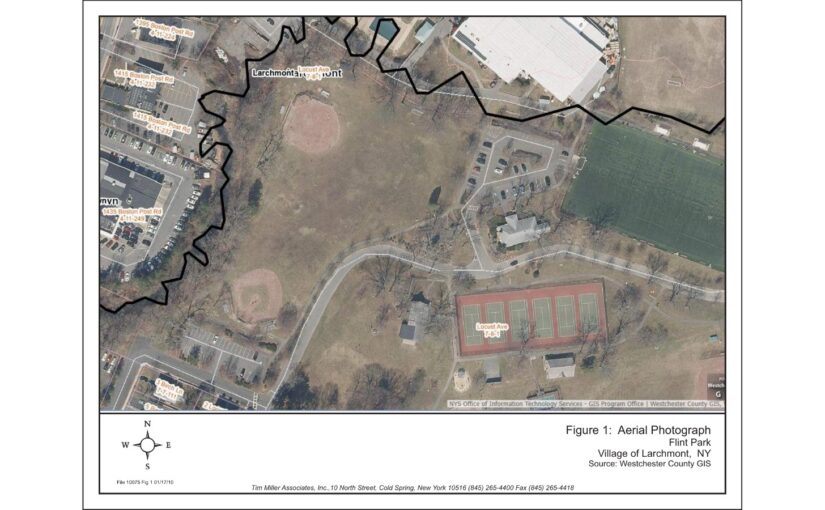
Environmental reports documented buried ash, elevated lead and other contaminants before the Village began renovating two athletic fields. State regulators subsequently cited Larchmont for disturbing a historic landfill without required approval.
LARCHMONT, NY (October 19, 2026) — The Village of Larchmont knew months before construction began at Flint Park that its athletic fields were situated on historically filled land containing incinerator ash and contaminated soil, according to environmental reports obtained by Talk of the Sound. The Village’s own consultants documented elevated concentrations of lead and other pollutants, identified the area as a former municipal waste-disposal site and warned that additional environmental permits might be necessary before excavation.
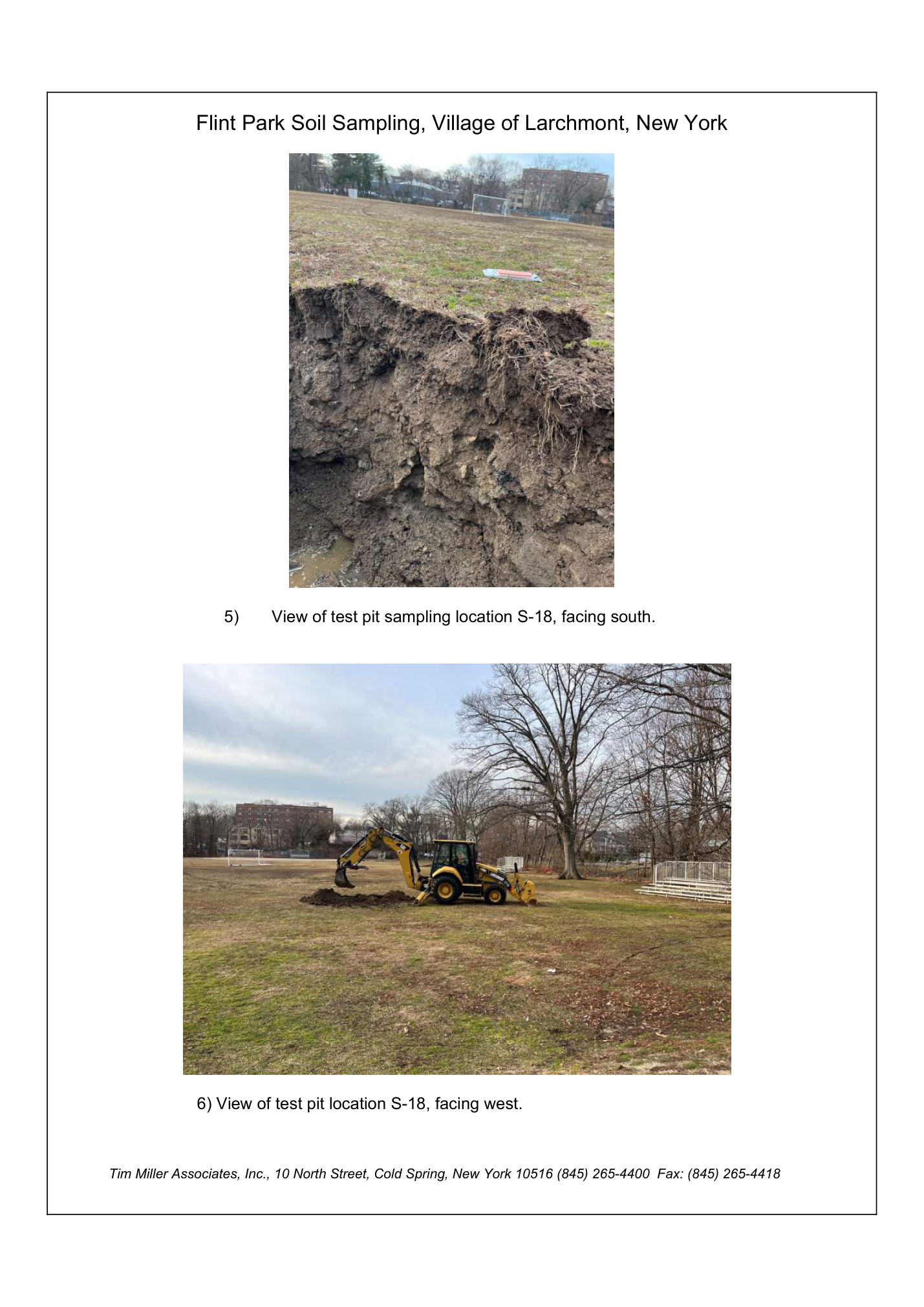
Despite those warnings, construction on Fields A and B began in late May and continued until August 19, when inspectors from the New York State Department of Environmental Conservation (DEC) visited the site following a complaint. The following day, DEC issued a formal Notice of Violation citing two provisions of New York’s solid-waste regulations. The agency determined that landfilled materials had been excavated and that the Village had undertaken a change in the use of a closed landfill without obtaining the required approval.
The project remains suspended while the Village works with DEC to determine the extent of the disturbance and develop appropriate remediation measures. The records raise significant questions about how Village officials handled environmental warnings before construction, why the project proceeded without the approvals DEC subsequently identified as necessary, and whether the Village’s public explanations accurately reflected what its consultants had already documented.
Environmental Warnings Predated Construction
The warnings began well before the August shutdown. In a November 20, 2025, proposal, Catizone Engineering identified the project area as land formerly used for municipal incinerator waste disposal and specifically raised the possibility that excavation would require additional permits. The engineering firm also identified other environmental considerations affecting the proposed renovations, including nearby wetlands, flood hazards and approximately 3.6 acres of anticipated soil disturbance.
“The Project area was formerly utilized for municipal incinerator waste disposal,” the firm wrote, explaining that soils would need to be tested to determine whether additional permits were required for excavation and disposal. The statement was not a retrospective assessment prepared after DEC intervened. It was part of the Village’s preconstruction planning documents, prepared approximately six months before work began.
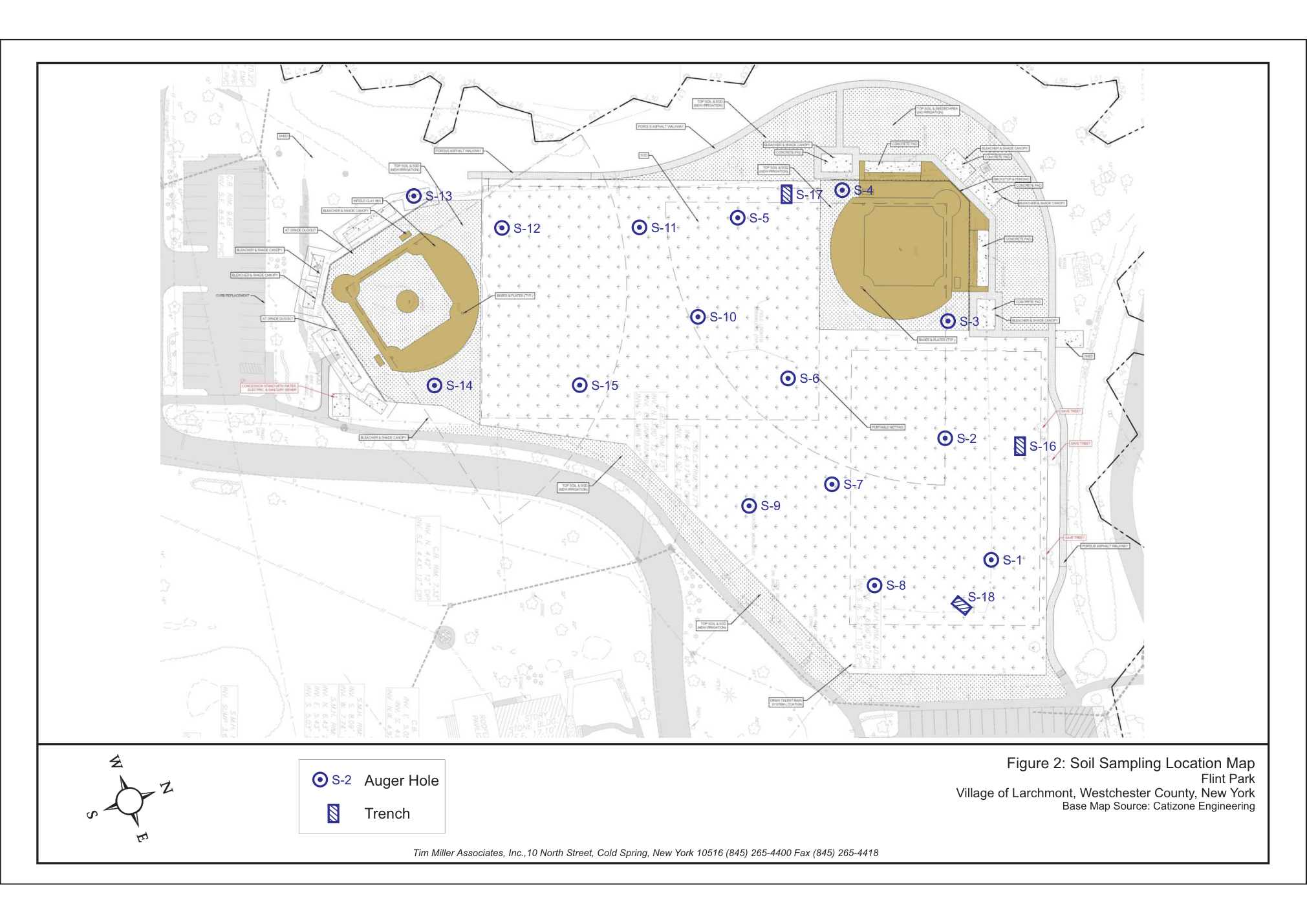
The Village subsequently retained Tim Miller Associates to investigate soil conditions in the proposed construction area. On January 13, 2026, the firm’s personnel collected 18 soil samples, primarily from shallow depths, along with three deeper test pits. Its 107-page report, dated March 2, was addressed directly to Village Administrator Aylone Katzin and copied to Catizone Engineering.
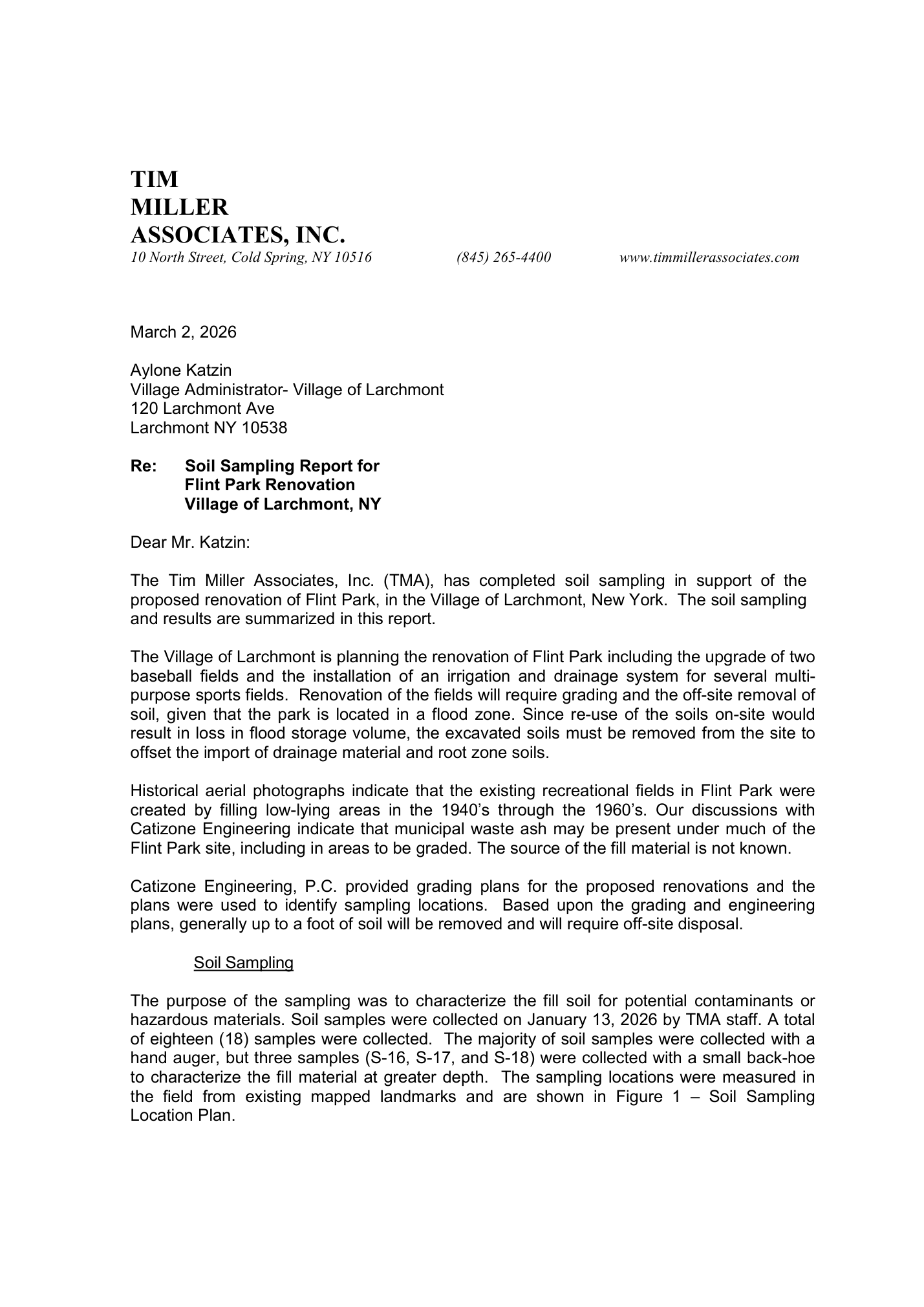
The report explained that historical aerial photographs showed the existing recreational fields had been created by filling low-lying areas between the 1940s and 1960s. According to the consultant, discussions with Catizone Engineering indicated that municipal waste ash might be present beneath much of Flint Park, including areas scheduled for grading. Although the report did not establish the origin of the fill, it made clear that the potential presence of buried ash was understood before construction commenced.
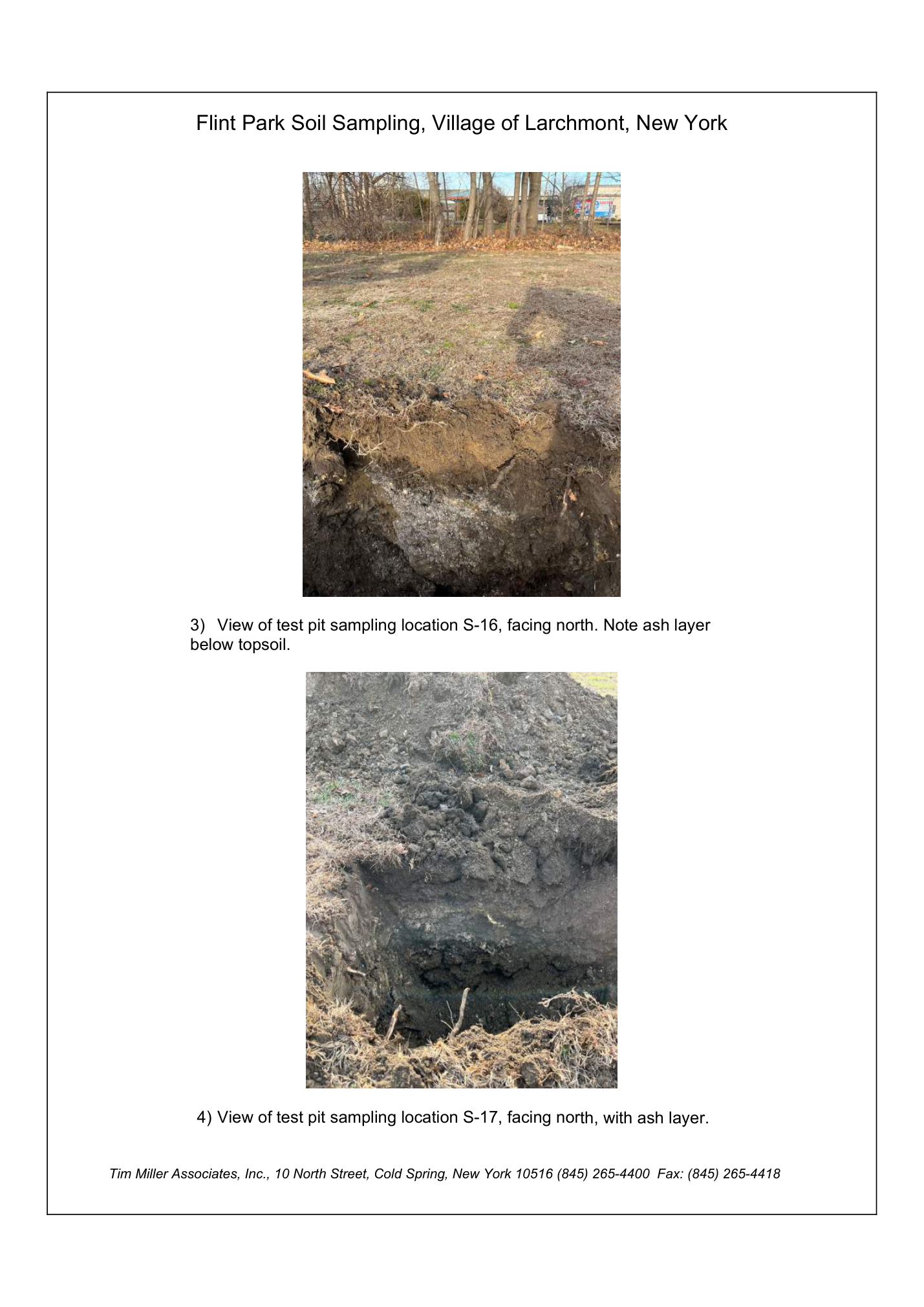
The investigation also found physical evidence of ash and other historic fill materials. Ash was identified in three sampling locations, including two deeper test pits where it appeared beneath approximately 12 inches of overlying soil. Other samples contained coal, glass and tile, which the consultant described as indications of fill material. These observations established that the site’s history presented more than a theoretical concern about what might be buried beneath the athletic fields.
Testing Found Elevated Lead and Other Pollutants
The laboratory results identified several categories of contaminants in the soil that would be affected by the renovation. Lead concentrations reached 898 parts per million in one sample, exceeding New York’s restricted-residential soil cleanup objective of 400 parts per million. Other samples contained elevated concentrations of metals, including chromium and mercury, relative to applicable soil cleanup criteria.
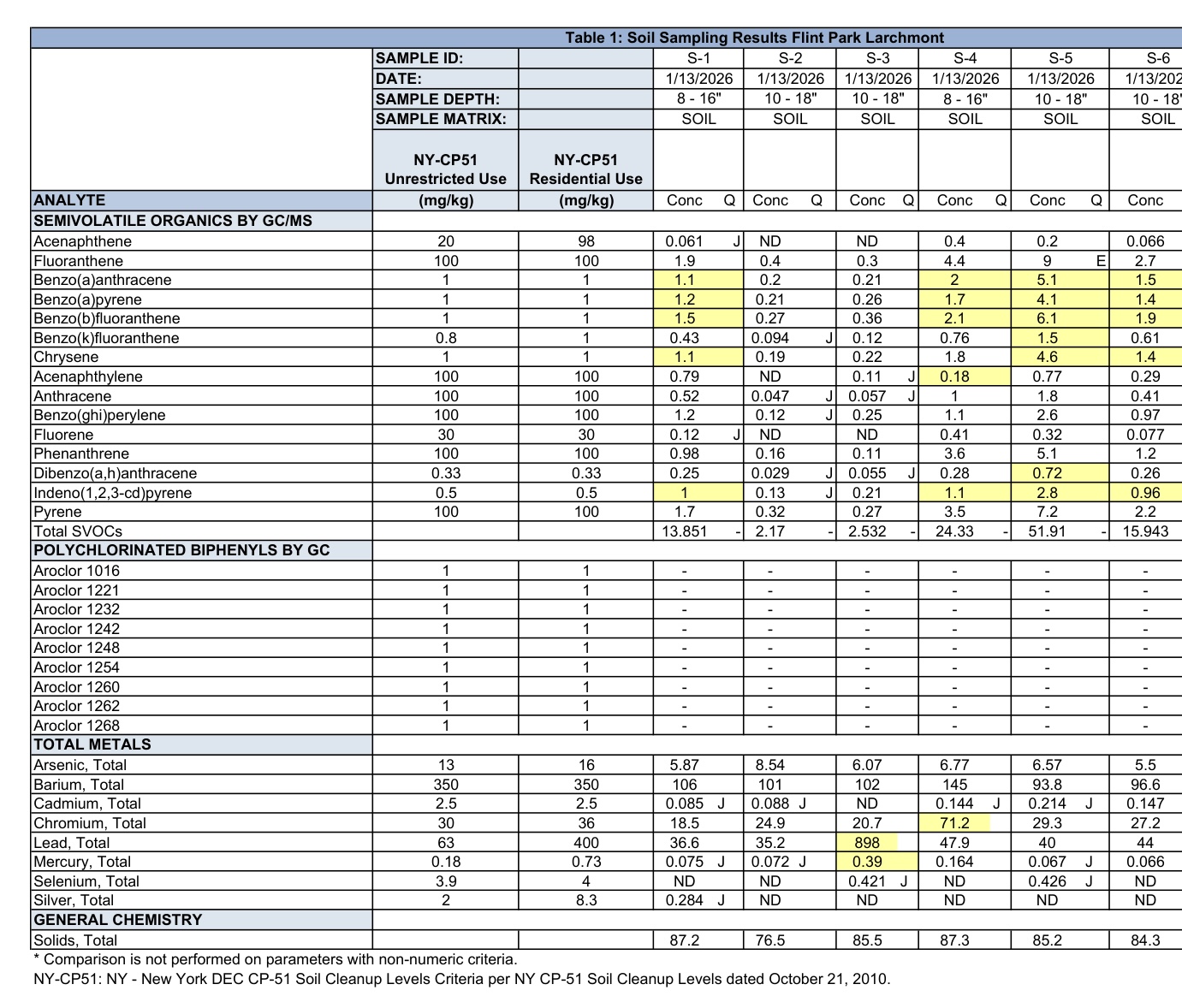
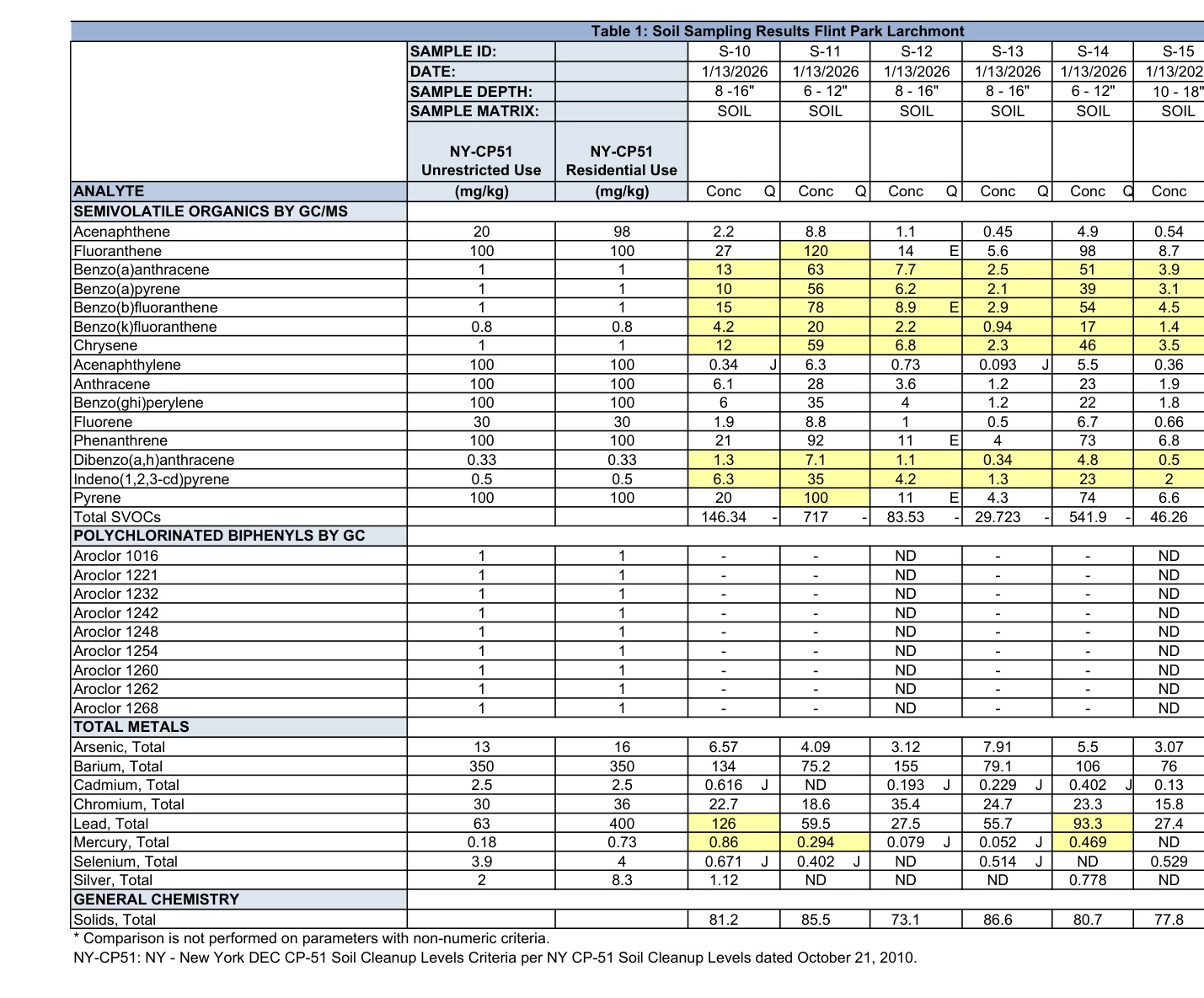
The report also documented widespread contamination by semi-volatile organic compounds, or SVOCs, which were detected in all 18 samples. Thirteen samples exceeded New York’s unrestricted-use soil cleanup objectives for at least two SVOCs. Among the substances detected were polycyclic aromatic hydrocarbons, commonly known as PAHs, a class of chemicals associated with combustion and other sources.
At one shallow sampling location, benzo(a)pyrene was measured at 56 milligrams per kilogram, substantially exceeding the soil cleanup objective used for comparison in the report. Several other PAHs were also present at elevated concentrations. The findings were particularly relevant because the proposed renovation involved removing existing soil, regrading the fields and installing drainage infrastructure that would disturb material beneath the surface.
These figures describe contaminant concentrations in soil, not measurements of human exposure. Exceeding a soil cleanup objective does not, by itself, demonstrate that park users or construction workers were exposed to harmful quantities of a substance, nor does it establish that anyone became ill. Nevertheless, the findings documented environmental conditions that required consideration in planning excavation, handling and disposal.
Tim Miller Associates supported removing excavated material from the property and disposing of it at appropriately licensed facilities because elevated concentrations of metals and semi-volatile compounds had been detected in a majority of the samples. The investigation was intended primarily to characterize soil for the proposed construction work, rather than to provide a comprehensive assessment of contamination or exposure throughout Flint Park. Its findings therefore established important conditions within the project area without resolving the broader environmental history of the park.
DEC Finds Violations After Construction Begins
Construction began in late May, approximately three months after the soil investigation was completed. The project was intended to improve drainage, durability and playing conditions on Fields A and B through a reinforced natural-turf system and upgraded stormwater infrastructure. Work continued through the summer until DEC inspectors arrived on August 19 in response to a complaint concerning the excavation.
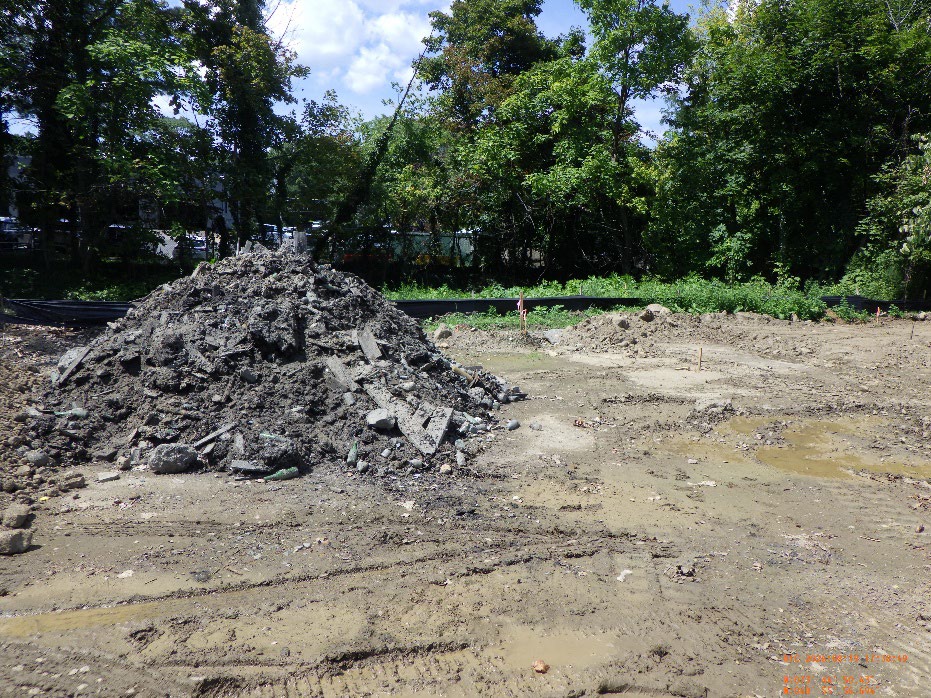
According to the agency’s August 20 Notice of Violation, inspectors observed excavated material appearing to contain ash residue, construction and demolition debris, and municipal solid waste. DEC reported that its own records indicated Flint Park might have been constructed on the site of a former Village landfill. The agency also raised concerns that material excavated from above the buried waste might have formed part of the landfill’s historic cover system.
DEC cited the Village under 6 NYCRR 360.9(a)(1), a provision concerning the construction or operation of regulated solid-waste facilities without appropriate authorization. The notice also cited 6 NYCRR 363-9.7(b), which prohibits implementing a change in the end use of a closed landfill without written DEC approval. The agency stated explicitly that no such approval had been issued for Flint Park.
The notice required the Village to address the extent of damage to the historic landfill cover and propose appropriate remedial measures. DEC also prohibited the operation of heavy equipment on the landfill cap area without prior approval. Although the agency reserved its authority to seek penalties and other relief, the notice did not impose a specific monetary penalty.
In an October 16 response to Talk of the Sound, DEC confirmed that the project remained paused and that the Village had been directed to determine the extent of the landfilled materials at the site. The agency also required measures to secure the construction area and control dust and leachate, liquids that may drain from or through buried waste. DEC said it would pursue enforcement action as necessary to protect public health and the environment.
The distinction between the contamination documented before construction and the violations identified afterward is important. The March soil investigation established the presence of ash and elevated pollutants, while DEC’s subsequent enforcement action addressed the excavation of landfilled material, possible disturbance of the historic landfill cover and the absence of required regulatory approval. Together, those records provide a chronology of environmental concerns that preceded construction and regulatory failures identified after excavation was underway.
Village Called Contamination an Unexpected Discovery
On October 1, more than six weeks after the DEC inspection, the Village issued a public statement describing the interruption as an “unexpected historic discovery.” The statement acknowledged that environmental testing had been conducted before construction but characterized the results as conditions consistent with urban fill commonly encountered in developed areas.
According to the Village, preconstruction testing “did not identify waste indicators,” and municipal solid waste had not been encountered at any of the original sampling locations. The Village explained that material believed to be municipal solid waste was discovered in one localized area during installation of a stormwater manhole, prompting DEC’s intervention and the suspension of construction.
The distinction between ash and identifiable municipal solid waste is relevant. Discovering ash, coal, glass or tile during soil sampling does not necessarily mean that the consultant encountered the same buried material that DEC later identified as apparent municipal solid waste. The March report, however, plainly documented indications of historic fill, including ash at three sampling locations, and specifically warned that municipal waste ash might underlie much of the park.
The Village’s October statement did not disclose those findings or explain why its consultants had previously identified the site as a former municipal incinerator waste-disposal area. It also did not reconcile its description of an unexpected, localized discovery with DEC’s concerns about excavated landfill material and a potentially disturbed historic cover system.
The Village maintained that the affected construction area had been fenced and secured, that excavated material had been covered and that the remainder of Flint Park was safe for public use. Those assurances may reflect measures taken after DEC’s intervention, but the preconstruction testing was not designed to determine environmental conditions throughout the park. The available records do not establish the full extent of buried waste or contamination beyond the locations investigated for Fields A and B.
Village Administrator Responds to Questions
Talk of the Sound submitted a detailed media inquiry to Village Administrator Aylone Katzin on Saturday, October 17, seeking explanations for the discrepancies between the Village’s environmental reports and its public statements. The questions also addressed the Village’s advance knowledge of the site’s landfill history, the permitting decisions that preceded construction and the regulatory violations documented by DEC.
The inquiry, emailed at 7:13 a.m. Saturday, requested a response by noon Monday, October 19, nearly 53 hours later. It also expressly invited the Village to request additional time if needed.
In his October 19 response, Katzin expressed disappointment that he had been given only three working hours to answer the questions. He did not request an extension, but provided a statement describing the Village’s current efforts to secure the site and cooperate with state regulators.
“We have secured the affected area of the park and posted signage so as to prevent access to that area,” Katzin wrote. “We are working cooperatively with NYSDEC to develop specific and appropriate mitigation, remediation and monitoring measures. We will keep the public apprised of those actions.”
The statement provided an update on measures being developed after the shutdown but did not address the findings of the March 2 soil report, the November 2025 engineering warnings or the decisions that preceded construction. Katzin also did not explain the differences between the environmental documents and the Village’s October 1 characterization of the discovery.
In a subsequent email, Talk of the Sound noted that the inquiry had been sent nearly 53 hours before the deadline, rather than three hours, and that the Village had been invited to request more time. The response acknowledged Katzin’s update concerning site security and DEC cooperation while reiterating that the substantive questions remained unanswered. The Village was invited to provide additional information.
A Privately Supported Renovation
The Fields A and B project is part of a broader program of improvements to Flint Park supported by the Flint Park Conservancy, a nonprofit organization that has worked with the Village on recreational facilities and private fundraising. The initiative has included improvements to playgrounds and other athletic facilities as well as plans to renovate the fields affected by DEC’s enforcement action.
The shutdown has interrupted a project intended to return improved playing fields to residents and local sports organizations. Melissa Manice, a former Conservancy president, expressed disappointment about the delay in comments previously reported by The Larchmont Loop, noting that the fields had been expected to accommodate recreational soccer during the fall season.
The Conservancy’s involvement helps explain the broader context of the renovation. The environmental reports, construction decisions and DEC Notice of Violation, however, concern the Village’s responsibility for carrying out work on land with a documented history of waste disposal.
What Happens Next?
The immediate question is what measures DEC will require before construction can resume. The Village must address the extent of disturbed landfill material, the condition of the historic cover and appropriate protections for the public and surrounding environment. Katzin’s latest statement indicates that mitigation, remediation and monitoring measures are still being developed in cooperation with DEC.
There are also unresolved questions about the environmental review and permitting decisions made before construction began. The records show that the Village’s engineers identified the area’s history as a waste-disposal site in November 2025, that soil testing in January 2026 confirmed buried ash and elevated contaminants, and that a detailed report documenting those findings was delivered to the Village Administrator in March. DEC’s subsequent Notice of Violation established that the Village lacked approval for the change in end use of the closed landfill and that landfilled materials had been excavated.
The Village has not explained how those earlier warnings were evaluated or why officials concluded that construction could proceed under the regulatory arrangements in place at the time. Nor has it explained why its October 1 statement described the discovery as unexpected without acknowledging the ash identified in its own preconstruction investigation.
Further investigation may also be necessary to establish the extent of historic fill beyond the current construction site. The March report examined a limited number of locations for a particular construction project; it did not determine the full footprint of the former landfill or identify the original source of the deposited material. Those questions remain open as DEC and the Village evaluate the site.
For now, the documentary record establishes that Larchmont possessed significant environmental information months before construction began, proceeded with the renovation and was subsequently cited by state regulators for disturbing landfilled materials without required approval. The Village has described its efforts to address the situation but has not provided a substantive public explanation of the decisions that led to it.
The shutdown was new. The environmental warnings were not.
RELATED
Larchmont Residents Get First Chance to Question Officials About Flint Park Shutdown at Monday Board Meeting (10/18/2026)
Larchmont Halts Flint Park Fields Project After Waste Discovery (10/10/2026)
Larchmont Announces Renovation of Flint Park Fields A & B (5/14/2026)
Flint Park Day Camp Registration Now Open in Larchmont (3/23/2026)
This article was prepared with the assistance of AI tools under the direction and editing of Robert Cox.
Have information about this story? Email robertcox@talkofthesound.com (preferred) or contact via WhatsApp: +353 089 972 0669.