
NEW ROCHELLE, NY (October 22, 2026) — Leaders of the Friends of the New Rochelle Public Library say they are willing to participate in mediation to resolve their dispute with library trustees over the shutdown of their used-book bookstore, and have proposed the executive director of the Westchester Library System as a potential mediator.
In an October 16 interview with Talk of the Sound, Friends President Pro Tempore Lynette Phillips and Treasurer David Krenkel said they would support a mediator acceptable to both organizations, with the costs divided equally between the Friends and the New Rochelle Public Library.
The Friends suggested Terry Kirchner, executive director of the Westchester Library System, as someone who might help the two organizations resolve their differences. The Westchester Library System provides services to member libraries throughout the county, including the New Rochelle Public Library. It is not known whether Kirchner has been approached or would agree to serve in that capacity.
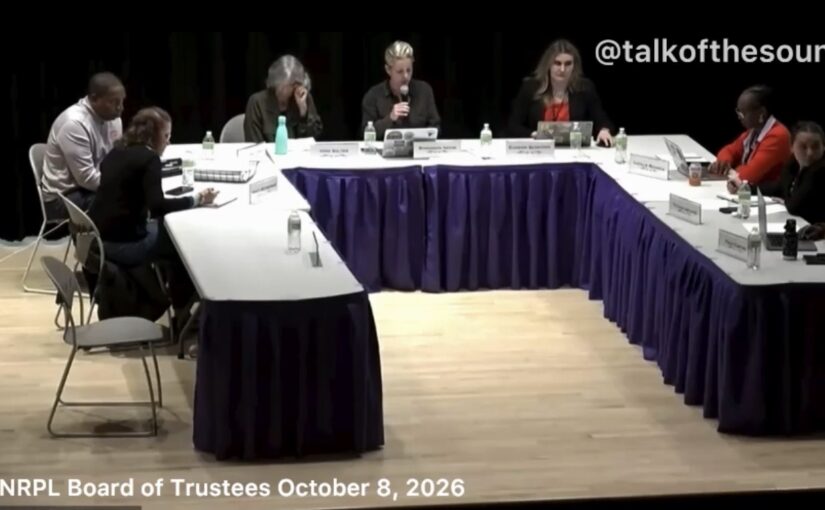
The proposal comes after Library Board President Rhiannon Navin and Executive Director Eugenia Schatoff told Talk of the Sound in an October 13 interview that they were willing to bring in a professional mediator to help repair the relationship. Talk of the Sound reported that proposal later the same day.
On October 16, Navin put the trustees’ position in writing in an email to the Friends.
“Even as the Bookstore goes on pause, and the Friends consider its future, please know that the Library Board remains open to working with a mediator to rebuild a productive partnership with the Friends,” Navin wrote. “We are also hopeful that new leadership at the Friends will approach us in a spirit of collaboration.”
The email followed the October 13 publication of the library’s mediation proposal. It also reflected the trustees’ continuing insistence that the Friends replace their current leadership before the organizations can restore their working relationship.
Phillips and Krenkel said the Friends’ voting membership had already rejected replacing its leaders, voting 14-0 to retain them. They maintain that the Friends is an independent nonprofit organization whose officers are selected by its members.
Both organizations have now expressed a willingness to mediate, but the leadership question remains a central obstacle to resolving the dispute.
Friends Describe How the Dispute Reached a Breaking Point
The Friends trace the deterioration of relations to disagreements over basement book storage, volunteer requirements and plans to renovate the library’s first floor.
Phillips and Krenkel said the situation reached a “boiling point” when they learned that the library’s modernization plans called for replacing their bookstore near the entrance with tables and chairs.
The bookstore was constructed approximately a decade ago using about $70,000 raised from donors and supporters. Its semi-permanent configuration allowed the Friends to display and sell books donated by New Rochelle residents, generating revenue for library programs.
The Friends said they were not meaningfully involved in planning the changes to the bookstore space and believed the decision had effectively been made before they were invited to consider alternatives.
They emphasized that they had supported the library’s $55 million capital improvement bond, approved by voters in May. Their objection was not to renovating the building, they said, but to decisions affecting their operations being made without adequate consultation or advance notice.
On September 18, the Friends submitted three alternative first-floor locations they believed could accommodate the bookstore. Their written proposal identified possible spaces elsewhere in the building, including an area currently occupied by DVDs.
The trustees subsequently responded that other matters, including volunteer background checks and conduct concerns, needed to be addressed before discussions about bookstore space could proceed.
The Friends also considered arrangements outside the library, but Phillips and Krenkel said off-site storage presented problems involving rent, transportation, security and the practical demands of moving inventory between locations.
Library officials had raised the possibility of selling books online. The Friends, however, consider the physical bookstore central to their mission.
For the organization, the library itself is the ideal location for selling inexpensive books to residents who already visit the building. The store also provides an opportunity for volunteers to interact with customers and one another.
Many longtime Friends volunteers are in their 70s and 80s. Phillips and Krenkel described the social relationships developed through volunteering as an important part of the organization’s appeal, beyond the revenue generated by book sales.
The Friends have also struggled to replenish their inventory. They said regular acceptance of donated books stopped early in 2026, when they were dealing with the relocation of their extensive basement inventory, and that subsequent restrictions prevented donations from resuming normally.
On October 3, Phillips learned that library security personnel had been instructed to turn away prospective book donors.
Without a continuing supply of donated books, the Friends said, maintaining an active bookstore becomes increasingly difficult.
Founded Before the Current Library Opened
The Friends of the New Rochelle Public Library was founded in 1977 and incorporated in 1978, during a significant transition in the library’s history.
At the time, New Rochelle was preparing to move its public library from the Carnegie-funded building at Main Street and Pintard Avenue, which had served the community since 1914, to a new facility on Library Green. The current library opened in September 1979.
The Friends were established before that move, with a mission that included promoting public awareness of the library, encouraging its use and supporting educational and cultural programming.
Their founding coincided with the effort to introduce residents to the new facility and build community support for the library’s future.
Over the following decades, the Friends developed into a substantial volunteer organization that raised money for children’s programs, concerts, films, lectures, adult education, summer reading activities and other services.
A historical account prepared for recognition by the New Rochelle Council of Community Services described an organization that once received approximately 1,000 donated books each week.
Volunteers sorted, evaluated, priced, shelved and sold the books, handling much of the work involved in operating the bookstore and periodic larger sales.
Historical program records identify a wide range of activities supported by the Friends, including music and dance performances, art programs, language learning, film screenings, children’s workshops and educational events.
The organization also supported cultural preservation projects, including restoration of Norman Rockwell’s Land of Enchantment, as well as improvements to library facilities and collections.
The bookstore itself became a significant fundraising project. Its construction was supported by a community campaign that included fundraising associated with former New York Yankees pitcher Mariano Rivera.
Nearly five decades after the Friends were established during the transition to the current building, the organization’s future has become uncertain as the library prepares for another major transformation through its $55 million capital improvement program.
Nearly $1.2 Million Raised Since 2010
Financial information provided by Krenkel shows that the Friends received approximately $1.194 million in income between 2010 and October 19, 2026.
The largest source was used-book sales, which generated approximately $643,000 over the period.
Grants accounted for another $251,000, while donations totaled approximately $243,000. Membership dues generated about $26,000, and fees associated with programs and services added approximately $31,000.
The figures illustrate the Friends’ role not only as a bookstore operator but also as a fundraising organization through which residents, estates, businesses and other organizations have supported library activities.
Krenkel’s financial summary identifies approximately $121,000 in grants from the New Rochelle Downtown Business Improvement District, $33,000 associated with an English-language learning project and $77,000 raised through the bookstore construction campaign.
Donations included approximately $88,000 from the estate of Karen Allen.
Krenkel said virtually all of the organization’s expenditures supported programs operated by the library, apart from relatively small administrative and office expenses.
The approximately $1.2 million figure represents money received by the Friends, rather than a calculation of the total amount ultimately spent on library programs. It includes fundraising for construction and other designated purposes.
Documents provided by the organization offer a more detailed picture of how the library relied on Friends funding.
On December 5, 2024, the library requested $74,900 in support for another year of programming, matching the amount it said the Friends had contributed during the preceding year.
The proposed funding included $28,100 for children’s programming, $17,000 for arts and cultural activities, $9,200 for yoga and wellness, $7,600 for young adult programming, and additional money for classes, citizenship programs and other activities.
The request also included $7,500 for staff training and continuing education and $2,500 for staff support.
In its accompanying explanation, the library reported that 16,013 children and caregivers had attended children’s programs through November 1, 2024, while 907 children participated in its summer reading challenge.
The library credited the Friends with helping make those offerings possible.
The documents illustrate how the Friends functioned as an intermediary between donors and the library, raising funds from multiple sources and supporting programs identified by library officials.
More recently, the Friends said they provided the library with a $40,000 contribution in June 2026 for children’s, young adult and adult programs, even as disagreements between the two organizations continued.
Fire Safety Concerns Predated the Dispute
The problems involving the Friends’ basement book storage did not emerge for the first time in December 2025.
A 2020 Physical Conditions Assessment prepared by Architectural Preservation Studio had already identified fire-safety and building deficiencies affecting the basement area used by the Friends, including deteriorated concrete exposing structural steel, missing fireproofing, firestopping deficiencies and electrical problems.
Talk of the Sound examined those findings in its April 2026 reporting on the library’s proposed $55 million capital improvement bond.
A subsequent assessment by Lothrop Associates Architects, dated December 15, 2025, identified additional code-compliance problems involving bookshelves that obstructed sprinkler coverage, insufficient overhead clearance and arrangements for emergency exits.
Both the library trustees and the Friends acknowledged that the storage conditions needed to be corrected.
Their disagreement centered on how the work was carried out, the deadlines imposed and the restrictions placed on volunteers and their inventory.
The Friends subsequently moved books into another basement room made available by the library. Other books were removed from the collection, including materials transferred to Bay State Book Company, which handles surplus books for potential resale, redistribution or recycling.
The Friends said more than half of their approximately 50,000-book inventory had to be removed because the replacement storage area was substantially smaller.
The exact number of books retained by the library, transferred to Bay State or ultimately recycled has not been established.
How a Working Relationship Deteriorated
Correspondence supplied by the Friends traces the deterioration of the relationship over approximately 11 months.
In November 2025, library trustees and Friends representatives were discussing how to address basement storage, volunteer conduct, financial procedures and cooperation between the two organizations.
At that stage, the exchanges anticipated a continuing relationship. The trustees acknowledged the Friends’ contributions and proposed steps to address operational concerns.
By December, the library and the Friends were discussing plans for moving the basement inventory, volunteer requirements and a proposed written agreement governing their operations.
A December planning document prepared by the trustees contemplated a temporary disruption followed by the resumption of Friends activities, including draft public communications welcoming the Friends back.
The correspondence shows both organizations attempting to address the storage situation while preserving the bookstore’s operations.
By March 31, 2026, representatives of the trustees, library administration and Friends were still meeting to discuss basement cleanup, access restrictions, volunteer screening and a proposed memorandum of understanding.
The meeting minutes recorded that the basement cleanup had been completed, although questions remained about access to the replacement storage area and other operational arrangements.
The Friends also experienced a leadership change during this period.
Amy Tietz, who had served as president, stepped down before the March 31 meeting. Phillips subsequently became president, with her election recorded in the Friends’ June 3 annual meeting minutes.
Lucille Renwick, who had served as president of the Library Board of Trustees, was the board’s liaison to the Friends, according to Navin. Renwick participated extensively in discussions and correspondence concerning the dispute.
Phillips and Krenkel described tensions that had developed between representatives of the two organizations during the negotiations, although the meeting records also document continuing efforts to resolve outstanding issues.
Throughout the spring and summer, correspondence shows discussions about basement access, volunteer identification, sexual harassment training, background checks, insurance and the proposed written agreement.
The Friends said they generally accepted the need for safety and volunteer requirements but questioned aspects of their implementation, including requests for sensitive personal information and the deadlines imposed on volunteers.
Library officials maintained that the requirements were necessary for people volunteering on library property and expressed frustration over the pace of compliance.
By September, the dispute had expanded to include the future of the bookstore itself.
After the Friends submitted alternative locations on September 18, the trustees responded by emphasizing the need to resolve volunteer screening and conduct concerns before moving forward with space discussions.
The exchange continued through late September and early October, as the Friends sought clarification about deadlines and the library’s instructions concerning book donations.
Trustees Declare Loss of Confidence in Friends Leadership
By October, relations between the two organizations had deteriorated to the point that library trustees declared they had lost confidence in the Friends’ leadership.
In an October 8 email to Phillips, copied to members of the Friends and Library Board President Navin, Renwick, writing on behalf of the trustees, said the Friends’ October 5 correspondence demonstrated that the current leadership could not satisfy the library’s requirements.
“The Library Board has no confidence that the current leadership can establish the conditions necessary to rebuild a productive and constructive relationship with the Library,” Renwick wrote.
The trustees accepted the Friends’ notification that bookstore operations would close October 16 and announced that the library would stop allocating space for the bookstore on that date.
The email also placed restrictions on access to bookstore and basement areas, established deadlines for removing inventory and offered assistance with locating replacement Friends leadership.
Renwick made the trustees’ expectations explicit, saying they looked forward to working with new leadership in every officer position on the Friends’ board before resuming discussions.
The Friends subsequently disputed the trustees’ account of the shutdown, maintaining that the library’s decisions had made continuing operations impractical.
In an October 12 public statement, the organization insisted that the decision to close had been made by the Library Board rather than the Friends.
“It is important to understand that the decision to close was made by the Library Board, NOT the Friends,” the statement said.
The trustees, meanwhile, maintained that the Friends had notified the library of their intention to suspend operations.
The distinction became one of the central disagreements in the public exchange between the organizations.
Leadership Remains the Principal Obstacle
The Friends operate as a separately incorporated nonprofit organization with their own officers and voting membership.
Phillips serves as president pro tempore and Krenkel as treasurer. According to their October 16 interview, the organization also has two vice presidents and a secretary, with 19 voting members whose participation is based on volunteer service.
Phillips and Krenkel said a vote among members resulted in a 14-0 decision to retain the current leadership.
They questioned the trustees’ insistence that the Friends replace their officers, maintaining that decisions about the organization’s leadership belong to its members.
Library officials have taken a different position about the practical relationship between the two organizations.
During their October 13 interview, Navin and Schatoff said they valued the Friends’ contributions but could not continue the existing working relationship under the current leadership.
Navin described that leadership as “compromised” and said further attempts to resolve the disagreements under the existing circumstances had become too difficult.
Schatoff emphasized the organizations’ shared commitment to the library and its patrons.
“We’re stronger together,” she said.
On October 16, Navin reiterated the board’s willingness to work with a mediator, while again expressing hope that new Friends leadership would help restore cooperation.
Her email did not explicitly state that the Friends must replace their officers before mediation itself could begin, although the trustees had previously conditioned the resumption of discussions on new leadership.
That distinction could prove important if the organizations agree to engage a mediator.
The Friends’ willingness to mediate raises the possibility of a negotiated solution, but several practical questions remain unanswered.
It is not yet known whether Kirchner has been approached about serving as mediator, whether the library trustees would agree to his involvement, or whether both organizations could begin mediation while retaining their existing representatives.
For now, the bookstore remains closed, donations are not being accepted, and there is no announced timetable for resuming operations.
After nearly five decades of financial support, volunteer service and collaboration, the Friends and the New Rochelle Public Library have reached a point where both sides say they want to restore their relationship but have yet to agree on how to proceed.
RELATED
New Rochelle Library Proposes Mediation in Dispute With Friends Over Bookstore Shutdown (10/13/2026)
Friends of New Rochelle Public Library Dispute Board’s Account of Bookstore Shutdown (10/12/2026)
Friends of New Rochelle Public Library to Suspend Operations Amid Dispute With Library Board (10/9/2026)
New Rochelle Library $55 Million Bond Voter Guide 2026: Full Analysis + Questions to Ask (4/15/2026)
This article was prepared with the assistance of AI tools under the direction and editing of Robert Cox.
Have information about this story? Email robertcox@talkofthesound.com (preferred) or contact via WhatsApp: +353 089 972 0669.
Discover more from Talk of the Sound
Subscribe to get the latest posts sent to your email.